Spike of Fineleaf Schizonepeta
- Chinese
- 荆芥穗
- Pinyin
- Jing Jie Sui
- Latin
- Spica Schizonepetae
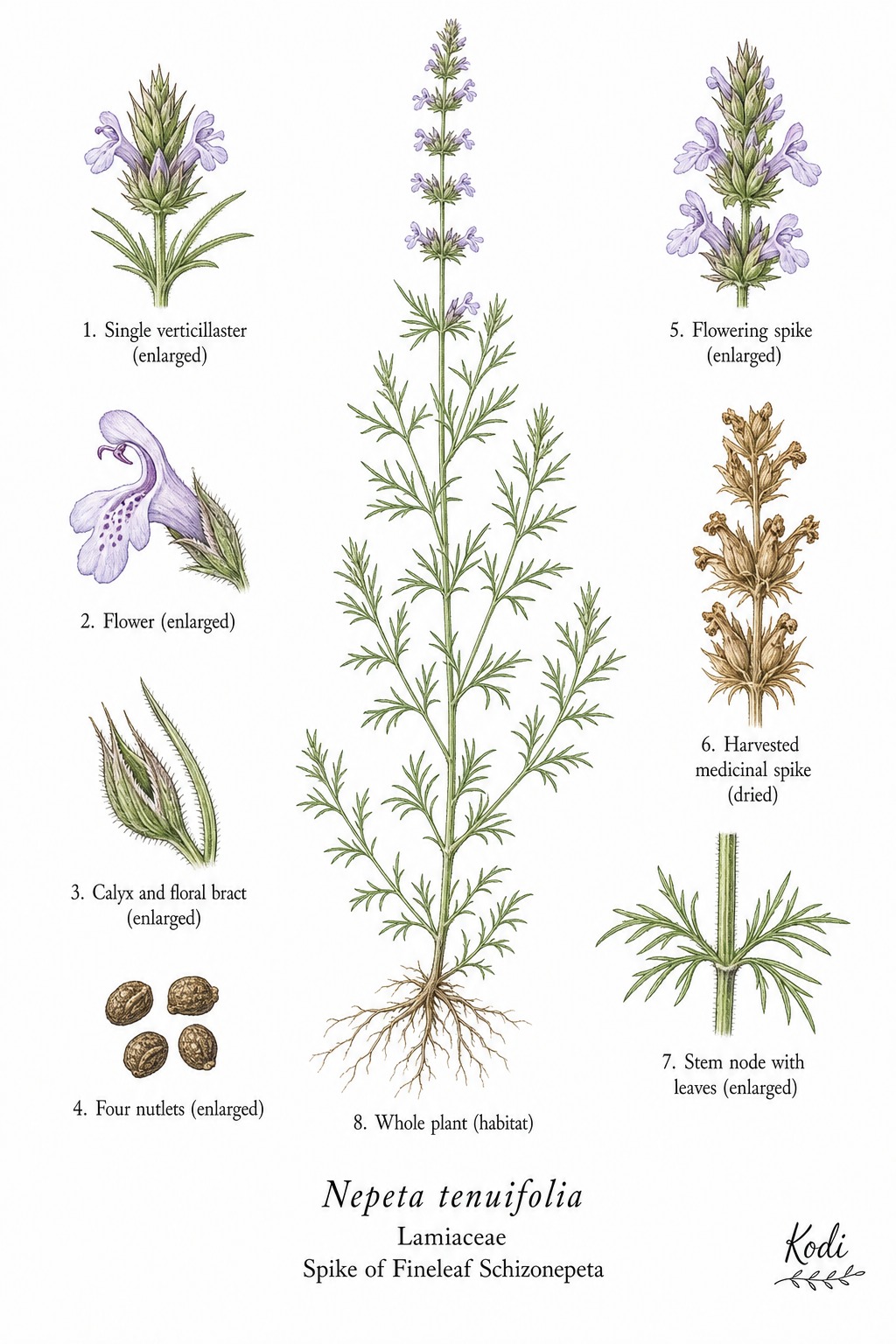
Known in TCM as Jing Jie Sui (荆芥穗), this acrid, slightly warm herb enters the Lung and Liver. Traditionally, it expels wind and releases exterior, most often applied for wind heat, common cold, and uterine bleeding. Modern research has identified Pulegone among its active constituents.
Part used: Spike
Also Known As
Latin: Spica Schizonepetae | Pinyin: Jing Jie Sui | Chinese: 荆芥穗
TCM Properties
- Taste
- acrid
- Temperature
- slightly warm
- Channels
- Lung, Liver
Traditional Use
Primary Actions
- Expels wind and releases exterior … preferred over the whole herb for its stronger aromatic dispersing action in wind-heat patterns; treats headache, fever, and nasal congestion
- Vents skin rashes and relieves itching … primary application for measles with incomplete eruption, urticaria, and wind-heat skin conditions; promotes rash to surface to shorten illness
- Stops bleeding when charred (Jing Jie Sui Tan 荆芥穗炭) … hemostatic for uterine bleeding, menorrhagia, and postpartum hemorrhage
Secondary Actions
- Treats early-stage sores and carbuncles before pus formation … disperses wind-heat accumulation in the exterior
- Relieves wind-heat eye conditions … conjunctivitis, photophobia, and excessive lacrimation from external wind
- In combination with other exterior-releasing herbs, addresses throat pain and swelling from wind-heat
Classic Formulas
- Xiao Feng San (消风散) … principal herb for wind-heat skin disease with itching, urticaria, and eczema; combined with Fang Feng and Ku Shen
- Jing Fang Bai Du San (荆防败毒散) … broad exterior-releasing formula; Jing Jie Sui used for its concentrated volatile oil and stronger dispersing action than the whole plant
- Huai Hua San (槐花散) … charred Jing Jie Sui (tan form) combined with Huai Hua for intestinal and uterine bleeding from heat
Classical References
- Bencao Gangmu (本草纲目, Li Shizhen, 1578) … Jing Jie Sui distinguished from the whole herb: flower spikes contain highest concentration of volatile oils; charred form specifically for hemostasis
- Yi Xue Zhong Zhong Can Xi Lu (医学衷中参西录, Zhang Xichun, 1909) … charred Jing Jie Sui recommended for postpartum hemorrhage when other hemostatics are insufficient
Modern Research
Active Compounds
- Pulegone (primary volatile oil component, 25–55%)
- Menthone
- Isomenthol
- Limonene
- Hesperidin
- Luteolin-7-O-glucoside
- Rosmarinic acid
- Caffeic acid derivatives
- Apigenin
Studied Effects
- Anti-inflammatory … volatile oil fraction inhibits NF-κB pathway and suppresses COX-2 and iNOS expression; hesperidin inhibits NLRP3 inflammasome activation
- Antipyretic and diaphoretic … pulegone and menthone stimulate sweat secretion and reduce febrile response in animal models; confirms classical exterior-releasing action
- Hemostatic (charred form) … carbonization increases tannin content and astringent surface area; significantly shortens bleeding and clotting time in mice models (PMID 24847832)
- Antibacterial … volatile oil shows broad inhibitory activity against Staphylococcus aureus, Streptococcus, and dermatophytes; supports use for skin wind-heat conditions
- Antihistaminic … flavonoid fraction reduces mast cell degranulation and histamine release; mechanism for anti-pruritic effect in urticaria
PubMed References
Safety & Interactions
Contraindications
- Spontaneous or excessive perspiration from exterior deficiency … aromatic dispersing action will further deplete wei qi and worsen sweating
- Internal fire or yin-deficiency heat without exterior pathogen … acrid warm nature is not appropriate for endogenous heat patterns
Cautions
- The charred form (Jing Jie Sui Tan) is a distinct preparation with opposite action … hemostatic rather than dispersing; do not substitute one for the other
- High-dose volatile oil may cause nausea, dizziness, or GI upset; standard decoction dose 3–9 g is safe
- Short decoction time recommended (add near end) … volatile oils evaporate with prolonged boiling, reducing efficacy
Conditions
- Wind Heat Traditional ★★★★☆ JSON
- Common Cold Traditional ★★★★☆ JSON
- Uterine Bleeding Traditional ★★★☆☆ JSON
Frequently Asked Questions
What is Spike of Fineleaf Schizonepeta used for?
Spike of Fineleaf Schizonepeta is traditionally used to Expels wind and releases exterior … preferred over the whole herb for its stronger aromatic dispersing action in wind-heat patterns; treats headache, fever, and nasal congestion, Vents skin rashes and relieves itching … primary application for measles with incomplete eruption, urticaria, and wind-heat skin conditions; promotes rash to surface to shorten illness, Stops bleeding when charred (Jing Jie Sui Tan 荆芥穗炭) … hemostatic for uterine bleeding, menorrhagia, and postpartum hemorrhage. Research has investigated its effects on: Anti-inflammatory … volatile oil fraction inhibits NF-κB pathway and suppresses COX-2 and iNOS expression; hesperidin inhibits NLRP3 inflammasome activation; Antipyretic and diaphoretic … pulegone and menthone stimulate sweat secretion and reduce febrile response in animal models; confirms classical exterior-releasing action.
What are other names for Spike of Fineleaf Schizonepeta?
Spike of Fineleaf Schizonepeta is also known as Schizonepeta. In TCM: 荆芥穗 (Jing Jie Sui); Spica Schizonepetae.
Is Spike of Fineleaf Schizonepeta safe during pregnancy?
The safety of Spike of Fineleaf Schizonepeta during pregnancy has not been established. Consult a qualified healthcare provider before use.
What are the contraindications for Spike of Fineleaf Schizonepeta?
Spike of Fineleaf Schizonepeta should not be used in: Spontaneous or excessive perspiration from exterior deficiency … aromatic dispersing action will further deplete wei qi and worsen sweating; Internal fire or yin-deficiency heat without exterior pathogen … acrid warm nature is not appropriate for endogenous heat patterns. Consult a qualified practitioner before use.