Japanese Inula Herb
- Chinese
- 金沸草
- Pinyin
- Jin Fei Cao
- Latin
- Herba Inulae
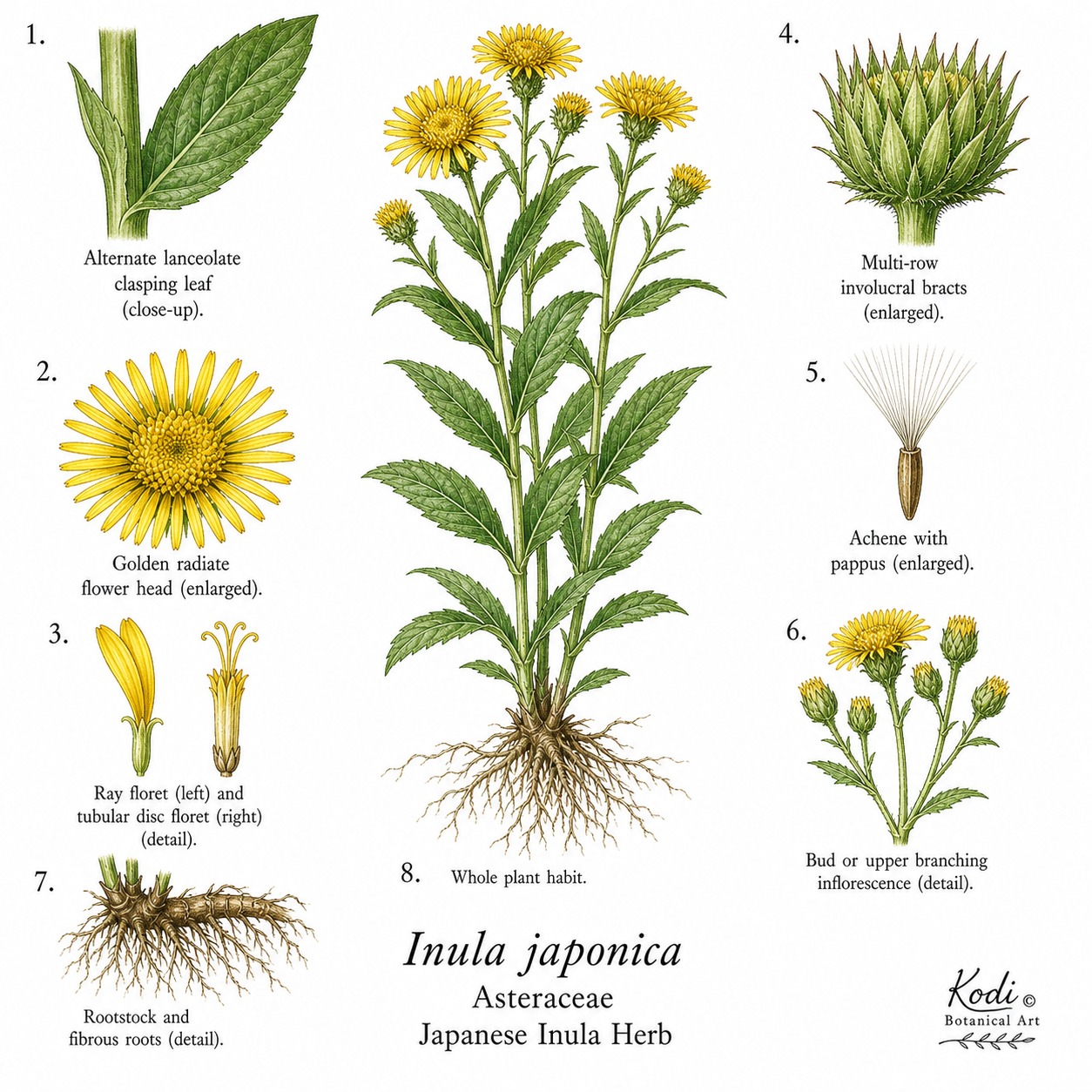
Known in TCM as Jin Fei Cao (金沸草), this salty and slightly bitter, warm herb enters the Lung, Stomach, and Spleen. Traditionally, it transforms Phlegm-Dampness and descends rebellious Lung Qi, most often applied for cough, bronchitis, and upper respiratory infection. Modern research has identified Inulicin among its active constituents.
Part used: Whole herb
Also Known As
Latin: Herba Inulae | Pinyin: Jin Fei Cao | Chinese: 金沸草
TCM Properties
- Taste
- salty, slightly bitter
- Temperature
- warm
- Channels
- Lung, Stomach, Spleen
Traditional Use
Primary Actions
- Transforms Phlegm-Dampness and descends rebellious Lung Qi
- Releases the exterior and disperses Wind-Cold
- Warms and transforms cold phlegm … especially copious, watery or frothy sputum
- Arrests cough and relieves wheezing
Secondary Actions
- Harmonises the Stomach and descends rebellious Stomach Qi (nausea, vomiting, hiccup)
- Distinct from the flower (Xuan Fu Hua 旋覆花) … whole aerial herb used when exterior release is also required
Classic Formulas
- Jin Fei Cao San (金沸草散) … classical formula for Wind-Cold cough with copious watery phlegm; Jin Fei Cao paired with Jing Jie, Ban Xia, Qian Hu, and Gan Cao
Classical References
- Ben Cao Gang Mu (Li Shizhen): 'Jin Fei Cao (the whole herb) descends rebellious Qi, disperses phlegm, releases the exterior, and warms the Lung … use when Wind-Cold has not resolved and phlegm is abundant'
- Note: Jin Fei Cao (金沸草, whole aerial herb) and Xuan Fu Hua (旋覆花, flower of Inula japonica or I. britannica) are related but distinct materia medica; Jin Fei Cao has stronger exterior-releasing action while Xuan Fu Hua is more strongly descending and softening
Modern Research
Active Compounds
- Inulicin (sesquiterpene lactone; principal bitter anti-inflammatory)
- Britannin (eudesmanolide sesquiterpene lactone)
- Taraxasterol (pentacyclic triterpenoid)
- Chlorogenic acid
- Caffeic acid
- Luteolin and luteolin-7-glucoside
- Quercetin
- 1-O-acetylbritannilide and related eudesmanolides
Studied Effects
- Anti-inflammatory: sesquiterpene lactones (inulicin, britannin) inhibit NF-κB and COX-2 pathways; taraxasterol demonstrated significant reduction of LPS-induced TNF-α and IL-6 in RAW264.7 macrophages and reduced paw oedema in rat carrageenan model
- Antitussive and expectorant: aqueous decoction showed dose-dependent antitussive effect in ammonia water-induced cough model in mice and increased tracheal phenol red output (expectorant activity), consistent with classical Phlegm-transforming indication
- Antibacterial: ethanol extract active against Staphylococcus aureus, Streptococcus pneumoniae, and Haemophilus influenzae … organisms relevant to its classical indication in respiratory tract infections with phlegm
PubMed References
Safety & Interactions
Contraindications
- Yin deficiency with Dry-Heat cough (no phlegm or scanty sticky phlegm, dry throat)
- Damp-Heat phlegm with yellow thick sputum (warm herb … use with caution)
Cautions
- Standard dose 5–10g decoction; most sources use 3–9g dried herb
- Distinguish from Xuan Fu Hua (旋覆花): the flower is more descending; the whole herb adds exterior release … use Jin Fei Cao San when Wind-Cold is still present
- Sesquiterpene lactones may cause contact dermatitis in rare cases … relevant mainly to bulk handlers, not oral use
Conditions
- Cough Traditional ★★★★☆ JSON
- Bronchitis Traditional ★★★★☆ JSON
- Upper Respiratory Infection Traditional ★★★☆☆ JSON
- Nausea Traditional ★★★☆☆ JSON
- Asthma Traditional ★★☆☆☆ JSON
Frequently Asked Questions
What is Japanese Inula Herb used for?
Japanese Inula Herb is traditionally used to Transforms Phlegm-Dampness and descends rebellious Lung Qi, Releases the exterior and disperses Wind-Cold, Warms and transforms cold phlegm … especially copious, watery or frothy sputum, Arrests cough and relieves wheezing. Research has investigated its effects on: Anti-inflammatory: sesquiterpene lactones (inulicin, britannin) inhibit NF-κB and COX-2 pathways; taraxasterol demonstrated significant reduction of LPS-induced TNF-α and IL-6 in RAW264.7 macrophages and reduced paw oedema in rat carrageenan model; Antitussive and expectorant: aqueous decoction showed dose-dependent antitussive effect in ammonia water-induced cough model in mice and increased tracheal phenol red output (expectorant activity), consistent with classical Phlegm-transforming indication.
What are other names for Japanese Inula Herb?
Japanese Inula Herb is also known as Inula. In TCM: 金沸草 (Jin Fei Cao); Herba Inulae.
Is Japanese Inula Herb safe during pregnancy?
The safety of Japanese Inula Herb during pregnancy has not been established. Consult a qualified healthcare provider before use.
What are the contraindications for Japanese Inula Herb?
Japanese Inula Herb should not be used in: Yin deficiency with Dry-Heat cough (no phlegm or scanty sticky phlegm, dry throat); Damp-Heat phlegm with yellow thick sputum (warm herb … use with caution). Consult a qualified practitioner before use.