Rippleseed Plantain Herb
- Chinese
- 车前草
- Pinyin
- Che Qian Cao
- Latin
- Herba Plantaginis
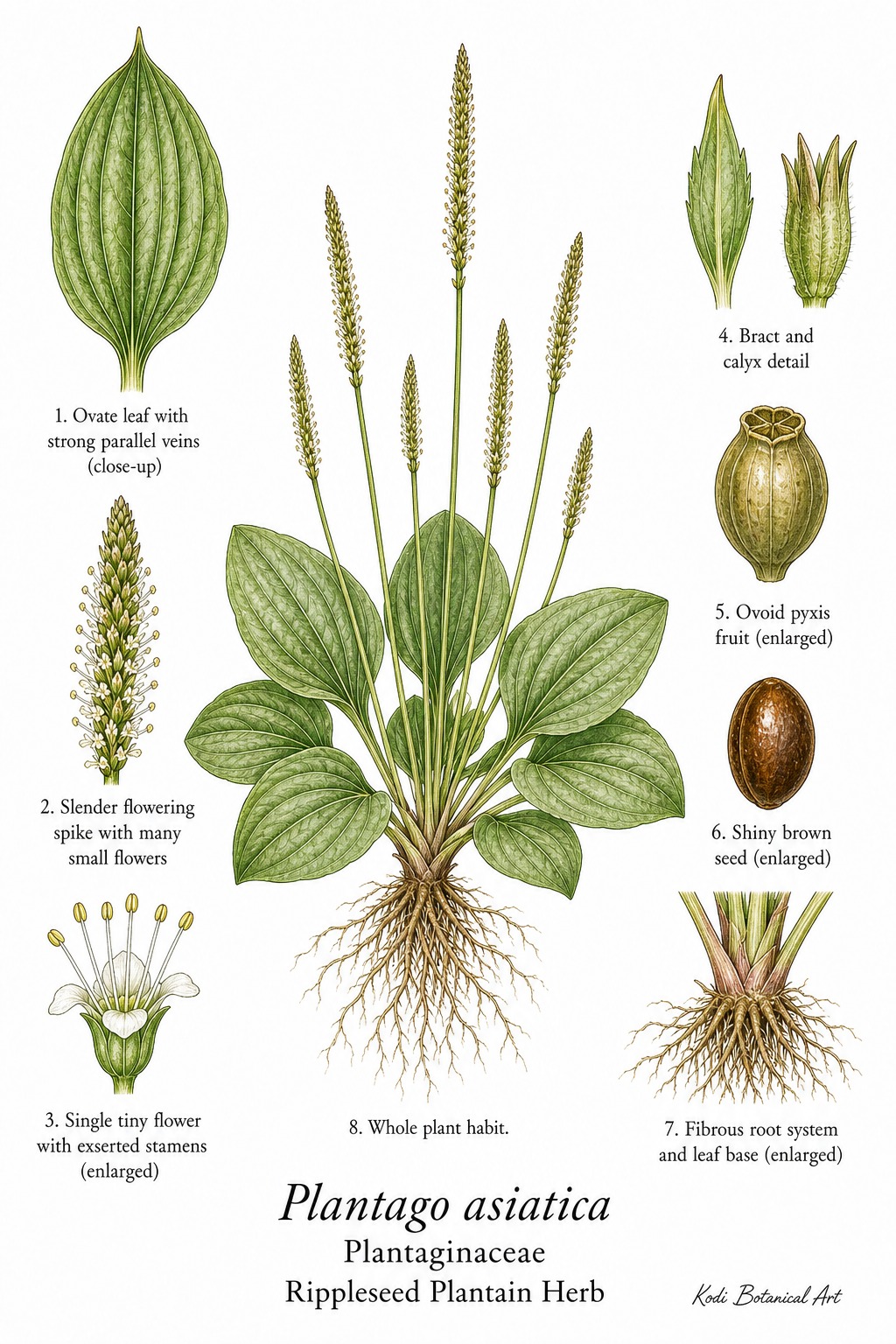
Known in TCM as Che Qian Cao (车前草), this sweet, cold herb enters the Liver, Kidney, Lung, and Small Intestine. Traditionally, it clears Heat and promotes urination, most often applied for urinary tract infection, cough, and conjunctivitis. Modern research has identified Aucubin (iridoid glycoside; anti-inflammatory, hepatoprotective, antioxidant among its active constituents.
Part used: Whole herb
Also Known As
Latin: Herba Plantaginis | Pinyin: Che Qian Cao | Chinese: 车前草
TCM Properties
- Taste
- sweet
- Temperature
- cold
- Channels
- Liver, Kidney, Lung, Small Intestine
Traditional Use
Primary Actions
- Clears Heat and promotes urination … lin syndrome (strangury), urinary tract infections, painful or difficult urination from Damp-Heat in the Bladder
- Expels Phlegm and stops cough … Lung heat cough with yellow or sticky phlegm, bronchitis
- Clears Liver Heat and brightens the eyes … red, painful, or swollen eyes and blurred vision from Liver Heat uprising
- Cools Blood and relieves toxicity … hematuria, epistaxis, skin sores, and carbuncles
Secondary Actions
- Edible medicinal food … young leaves consumed as a vegetable in Chinese, Korean, and European folk cuisines; nutritional supplementation with anti-inflammatory intent
- Reduces edema … promotes urination to resolve lower-body fluid accumulation from Damp-Heat or Kidney channel Heat
Classic Formulas
- Ba Zheng San (八正散) … canonical formula for heat strangury; official formula uses Che Qian Zi (seeds, Semen Plantaginis) but Che Qian Cao (whole herb) is used interchangeably in many clinical adaptations; combined with Mu Tong, Hua Shi, Qu Mai, Bian Xu, Da Huang, Zhi Zi, Gan Cao
- Che Qian Cao Dan Fang (车前草单方) … single-herb decoction of fresh whole herb (30–60 g) for acute urinary tract infection and hematuria; classical folk application widely referenced in modern TCM emergency texts
Classical References
- Shen Nong Ben Cao Jing (神农本草经): lists Che Qian Zi (seeds) in the upper grade, noting that both seed and herb 'promote urination, clear heat from the Bladder, and benefit sight and essence'; the whole herb Che Qian Cao is treated as an extension of the same drug in later materia medica
- Ben Cao Gang Mu (Li Shizhen): 'Che Qian Cao clears heat in the Liver and Bladder, promotes urination, opens the orifices, brightens the eyes, and cools blood … it may be eaten as a vegetable or taken as medicine, and is suitable for summer-heat patterns with scanty dark urine'
Modern Research
Active Compounds
- Aucubin (iridoid glycoside; anti-inflammatory, hepatoprotective, antioxidant … principal marker compound)
- Acteoside (verbascoside; phenylethanoid glycoside; anti-inflammatory, antioxidant, antimicrobial, wound healing)
- Plantagin (flavone glucoside; antitussive, expectorant)
- Plantamajoside (phenylethanoid glycoside; anti-inflammatory, antioxidant)
- Luteolin and apigenin (flavonoids; anti-inflammatory, antispasmodic)
- Mucilaginous polysaccharides (demulcent, prebiotic, stool-bulking)
- β-Sitosterol (phytosterol; anti-inflammatory, lipid-modulating)
Studied Effects
- Anti-inflammatory and antioxidant: aucubin and acteoside from Plantago asiatica inhibit NF-κB signalling and suppress COX-2 and iNOS expression in LPS-stimulated macrophage models; flavonoid fraction scavenges superoxide and hydroxyl radicals … mechanistic validation of the Heat-clearing and toxin-resolving TCM profile
- Hepatoprotective: aucubin protects hepatocytes against CCl4- and D-galactosamine-induced toxicity in rodent models by preserving mitochondrial membrane potential and reducing oxidative stress markers (ALT, AST); supports folk use of the herb for liver-related Heat conditions
- Antimicrobial and urinary tract activity: aqueous and ethanol extracts of P. asiatica inhibit common uropathogens including Escherichia coli, Staphylococcus aureus, and Proteus mirabilis in disc-diffusion and MIC assays … consistent with the primary TCM indication for Damp-Heat strangury and urinary tract infection
- Antitussive and expectorant: plantagin and polysaccharides from P. asiatica reduce cough frequency in citric-acid-induced cough models and increase tracheal mucus secretion in animal studies … validates the Phlegm-resolving and cough-stopping secondary action
Safety & Interactions
Contraindications
- Kidney Yang deficiency with clear copious urine (cold pattern) … cold-natured herb would worsen Yang deficiency
- Spleen-Stomach Deficiency Cold with loose stools … cold-nature and diuretic action may further impair Spleen function
Cautions
- Standard dose: 9–30 g dried herb in decoction; 30–60 g fresh herb; higher doses used in acute UTI protocols
- Diuretic medications (furosemide, hydrochlorothiazide, spironolactone): additive diuretic effect; monitor fluid balance and electrolytes, especially in elderly or cardiac patients
- Considered safe at culinary and standard therapeutic doses based on centuries of use as both food and medicine across multiple cultures
- Che Qian Cao (whole herb) is milder and broader-acting than Che Qian Zi (seeds, Semen Plantaginis) … clinical applications overlap but are not identical; seeds have stronger diuretic and lipid-lowering effects
- Pregnancy: traditionally considered relatively safe at food doses; higher therapeutic doses should be used cautiously as large doses of the seed (Che Qian Zi) have mild uterine-stimulant effects in animal models
Drug Interactions
- Loop and thiazide diuretics … additive diuretic effect; monitor fluid and electrolyte balance
Conditions
- Urinary Tract Infection Traditional ★★★★☆ JSON
- Cough Traditional ★★★★☆ JSON
- Conjunctivitis Traditional ★★★☆☆ JSON
- Edema Traditional ★★★☆☆ JSON
- Hematuria Traditional ★★★☆☆ JSON
Frequently Asked Questions
What is Rippleseed Plantain Herb used for?
Rippleseed Plantain Herb is traditionally used to Clears Heat and promotes urination … lin syndrome (strangury), urinary tract infections, painful or difficult urination from Damp-Heat in the Bladder, Expels Phlegm and stops cough … Lung heat cough with yellow or sticky phlegm, bronchitis, Clears Liver Heat and brightens the eyes … red, painful, or swollen eyes and blurred vision from Liver Heat uprising, Cools Blood and relieves toxicity … hematuria, epistaxis, skin sores, and carbuncles. Research has investigated its effects on: Anti-inflammatory and antioxidant: aucubin and acteoside from Plantago asiatica inhibit NF-κB signalling and suppress COX-2 and iNOS expression in LPS-stimulated macrophage models; flavonoid fraction scavenges superoxide and hydroxyl radicals … mechanistic validation of the Heat-clearing and toxin-resolving TCM profile; Hepatoprotective: aucubin protects hepatocytes against CCl4- and D-galactosamine-induced toxicity in rodent models by preserving mitochondrial membrane potential and reducing oxidative stress markers (ALT, AST); supports folk use of the herb for liver-related Heat conditions.
What are other names for Rippleseed Plantain Herb?
Rippleseed Plantain Herb is also known as Plantaginis. In TCM: 车前草 (Che Qian Cao); Herba Plantaginis.
Is Rippleseed Plantain Herb safe during pregnancy?
The safety of Rippleseed Plantain Herb during pregnancy has not been established. Consult a qualified healthcare provider before use.
What are the contraindications for Rippleseed Plantain Herb?
Rippleseed Plantain Herb should not be used in: Kidney Yang deficiency with clear copious urine (cold pattern) … cold-natured herb would worsen Yang deficiency; Spleen-Stomach Deficiency Cold with loose stools … cold-nature and diuretic action may further impair Spleen function. Consult a qualified practitioner before use.
Does Rippleseed Plantain Herb interact with any medications?
Rippleseed Plantain Herb may interact with: Loop and thiazide diuretics … additive diuretic effect; monitor fluid and electrolyte balance. Always inform your healthcare provider of any herbal supplements you are taking.