Songaria Cynomorium
- Chinese
- 锁阳
- Pinyin
- Suo Yang
- Latin
- Herba Cynomorii
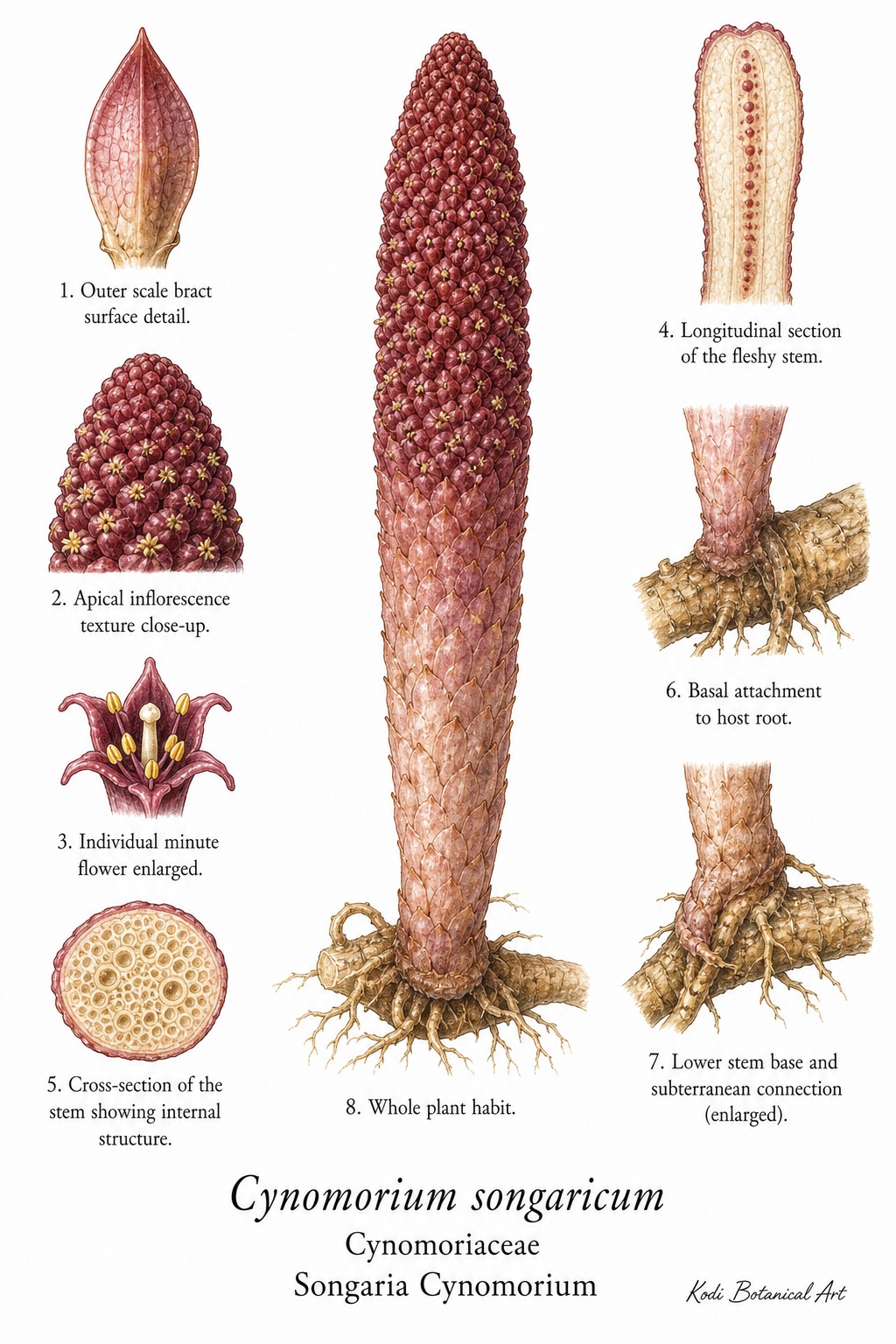
Known in TCM as Suo Yang (锁阳), this sweet, warm herb enters the Kidney, Liver, and Large Intestine. Traditionally, it tonifies Kidney Yang and strengthens Essence, most often applied for erectile dysfunction, kidney deficiency, and constipation. Modern research has identified Anthocyanins among its active constituents.
Part used: Whole herb
Also Known As
Latin: Herba Cynomorii | Pinyin: Suo Yang | Chinese: 锁阳
TCM Properties
- Taste
- sweet
- Temperature
- warm
- Channels
- Kidney, Liver, Large Intestine
Traditional Use
Primary Actions
- Tonifies Kidney Yang and strengthens Essence … impotence, infertility, cold lumbar soreness, weakness of knees and lower limbs from Kidney Yang deficiency
- Nourishes Liver Blood and strengthens sinews and bones … sinew atrophy, paralysis, and weakness in Kidney-Liver deficiency patterns
- Moistens the Intestines and unblocks stool … constipation in the elderly, postpartum, or in Qi-Blood deficiency patients where dryness rather than Heat is the cause
Secondary Actions
- Desert tonic food … consumed as a food supplement in northwest China (Inner Mongolia, Qinghai, Xinjiang, Gansu) and Mongolia; eaten steamed, roasted, or as congee; historical use by soldiers and travellers for endurance in arid climates
- Antioxidant and anti-aging tonic … used in longevity formulas alongside Rou Cong Rong (Cistanche) and He Shou Wu in northwest China folk medicine
Classic Formulas
- Hu Qian Wan (虎潜丸) … classical formula for Kidney-Liver deficiency with sinew atrophy and weakness; Suo Yang combined with Huang Bai, Zhi Mu, Shu Di Huang, Bai Shao, Gui Ban … one of the foundational formulas for 'wei syndrome' (flaccid paralysis)
- Combined with Rou Cong Rong (肉苁蓉) in many Kidney Yang tonic formulas for elderly constipation and sexual deficiency; the two desert parasitic plants are often paired as the 'desert twin tonics'
Classical References
- Ben Cao Gang Mu (Li Shizhen): 'Suo Yang (Lock Yang) fills Essence, invigorates Yang, moistens dryness, nourishes sinews and bones, treats impotence and coldness, and relieves constipation in the elderly … it is warm but not drying, a balanced Yang tonic'
- IMPORT NOTE: XLSX source filed this herb as 'All-Grass' but Suo Yang (锁阳) is not a grass … it is a leafless parasitic fleshy stem of Cynomorium songaricum Rupr. (Cynomoriaceae), a root parasite growing on Nitraria and Ephedra roots in desert and semi-arid regions of northwest China; the official Chinese Pharmacopoeia 2020 drug is the fleshy stem
Modern Research
Active Compounds
- Anthocyanins and procyanidins (cyanidin-3-O-glucoside, procyanidin B2; antioxidant, vascular-protective)
- Ursolic acid and oleanolic acid (triterpenoids; anti-inflammatory, anti-osteoporotic, hepatoprotective)
- Cynomorium polysaccharides (immunostimulatory, anti-fatigue, anti-osteoporotic)
- Catechin and epicatechin (condensed tannins; antioxidant, cardiovascular-protective)
- β-Sitosterol and stigmasterol (phytosterols; anti-inflammatory, partial androgen receptor agonism)
- Amino acids: glutamic acid, proline, hydroxyproline (collagen precursors; sinew/bone support)
- Organic acids: ursolic acid, chlorogenic acid
Studied Effects
- Anti-osteoporotic: Cynomorium polysaccharides and ursolic acid promote osteoblast differentiation and inhibit osteoclast activity in in vitro and ovariectomised rodent osteoporosis models; bone mineral density improvement comparable to low-dose oestrogen in some studies … validates the classical sinew-and-bone strengthening indication and the Hu Qian Wan application for Kidney deficiency with skeletal weakness
- Anti-fatigue and adaptogenic: polysaccharide fractions from C. songaricum significantly reduce forced-swim immobility time, lower post-exercise blood lactate and serum urea nitrogen, and increase hepatic glycogen reserves in rodent models … provides biochemical basis for the desert-tonic endurance application and the Kidney Yang-tonifying anti-fatigue claim
- Antioxidant and neuroprotective: high anthocyanin and procyanidin content from C. songaricum demonstrates potent DPPH radical scavenging and protects neural cells against hydrogen peroxide-induced oxidative injury in in vitro models; in vivo studies show improved cognitive performance and reduced brain lipid peroxidation in aging rodents … consistent with the longevity and anti-aging tonic tradition
Safety & Interactions
Contraindications
- Yin Deficiency with Heat signs (afternoon fever, night sweats, dry mouth, red tongue without coat) … warm tonic will worsen deficiency Heat
- Damp-Heat patterns … warm nature and Intestine-moistening action contraindicated in diarrhea, dysentery, or Damp-Heat strangury
- Excess Fire patterns (strong Heat, infection, acute inflammatory illness)
Cautions
- Standard dose: 6–15 g dried stem in decoction; also prepared as pill, tincture, or powder
- Laxative-type medications and stool softeners: additive bowel-loosening effect with Suo Yang's intestinal moistening action; may cause diarrhea
- Hormone-sensitive conditions: β-sitosterol and phytosterols have weak partial androgen receptor activity; theoretical concern for hormone-dependent conditions; no clinical reports at standard doses
- Generally considered safe at therapeutic and food doses; long history of dietary use in northwest China without documented toxicity
Conditions
- Erectile Dysfunction Traditional ★★★★☆ JSON
- Kidney Deficiency Traditional ★★★★★ JSON
- Constipation Traditional ★★★★☆ JSON
- Osteoporosis Research ★★★☆☆ JSON
- Fatigue Research ★★★☆☆ JSON
Frequently Asked Questions
What is Songaria Cynomorium used for?
Songaria Cynomorium is traditionally used to Tonifies Kidney Yang and strengthens Essence … impotence, infertility, cold lumbar soreness, weakness of knees and lower limbs from Kidney Yang deficiency, Nourishes Liver Blood and strengthens sinews and bones … sinew atrophy, paralysis, and weakness in Kidney-Liver deficiency patterns, Moistens the Intestines and unblocks stool … constipation in the elderly, postpartum, or in Qi-Blood deficiency patients where dryness rather than Heat is the cause. Research has investigated its effects on: Anti-osteoporotic: Cynomorium polysaccharides and ursolic acid promote osteoblast differentiation and inhibit osteoclast activity in in vitro and ovariectomised rodent osteoporosis models; bone mineral density improvement comparable to low-dose oestrogen in some studies … validates the classical sinew-and-bone strengthening indication and the Hu Qian Wan application for Kidney deficiency with skeletal weakness; Anti-fatigue and adaptogenic: polysaccharide fractions from C. songaricum significantly reduce forced-swim immobility time, lower post-exercise blood lactate and serum urea nitrogen, and increase hepatic glycogen reserves in rodent models … provides biochemical basis for the desert-tonic endurance application and the Kidney Yang-tonifying anti-fatigue claim.
What are other names for Songaria Cynomorium?
Songaria Cynomorium is also known as Cynomorium. In TCM: 锁阳 (Suo Yang); Herba Cynomorii.
Is Songaria Cynomorium safe during pregnancy?
The safety of Songaria Cynomorium during pregnancy has not been established. Consult a qualified healthcare provider before use.
What are the contraindications for Songaria Cynomorium?
Songaria Cynomorium should not be used in: Yin Deficiency with Heat signs (afternoon fever, night sweats, dry mouth, red tongue without coat) … warm tonic will worsen deficiency Heat; Damp-Heat patterns … warm nature and Intestine-moistening action contraindicated in diarrhea, dysentery, or Damp-Heat strangury; Excess Fire patterns (strong Heat, infection, acute inflammatory illness). Consult a qualified practitioner before use.