Wrinkled Gianthyssop Herb
- Chinese
- 藿香
- Pinyin
- Huo Xiang
- Latin
- Herba Agastaches
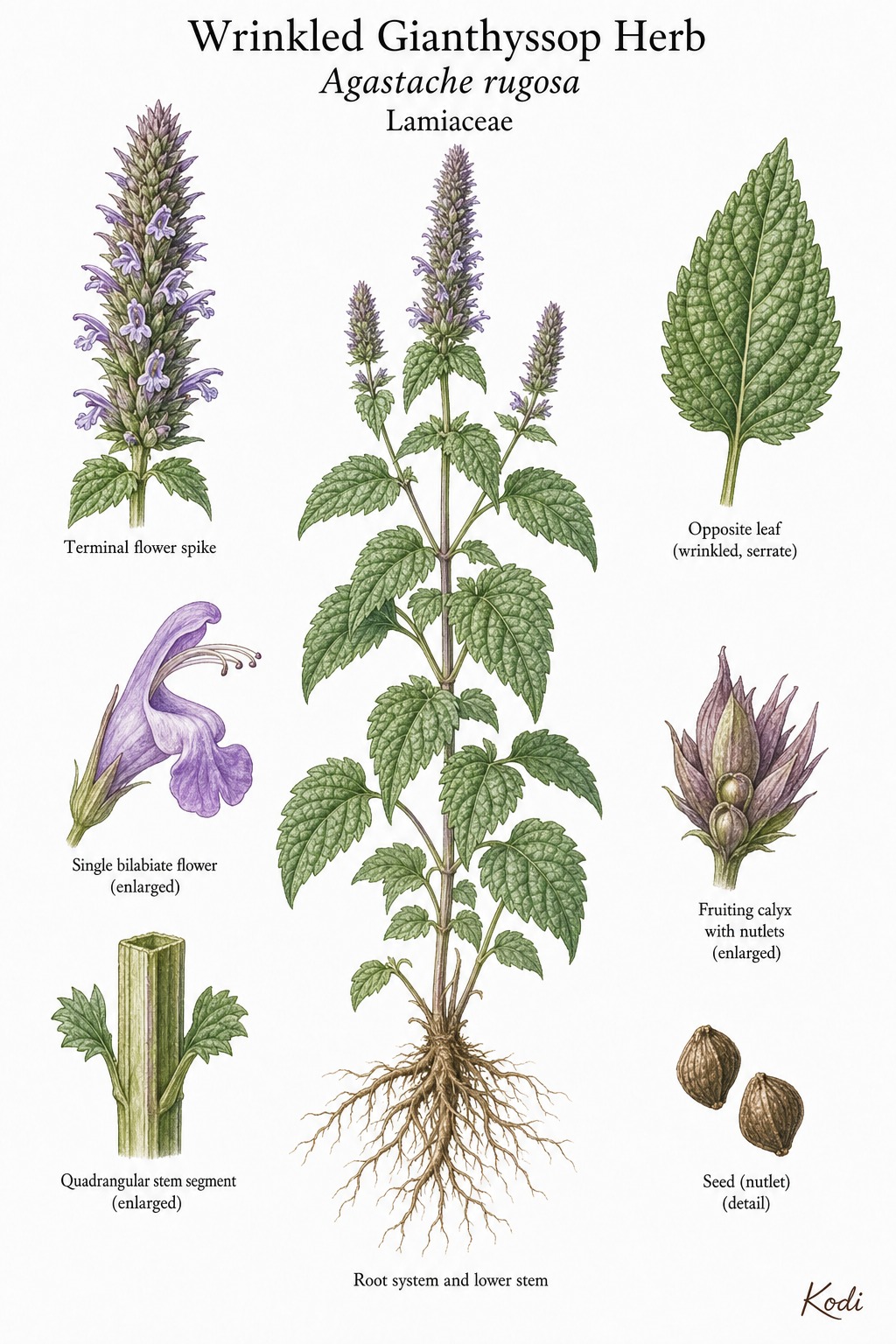
Known in TCM as Huo Xiang (藿香), this pungent, slightly warm herb enters the Spleen, Stomach, and Lung. Traditionally, it transforms Dampness and harmonises the Middle Jiao, most often applied for nausea, diarrhea, and common cold. Modern research has identified Methyl among its active constituents.
Part used: Whole herb
Also Known As
Latin: Herba Agastaches | Pinyin: Huo Xiang | Chinese: 藿香
TCM Properties
- Taste
- pungent
- Temperature
- slightly warm
- Channels
- Spleen, Stomach, Lung
Traditional Use
Primary Actions
- Transforms Dampness and harmonises the Middle Jiao … principal aromatic Dampness-transforming herb; nausea, vomiting, epigastric fullness, abdominal distension, and diarrhea from Damp obstructing Spleen-Stomach
- Releases exterior and dispels Summer-Heat-Damp … summer febrile illness with fever, chills, nausea, heavy limbs, and diarrhea from Wind-Cold attacking surface while interior Dampness is present
- Stops vomiting … one of the premier anti-emetic herbs in TCM; effective for vomiting from multiple causes including morning sickness, motion sickness, and post-operative nausea
Secondary Actions
- Aromatic digestive … stimulates gastric secretion, promotes intestinal motility; used for poor appetite, bloating, and nausea in Damp-Cold Spleen patterns
- Antifungal topical use … strong essential oil used for tinea pedis, athlete's foot, and oral candidiasis in folk practice
Classic Formulas
- Huo Xiang Zheng Qi San (藿香正气散) … one of the most widely prescribed formulas in Chinese medicine; Huo Xiang combined with Bai Zhi, Zi Su, Hou Po, Ban Xia, Bai Zhu, Fu Ling, Chen Pi, Jie Geng, Da Fu Pi, and Zhi Gan Cao; for Exterior Wind-Cold with Interior Damp; summer gastroenteritis, food poisoning, motion sickness, and diarrhoea from summer cold; sold as Huo Xiang Zheng Qi Wan (pills) and liquid … one of the most commercially available OTC Chinese herbal medicines
- Huo Xiang Huang Lian Tang (藿香黄连汤) … combined with Huang Lian (黄连) for Damp-Heat nausea and vomiting; Stomach rebelliousness with Damp-Heat signs
Classical References
- Jing Yue Quan Shu (景岳全书, Zhang Jingyue, 1624): 'Huo Xiang (aromatic herb) is the commander of all aromatic herbs that transform Dampness … it awakens the Spleen, harmonises the Stomach, stops vomiting, and resolves summer-heat; combined with other aromatic Damp-transforming herbs it treats all exterior-interior combined Damp disorders'
- SPECIES NOTE: Two distinct plants are called Huo Xiang in Chinese medicine: (1) Agastache rugosa (Fischer & Meyer) Kuntze (土藿香, Tu Huo Xiang … 'local Huo Xiang'; Lamiaceae; this herb #86, Herba Agastaches), used primarily in northern China; (2) Pogostemon cablin (Blanco) Benth. (广藿香, Guang Huo Xiang … 'Guangdong Huo Xiang'; also Lamiaceae; the official Chinese Pharmacopoeia 2020 species for Huo Xiang Zheng Qi formulas). Agastache rugosa is widely used as a substitute but has a different essential oil composition (methyl chavicol-dominant vs. patchouli-oil-dominant)
Modern Research
Active Compounds
- Methyl chavicol (estragole; ~70–80% of essential oil; antimicrobial, antispasmodic, anti-inflammatory)
- Anisaldehyde (essential oil aldehyde; antimicrobial, antifungal)
- Limonene and linalool (essential oil monoterpenes; anti-inflammatory, anxiolytic)
- Apigenin and luteolin (flavonoids; anti-inflammatory, antioxidant, spasmolytic)
- Rosmarinic acid (phenylpropanoid ester; anti-inflammatory, antioxidant … characteristic of aromatic Lamiaceae)
- Acacetin (flavone; antispasmodic, mild anxiolytic)
Studied Effects
- Anti-emetic and gastrointestinal: essential oil from Agastache rugosa relaxes intestinal smooth muscle via Ca2+-channel antagonism and 5-HT3 receptor modulation; antiemetic activity confirmed in cisplatin-induced emesis models and gastric emptying studies … validates the anti-vomiting and Stomach-harmonising TCM application and provides a mechanistic basis for the use in Huo Xiang Zheng Qi San
- Antimicrobial and antifungal: methyl chavicol and anisaldehyde from A. rugosa essential oil exhibit broad-spectrum antimicrobial activity against Staphylococcus aureus, Escherichia coli, Salmonella typhi, and Candida albicans in MIC assays; anti-biofilm activity against oral pathogens also demonstrated … consistent with the summer diarrhea, gastroenteritis, and topical antifungal applications
- Anti-inflammatory: rosmarinic acid and apigenin from A. rugosa inhibit NF-κB, COX-2, and TNF-α/IL-6 in LPS-activated macrophage models; in vivo anti-inflammatory efficacy confirmed in carrageenan paw edema assay … supports the Summer-Heat-Damp releasing and fever-associated inflammation applications
Safety & Interactions
Contraindications
- Yin Deficiency with Heat or interior Heat patterns … pungent-warm aromatic nature will aggravate deficiency Heat, dry fluids, and worsen thirst
- Excess Heat patterns without Dampness … aromatic warming herbs contraindicated with pure Heat presentations
Cautions
- Standard dose: 6–12 g dried herb; add near end of decocting (last 10–15 minutes) to preserve volatile essential oils … prolonged boiling destroys therapeutic aromatics
- Methyl chavicol (estragole) in the essential oil is classified as a potential genotoxin and carcinogen in concentrated form by EFSA and HMPC; at standard therapeutic decoction doses the exposure is negligible and not clinically concerning; avoid prolonged use of high-concentration essential oil preparations
- Agastache rugosa vs. Pogostemon cablin substitution: the two plants have different essential oil compositions; clinical substitution in Huo Xiang Zheng Qi San should be noted as non-pharmacopoeial
- Pregnancy: aromatic/pungent herbs traditionally used cautiously in pregnancy; short-term use at standard doses for morning sickness generally considered acceptable in TCM practice
Conditions
- Nausea Traditional ★★★★★ JSON
- Diarrhea Traditional ★★★★☆ JSON
- Common Cold Traditional ★★★☆☆ JSON
- Gastroenteritis Traditional ★★★★☆ JSON
Frequently Asked Questions
What is Wrinkled Gianthyssop Herb used for?
Wrinkled Gianthyssop Herb is traditionally used to Transforms Dampness and harmonises the Middle Jiao … principal aromatic Dampness-transforming herb; nausea, vomiting, epigastric fullness, abdominal distension, and diarrhea from Damp obstructing Spleen-Stomach, Releases exterior and dispels Summer-Heat-Damp … summer febrile illness with fever, chills, nausea, heavy limbs, and diarrhea from Wind-Cold attacking surface while interior Dampness is present, Stops vomiting … one of the premier anti-emetic herbs in TCM; effective for vomiting from multiple causes including morning sickness, motion sickness, and post-operative nausea. Research has investigated its effects on: Anti-emetic and gastrointestinal: essential oil from Agastache rugosa relaxes intestinal smooth muscle via Ca2+-channel antagonism and 5-HT3 receptor modulation; antiemetic activity confirmed in cisplatin-induced emesis models and gastric emptying studies … validates the anti-vomiting and Stomach-harmonising TCM application and provides a mechanistic basis for the use in Huo Xiang Zheng Qi San; Antimicrobial and antifungal: methyl chavicol and anisaldehyde from A. rugosa essential oil exhibit broad-spectrum antimicrobial activity against Staphylococcus aureus, Escherichia coli, Salmonella typhi, and Candida albicans in MIC assays; anti-biofilm activity against oral pathogens also demonstrated … consistent with the summer diarrhea, gastroenteritis, and topical antifungal applications.
What are other names for Wrinkled Gianthyssop Herb?
Wrinkled Gianthyssop Herb is also known as Agastaches. In TCM: 藿香 (Huo Xiang); Herba Agastaches.
Is Wrinkled Gianthyssop Herb safe during pregnancy?
The safety of Wrinkled Gianthyssop Herb during pregnancy has not been established. Consult a qualified healthcare provider before use.
What are the contraindications for Wrinkled Gianthyssop Herb?
Wrinkled Gianthyssop Herb should not be used in: Yin Deficiency with Heat or interior Heat patterns … pungent-warm aromatic nature will aggravate deficiency Heat, dry fluids, and worsen thirst; Excess Heat patterns without Dampness … aromatic warming herbs contraindicated with pure Heat presentations. Consult a qualified practitioner before use.