Curly Bristlethistle Herb
- Chinese
- 飞廉
- Pinyin
- Fei Lian
- Latin
- Herba Cardui Crispi
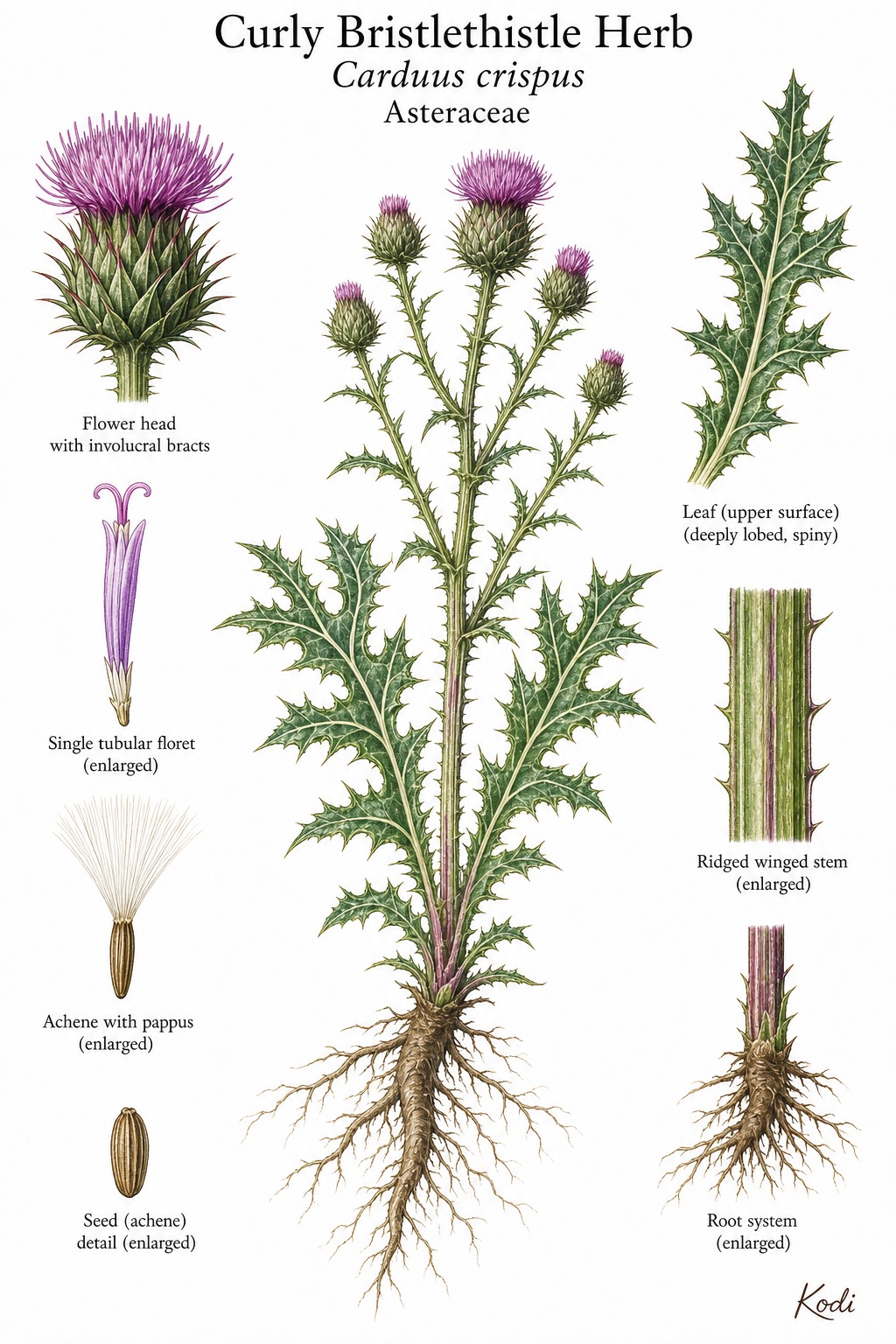
Known in TCM as Fei Lian (飞廉), this bitter, cool herb enters the Liver and Heart. Traditionally, it cools Blood and stops bleeding, most often applied for hematuria, uterine bleeding, and hypertension. Modern research has identified Pectolinarin and linarin (flavone glycosides; anti-inflammatory, antihypertensive among its active constituents.
Part used: Whole herb
Also Known As
Latin: Herba Cardui Crispi | Pinyin: Fei Lian | Chinese: 飞廉
TCM Properties
- Taste
- bitter
- Temperature
- cool
- Channels
- Liver, Heart
Traditional Use
Primary Actions
- Cools Blood and stops bleeding … hemoptysis, epistaxis, hematuria, and uterine bleeding from Blood Heat
- Clears Heat and resolves toxicity … carbuncles, abscesses, febrile illness, and skin infections
- Dispels Wind and stops pain … headache, dizziness, and Wind-Heat-type pain syndromes
- Disperses Blood stasis and reduces swelling … traumatic injury and Blood-stasis swellings
Secondary Actions
- Lowers blood pressure … traditional use for Wind-Liver hypertension in Chinese folk medicine
- External use: decoction wash for skin sores, carbuncles, and venomous bites
Classical References
- Shen Nong Ben Cao Jing: lists Fei Lian (飞廉, 'flying scallop' … named for the prickly winged stems) in the middle grade for dispelling Wind, stopping pain, and treating bone-joint bi syndrome; one of the older documented thistle herbs in Chinese materia medica
- Ben Cao Gang Mu (Li Shizhen): 'Fei Lian (Carduus crispus) dispels Wind Damp from the bones and sinews, treats headache and dizziness from Wind-Heat, and cools blood for bleeding … it is similar in action to Da Ji and Xiao Ji but weaker in stopping bleeding and stronger in dispelling Wind'
Modern Research
Active Compounds
- Pectolinarin and linarin (flavone glycosides; anti-inflammatory, antihypertensive … shared with related Asteraceae thistles)
- Luteolin and apigenin (flavonoids; anti-inflammatory, antioxidant)
- Chlorogenic acid and caffeic acid (phenolic acids; antioxidant, antimicrobial)
- Taraxasterol and β-amyrin (triterpenoids; anti-inflammatory)
- Tannins (astringent, haemostatic)
Studied Effects
- Anti-inflammatory: flavonoid fraction from Carduus crispus inhibits NF-κB and COX-2 in in vitro macrophage assays; the flavonoid profile (pectolinarin, luteolin) closely parallels the related Japanese Thistle (Cirsium japonicum, Da Ji) and confers similar anti-inflammatory and haemostatic pharmacology … validates the Blood-Heat cooling and toxin-resolving folk applications
- Antihypertensive: pectolinarin and linarin produce vasodilation and blood-pressure reduction in hypertensive animal models via Ca2+-channel antagonism; consistent with the traditional Wind-Liver hypertension indication in Chinese folk medicine
- Antioxidant: chlorogenic acid and caffeic acid from C. crispus demonstrate significant DPPH and ABTS radical scavenging activity in standard antioxidant assays; antioxidant capacity comparable to related Asteraceae medicinal herbs
Safety & Interactions
Contraindications
- Cold-pattern bleeding without Blood Heat (pale blood, cold extremities, weak pulse) … cooling herb contraindicated in cold-deficiency haemorrhage
- Spleen-Stomach Deficiency Cold … cool-bitter nature impairs digestive Yang with prolonged use
Cautions
- Standard dose: 9–15 g dried herb or root in decoction; 30–60 g fresh herb
- Antihypertensive drugs: additive blood-pressure lowering; monitor in patients on antihypertensives
- Anticoagulants: complex haemostatic-anticoagulant interaction; monitor bleeding parameters
- Pregnancy: Blood-cooling and potentially Blood-moving action; traditionally used with caution in pregnancy
- Asteraceae allergy: contact dermatitis possible in highly sensitised individuals
Drug Interactions
- Antihypertensive drugs … additive blood-pressure lowering via flavonoid vasodilation
Conditions
- Hematuria Traditional ★★★☆☆ JSON
- Uterine Bleeding Traditional ★★★☆☆ JSON
- Hypertension Traditional ★★★☆☆ JSON
- Headache Traditional ★★☆☆☆ JSON
- Carbuncle Traditional ★★☆☆☆ JSON
Frequently Asked Questions
What is Curly Bristlethistle Herb used for?
Curly Bristlethistle Herb is traditionally used to Cools Blood and stops bleeding … hemoptysis, epistaxis, hematuria, and uterine bleeding from Blood Heat, Clears Heat and resolves toxicity … carbuncles, abscesses, febrile illness, and skin infections, Dispels Wind and stops pain … headache, dizziness, and Wind-Heat-type pain syndromes, Disperses Blood stasis and reduces swelling … traumatic injury and Blood-stasis swellings. Research has investigated its effects on: Anti-inflammatory: flavonoid fraction from Carduus crispus inhibits NF-κB and COX-2 in in vitro macrophage assays; the flavonoid profile (pectolinarin, luteolin) closely parallels the related Japanese Thistle (Cirsium japonicum, Da Ji) and confers similar anti-inflammatory and haemostatic pharmacology … validates the Blood-Heat cooling and toxin-resolving folk applications; Antihypertensive: pectolinarin and linarin produce vasodilation and blood-pressure reduction in hypertensive animal models via Ca2+-channel antagonism; consistent with the traditional Wind-Liver hypertension indication in Chinese folk medicine.
What are other names for Curly Bristlethistle Herb?
Curly Bristlethistle Herb is also known as Cardui. In TCM: 飞廉 (Fei Lian); Herba Cardui Crispi.
Is Curly Bristlethistle Herb safe during pregnancy?
The safety of Curly Bristlethistle Herb during pregnancy has not been established. Consult a qualified healthcare provider before use.
What are the contraindications for Curly Bristlethistle Herb?
Curly Bristlethistle Herb should not be used in: Cold-pattern bleeding without Blood Heat (pale blood, cold extremities, weak pulse) … cooling herb contraindicated in cold-deficiency haemorrhage; Spleen-Stomach Deficiency Cold … cool-bitter nature impairs digestive Yang with prolonged use. Consult a qualified practitioner before use.
Does Curly Bristlethistle Herb interact with any medications?
Curly Bristlethistle Herb may interact with: Antihypertensive drugs … additive blood-pressure lowering via flavonoid vasodilation. Always inform your healthcare provider of any herbal supplements you are taking.