Amber
- Chinese
- 琥珀
- Pinyin
- Hu Po
- Latin
- Succinus
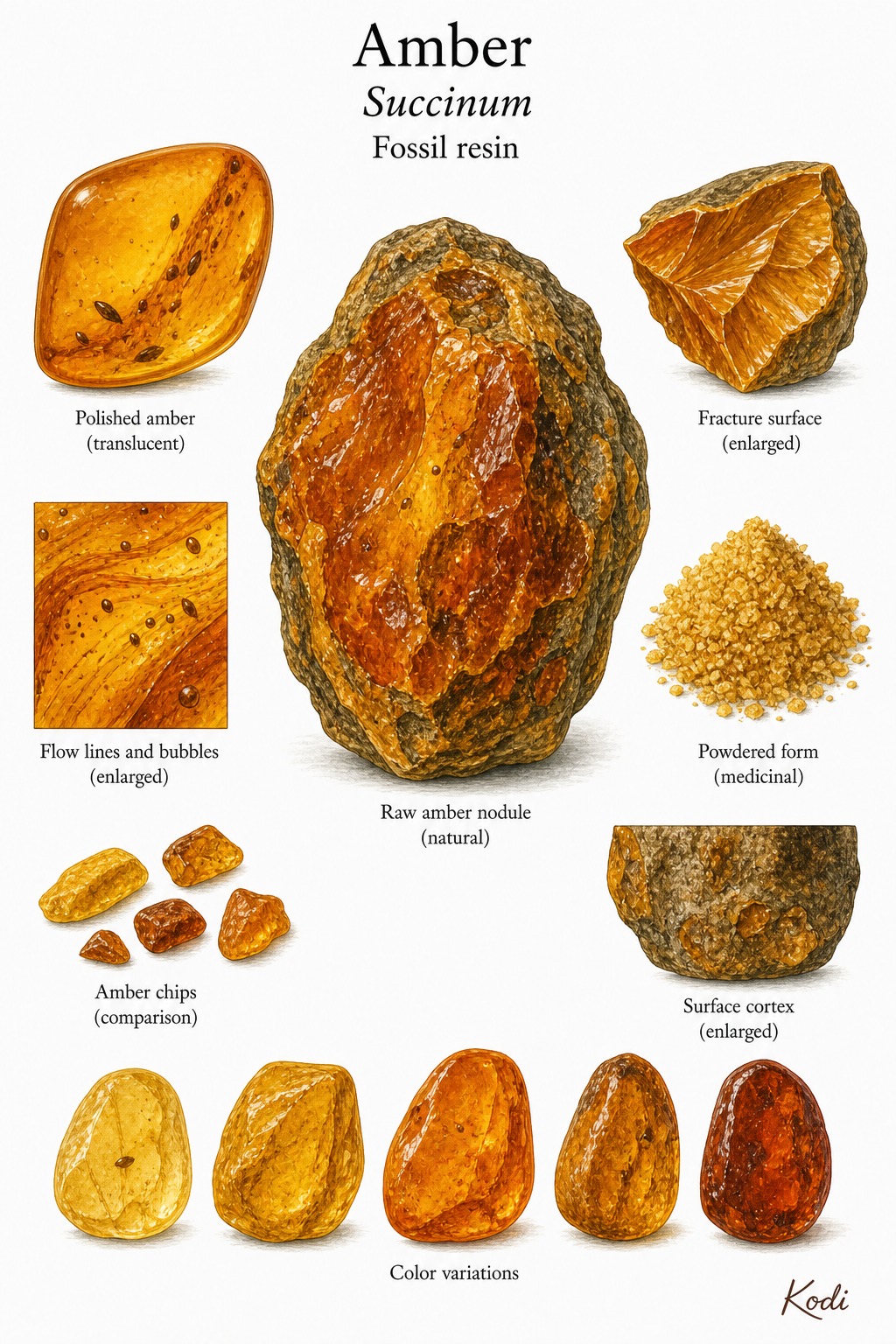
Known in TCM as Hu Po (琥珀), this sweet, neutral herb enters the Heart, Liver, and Urinary Bladder. Traditionally, it quiets the Spirit and calms the Heart (An Shen), most often applied for insomnia, anxiety, and palpitations. Modern research has identified Succinic acid (amber acid) among its active constituents.
Part used: Amber
TCM Properties
- Taste
- sweet
- Temperature
- neutral
- Channels
- Heart, Liver, Urinary Bladder
Traditional Use
Primary Actions
- Quiets the Spirit and calms the Heart (An Shen) … palpitations, anxiety, insomnia, and nightmares from Heart Shen disturbance; one of the principal An Shen (Spirit-calming) drugs in the TCM pharmacopoeia alongside Long Gu (dragon bone), Zhen Zhu Mu (pearl), and Ci Shi (magnetite)
- Activates Blood and dissolves Blood Stasis … amenorrhea, dysmenorrhea, post-partum Blood Stasis, and abdominal masses from Liver Blood Stasis; descending action of Liver channel herb reaches the lower abdomen
- Promotes urination and dissolves Bladder Stagnation … dysuria, haematuria, urinary calculi (stones), and painful urinary strangury (lin); classical use for Blood Lin (bloody painful urination) and Stone Lin (urinary calculi)
- Reduces swelling and heals wounds (external) … chronic non-healing ulcers and infected wounds; Hu Po powder dusted onto wound surfaces; traditionally combined with Long Gu in topical ulcer powder
Secondary Actions
- Calms convulsions in children … febrile convulsions and epilepsy in children; Shen-calming and Liver-Wind-settling action; classical pairing with Zhu Sha (cinnabar) now avoided due to mercury toxicity … Hu Po used alone or with non-toxic alternatives
- Clears Heart Fire … oral ulcers, tongue sores, and irritability from Heart Fire ascending; sweet-neutral nature clears without excessive cold injury
Classic Formulas
- Hu Po Duo Mei Wan (琥珀多寐丸) … for insomnia, anxiety, and nightmares; Hu Po combined with Ren Shen, Long Yan Rou (longan), Dang Gui, Fu Ling, and Suan Zao Ren; restores Heart Blood and quiets Shen; classical formula still used in contemporary TCM for Heart Blood deficiency insomnia with anxiety
- Hu Po San (琥珀散) … multiple classical versions; the urinary variant combines Hu Po with Mu Tong, Hua Shi (talcum), Che Qian Zi, and Deng Xin Cao for Blood Lin and Stone Lin; promotes urination and dissolves Bladder Stasis
- An Shen Wan (安神丸) variant … Hu Po as one of several An Shen drugs combined with Zhen Zhu Mu, Long Gu, Bai Zi Ren, and He Huan Pi for composite Spirit-calming formula
Classical References
- Ming Yi Bie Lu (Tao Hongjing, 500 CE): 'Hu Po is sweet, neutral … calms the Spirit, dispels nightmares, breaks Blood Stasis, promotes urination, dissolves Lin strangury … it is fossilised pine resin transformed by the earth over countless generations; enter it with Bao Mu (preserved wood)'
- Ben Cao Gang Mu (Li Shizhen): 'Hu Po enters the Heart and Liver blood aspects … calms the Shen, breaks Blood, drains Lin strangury, reduces swellings; the name Hu Po (tiger + amber) may derive from folk belief that tiger spirit transforms into stone after death … or from the yellow-orange colour resembling tiger markings; genuine Hu Po should give a resinous pine aroma when touched with a hot needle and float in saturated salt solution'
- MINERAL NOTE: Hu Po (琥珀) is fossilised tree resin (amber) … an organic-mineral drug, not a plant, though it is of botanical origin (ancient conifers). Commercial Hu Po comes principally from Baltic amber (succinite, 3–8% succinic acid) and Burmese amber (burmite). Widely adulterated with copal (young resin), synthetic resins, and plastics … verify by hot-needle test (pine-resin aroma), salt-water float test (density ~1.05–1.10 g/cm³), and UV fluorescence. Hu Po is always used as a powder or in pills … NEVER decocted (heat degrades the drug).
Modern Research
Active Compounds
- Succinic acid (amber acid) … 3–8% in Baltic amber; Krebs cycle intermediate; anti-inflammatory, neuroprotective, mildly stimulatory
- Abietic acid and isoabietic acid (diterpenoid resin acids) … anti-inflammatory, antimicrobial
- Communic acid and agathic acid (labdanoid diterpene acids) … characteristic of Baltic amber (succinite); antioxidant
- Volatile sesquiterpene and diterpene hydrocarbons … aromatic compounds; anxiolytic effects in some studies
- Phenolic compounds (amber-specific) … antioxidant; minor fraction in high-quality amber
Studied Effects
- Succinic acid and anti-inflammatory activity: succinic acid from Baltic amber demonstrates anti-inflammatory effects in LPS-stimulated macrophage models, reducing IL-6 and TNF-α production; neuroprotective effects observed in oxidative stress models … provides a mechanistic basis for the traditional Spirit-calming and anti-inflammatory applications, though bioavailability of succinic acid from orally administered amber powder is not well-characterised
- Anxiolytic and sedative: diterpene resin acids from amber interact with GABA-A receptor modulatory sites in preliminary in vitro studies; provides a plausible pharmacological mechanism for the classical Spirit-calming indication, though human clinical data on amber as a sedative is absent; pharmacological validation of the An Shen action remains preliminary
- Succinic acid in metabolic medicine: exogenous succinic acid supplementation (as a pharmaceutical compound, not amber) improves mitochondrial function in hypoxic and post-ischaemic states; extrapolation of this effect to powdered amber ingestion is speculative given the different bioavailability profiles
Safety & Interactions
Contraindications
- Yin Deficiency with hyperactive Fire … sweet-neutral with Blood-moving properties; the descending blood-activating action may aggravate restlessness in Yin Deficiency Fire patterns
- No Stasis present … Blood-activating drugs inappropriate without Blood Stasis; avoid in pure deficiency patterns without stagnation
Cautions
- Standard dose: 1.5–3 g as a powder taken with decoction (chong fu); NOT boiled in decoction … heat destroys amber; always added to the finished decoction or taken as pill/powder
- Adulteration risk: Hu Po is among the most adulterated TCM minerals; copal (young resin) and synthetic amber are commonly substituted; copal has different chemistry and lacks succinic acid content; always source from verified TCM pharmacies with authentication testing
- Authenticity test: genuine amber gives a characteristic pine-resin aroma when briefly touched with a hot needle; floats in saturated salt solution (density ~1.05–1.10 g/cm³); synthetic resin sinks or gives acrid plastic smell
- Blood-activating caution: Hu Po activates Blood … use cautiously in patients with bleeding disorders or on anticoagulants; standard therapeutic doses are unlikely to cause significant haemostatic effects but monitor in high-risk patients
Conditions
- Insomnia Traditional ★★★★☆ JSON
- Anxiety Traditional ★★★☆☆ JSON
- Palpitations Traditional ★★★☆☆ JSON
- Dysmenorrhea Traditional ★★☆☆☆ JSON
- Urinary Tract Infection Traditional ★★☆☆☆ JSON
Frequently Asked Questions
What is Amber used for?
Amber is traditionally used to Quiets the Spirit and calms the Heart (An Shen) … palpitations, anxiety, insomnia, and nightmares from Heart Shen disturbance; one of the principal An Shen (Spirit-calming) drugs in the TCM pharmacopoeia alongside Long Gu (dragon bone), Zhen Zhu Mu (pearl), and Ci Shi (magnetite), Activates Blood and dissolves Blood Stasis … amenorrhea, dysmenorrhea, post-partum Blood Stasis, and abdominal masses from Liver Blood Stasis; descending action of Liver channel herb reaches the lower abdomen, Promotes urination and dissolves Bladder Stagnation … dysuria, haematuria, urinary calculi (stones), and painful urinary strangury (lin); classical use for Blood Lin (bloody painful urination) and Stone Lin (urinary calculi), Reduces swelling and heals wounds (external) … chronic non-healing ulcers and infected wounds; Hu Po powder dusted onto wound surfaces; traditionally combined with Long Gu in topical ulcer powder. Research has investigated its effects on: Succinic acid and anti-inflammatory activity: succinic acid from Baltic amber demonstrates anti-inflammatory effects in LPS-stimulated macrophage models, reducing IL-6 and TNF-α production; neuroprotective effects observed in oxidative stress models … provides a mechanistic basis for the traditional Spirit-calming and anti-inflammatory applications, though bioavailability of succinic acid from orally administered amber powder is not well-characterised; Anxiolytic and sedative: diterpene resin acids from amber interact with GABA-A receptor modulatory sites in preliminary in vitro studies; provides a plausible pharmacological mechanism for the classical Spirit-calming indication, though human clinical data on amber as a sedative is absent; pharmacological validation of the An Shen action remains preliminary.
Is Amber safe during pregnancy?
The safety of Amber during pregnancy has not been established. Consult a qualified healthcare provider before use.
What are the contraindications for Amber?
Amber should not be used in: Yin Deficiency with hyperactive Fire … sweet-neutral with Blood-moving properties; the descending blood-activating action may aggravate restlessness in Yin Deficiency Fire patterns; No Stasis present … Blood-activating drugs inappropriate without Blood Stasis; avoid in pure deficiency patterns without stagnation. Consult a qualified practitioner before use.