Cremastra Pseudobulb
- Chinese
- 山慈菇
- Pinyin
- Shan Ci Gu
- Latin
- Pseudobulbus Cremastrae Seu Pleiones
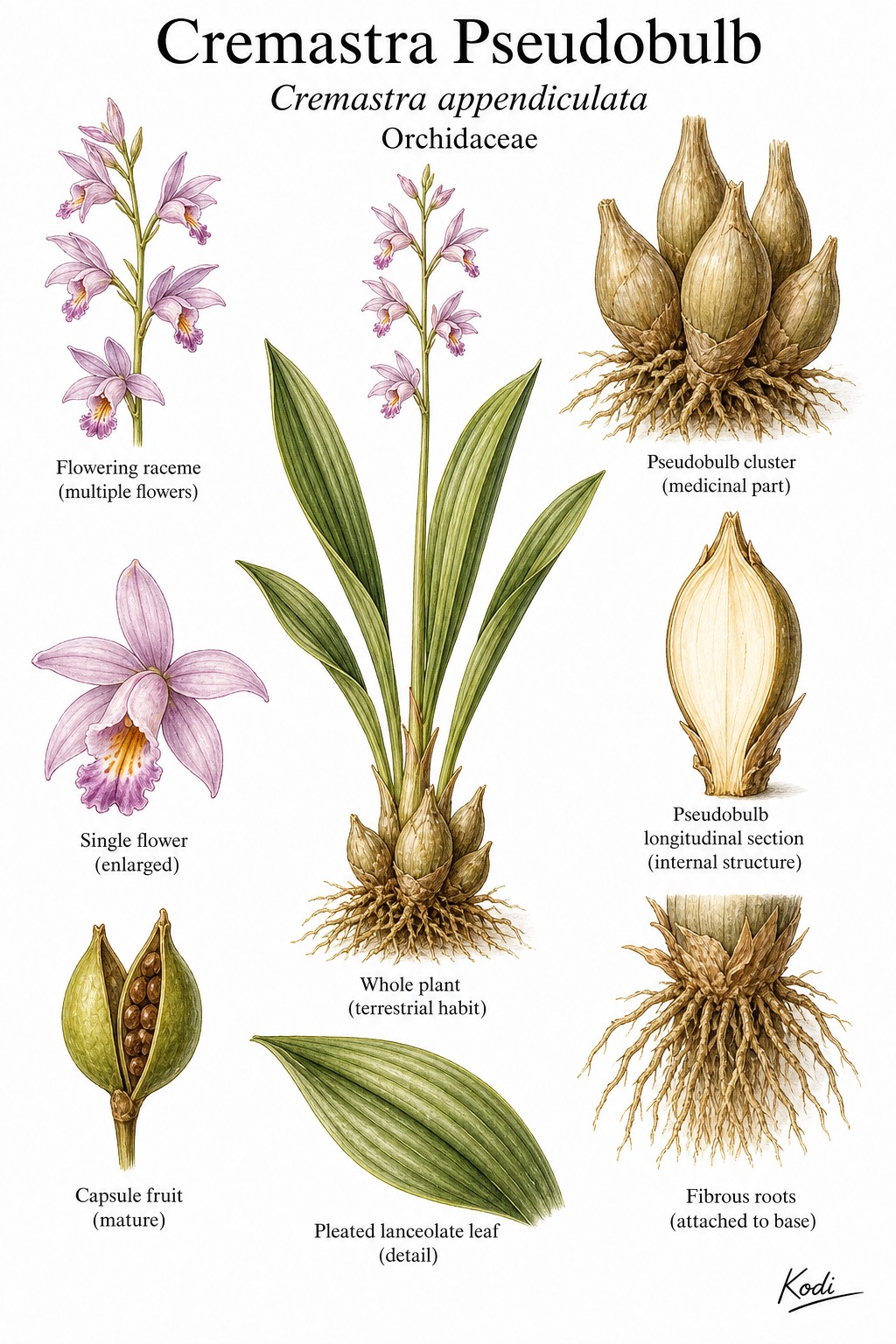
Known in TCM as Shan Ci Gu (山慈菇), this sweet and slightly pungent, cool herb enters the Liver and Spleen. Traditionally, it resolves toxicity and disperses nodules, most often applied for cancer, carbuncle, and lymphadenitis. Modern research has identified Colchicine and colchicine-type alkaloids (Cremastra fraction) among its active constituents.
Part used: Pseudobulb
Also Known As
Latin: Pseudobulbus Cremastrae Seu Pleiones | Pinyin: Shan Ci Gu | Chinese: 山慈菇
TCM Properties
- Taste
- sweet, slightly pungent
- Temperature
- cool
- Channels
- Liver, Spleen
Traditional Use
Primary Actions
- Resolves toxicity and disperses nodules … the principal TCM herb for lymph node enlargement (scrofula), thyroid nodules, carbuncles, hard abscesses, and cancer-type Phlegm-toxin masses; the anti-nodule, mass-dispersing action is its primary classical indication
- Clears Heat toxicity and reduces swelling … hot abscesses, carbuncles, snake bite, insect sting, and infected wounds; topical fresh pseudobulb paste applied directly to toxin lesions
- Reduces Phlegm-toxin masses … hard, fixed nodules classified as Phlegm-Stasis accumulation in TCM; combined with other Phlegm-softening and Blood-activating herbs in cancer and chronic nodule formulas
Secondary Actions
- External antidote … fresh Shan Ci Gu pseudobulb ground to paste applied topically for snake bite (Pi She Shang), wasp stings, and furuncles; one of the classical emergency external applications
- Clears Liver Fire … Liver Fire with red eyes, headache, and irritability in the context of Phlegm-Fire accumulation
Classic Formulas
- Xiao Jin Dan (小金丹) … classical formula for scrofula, lymph node tuberculosis, and Phlegm-Stasis masses; Shan Ci Gu combined with Bai Jie Zi, Ma Qian Zi, She Xiang, Ru Xiang, and Mo Yao; dissolves Phlegm-Blood Stasis nodules; one of the main formulas still used for benign and malignant lymph node masses in TCM oncology
- Zi Jin Ding (紫金锭) / Wan Ying Dan … classical multi-use detoxifying tablet containing Shan Ci Gu as a key 'five tiger' anti-toxin ingredient; combined with Shan Zha, Wu Bei Zi, Zhu Sha, and She Xiang; treats food poisoning, internal toxin, and topical infections
Classical References
- Ben Cao Hui Yan (Ni Zhumo, 1624 CE): 'Shan Ci Gu (山慈菇) resolves toxins, disperses nodules, treats scrofula and snake bite; the corm (pseudobulb) is the medicinal part … applied externally as a poultice or taken internally; reduces hard Phlegm masses that do not soften with ordinary treatment'
- Ben Cao Gang Mu (Li Shizhen): 'Shan Ci Gu … sweet, slightly cold; enters the Liver and Spleen; treats scrofula and carbuncles, reduces masses, resolves toxins; used both internally in decoction and externally as paste; the name (mountain water-chestnut) reflects the rounded corm appearance'
- COLCHICINE NOTE: Cremastra appendiculata (the primary Shan Ci Gu source) contains colchicine and related colchicine-type alkaloids; colchicine is a potent microtubule-disrupting anti-mitotic compound … the molecular basis of the anti-proliferative/anti-tumour TCM indication; it is also the active compound in modern gout treatment (pharmaceutical colchicine). However, colchicine has a narrow therapeutic index: toxicity (myopathy, bone marrow suppression, multi-organ failure) can occur with drug interactions via CYP3A4/P-gp inhibitors. Standard TCM decoction doses of Shan Ci Gu contain far less colchicine than pharmaceutical doses, but the interaction risk warrants flag=1 and documentation. The alternative source Pleione bulbocodioides contains dactylorhin lectins rather than colchicine … has lower interaction risk.
Modern Research
Active Compounds
- Colchicine and colchicine-type alkaloids (Cremastra fraction) … microtubule polymerisation inhibitor; anti-mitotic, anti-inflammatory (gout mechanism), cytotoxic at high doses
- Dactylorhin E and military orchid glycosides (Pleione fraction) … mannose-binding orchid lectins; immunostimulatory, antiviral
- β-Sitosterol and stigmasterol (phytosterols) … anti-inflammatory
- Polysaccharide complex (glucomannans and fructans) … immunostimulatory, anti-tumor in vivo
- Cremastrine (phenanthridine alkaloid) … anti-tumor in vitro
Studied Effects
- Anti-tumor and anti-proliferative: colchicine from Cremastra appendiculata inhibits cell proliferation across multiple cancer cell lines (breast, liver, lung, colorectal) via tubulin polymerisation disruption and mitotic arrest; validates the classical anti-cancer mass-dispersing indication; colchicine-derived drugs (vinblastine-type compounds) are modern antineoplastic agents, establishing the pharmacological rationale for the anti-tumour TCM action class
- Anti-inflammatory: colchicine (pure pharmaceutical compound) is the validated treatment for acute gout … potently reduces NLRP3 inflammasome activation and neutrophil migration; Shan Ci Gu decoction extracts show similar but attenuated anti-inflammatory activity consistent with colchicine content
- Antiviral: polysaccharide fractions from Pleione pseudobulbs demonstrate in vitro inhibitory activity against influenza virus and other RNA viruses; validates broad anti-toxin/anti-pathogen classical indications
Safety & Interactions
Contraindications
- Pregnancy … absolutely contraindicated; colchicine is teratogenic (disrupts spindle formation in dividing cells) and associated with miscarriage and fetal abnormalities at supratherapeutic doses
- Spleen-Stomach Deficiency Cold without Phlegm-toxin masses … cool, dispersing action injures digestive Yang in Cold deficiency patterns
- Known colchicine hypersensitivity
Cautions
- Standard dose: 3–9 g dried pseudobulb in decoction; 30–60 g fresh herb ground to poultice for external use; do not exceed standard doses
- Colchicine content: standard decoction doses contain far less colchicine than pharmaceutical anti-gout doses; myopathy and bone marrow suppression risks are low at therapeutic TCM doses … but the risk multiplies dramatically with CYP3A4/P-gp inhibitors (see drug interactions)
- Distinguish Cremastra vs Pleione source: Cremastra appendiculata contains colchicine; Pleione bulbocodioides lacks colchicine but has orchid lectins … pharmacologically distinct; market supplies often mix the two; Pleione source carries lower interaction risk
Drug Interactions
- CYP3A4 inhibitors (clarithromycin, erythromycin, azithromycin, verapamil, diltiazem, itraconazole, ketoconazole) … SERIOUS: CYP3A4 is the primary metabolic pathway for colchicine; concurrent CYP3A4 inhibitors dramatically increase colchicine plasma levels to potentially toxic concentrations; macrolide antibiotic + colchicine is a known clinically fatal drug combination at pharmaceutical doses; monitor carefully even at TCM decoction doses
- P-glycoprotein inhibitors (cyclosporine, quinidine, verapamil) … P-gp is the primary efflux pump for colchicine; P-gp inhibitors increase colchicine bioavailability and toxicity risk; cyclosporine combination is particularly dangerous
- Statins (HMG-CoA reductase inhibitors … simvastatin, atorvastatin) … colchicine + statins increases myopathy risk; monitor for muscle pain and weakness
Conditions
- Cancer Research ★★☆☆☆ JSON
- Carbuncle Traditional ★★★★☆ JSON
- Lymphadenitis Traditional ★★★☆☆ JSON
- Thyroid Nodule Traditional ★★☆☆☆ JSON
- Snakebite Traditional ★★☆☆☆ JSON
Frequently Asked Questions
What is Cremastra Pseudobulb used for?
Cremastra Pseudobulb is traditionally used to Resolves toxicity and disperses nodules … the principal TCM herb for lymph node enlargement (scrofula), thyroid nodules, carbuncles, hard abscesses, and cancer-type Phlegm-toxin masses; the anti-nodule, mass-dispersing action is its primary classical indication, Clears Heat toxicity and reduces swelling … hot abscesses, carbuncles, snake bite, insect sting, and infected wounds; topical fresh pseudobulb paste applied directly to toxin lesions, Reduces Phlegm-toxin masses … hard, fixed nodules classified as Phlegm-Stasis accumulation in TCM; combined with other Phlegm-softening and Blood-activating herbs in cancer and chronic nodule formulas. Research has investigated its effects on: Anti-tumor and anti-proliferative: colchicine from Cremastra appendiculata inhibits cell proliferation across multiple cancer cell lines (breast, liver, lung, colorectal) via tubulin polymerisation disruption and mitotic arrest; validates the classical anti-cancer mass-dispersing indication; colchicine-derived drugs (vinblastine-type compounds) are modern antineoplastic agents, establishing the pharmacological rationale for the anti-tumour TCM action class; Anti-inflammatory: colchicine (pure pharmaceutical compound) is the validated treatment for acute gout … potently reduces NLRP3 inflammasome activation and neutrophil migration; Shan Ci Gu decoction extracts show similar but attenuated anti-inflammatory activity consistent with colchicine content.
What are other names for Cremastra Pseudobulb?
Cremastra Pseudobulb is also known as Cremastra. In TCM: 山慈菇 (Shan Ci Gu); Pseudobulbus Cremastrae Seu Pleiones.
Is Cremastra Pseudobulb safe during pregnancy?
Cremastra Pseudobulb is not recommended during pregnancy.
What are the contraindications for Cremastra Pseudobulb?
Cremastra Pseudobulb should not be used in: Pregnancy … absolutely contraindicated; colchicine is teratogenic (disrupts spindle formation in dividing cells) and associated with miscarriage and fetal abnormalities at supratherapeutic doses; Spleen-Stomach Deficiency Cold without Phlegm-toxin masses … cool, dispersing action injures digestive Yang in Cold deficiency patterns; Known colchicine hypersensitivity. Consult a qualified practitioner before use.
Does Cremastra Pseudobulb interact with any medications?
Cremastra Pseudobulb may interact with: CYP3A4 inhibitors (clarithromycin, erythromycin, azithromycin, verapamil, diltiazem, itraconazole, ketoconazole) … SERIOUS: CYP3A4 is the primary metabolic pathway for colchicine; concurrent CYP3A4 inhibitors dramatically increase colchicine plasma levels to potentially toxic concentrations; macrolide antibiotic + colchicine is a known clinically fatal drug combination at pharmaceutical doses; monitor carefully even at TCM decoction doses; P-glycoprotein inhibitors (cyclosporine, quinidine, verapamil) … P-gp is the primary efflux pump for colchicine; P-gp inhibitors increase colchicine bioavailability and toxicity risk; cyclosporine combination is particularly dangerous; Statins (HMG-CoA reductase inhibitors … simvastatin, atorvastatin) … colchicine + statins increases myopathy risk; monitor for muscle pain and weakness. Always inform your healthcare provider of any herbal supplements you are taking.