Bitter Apricot Kernel
- Chinese
- 苦杏仁
- Pinyin
- Xing Ren
- Latin
- Semen Armeniacae
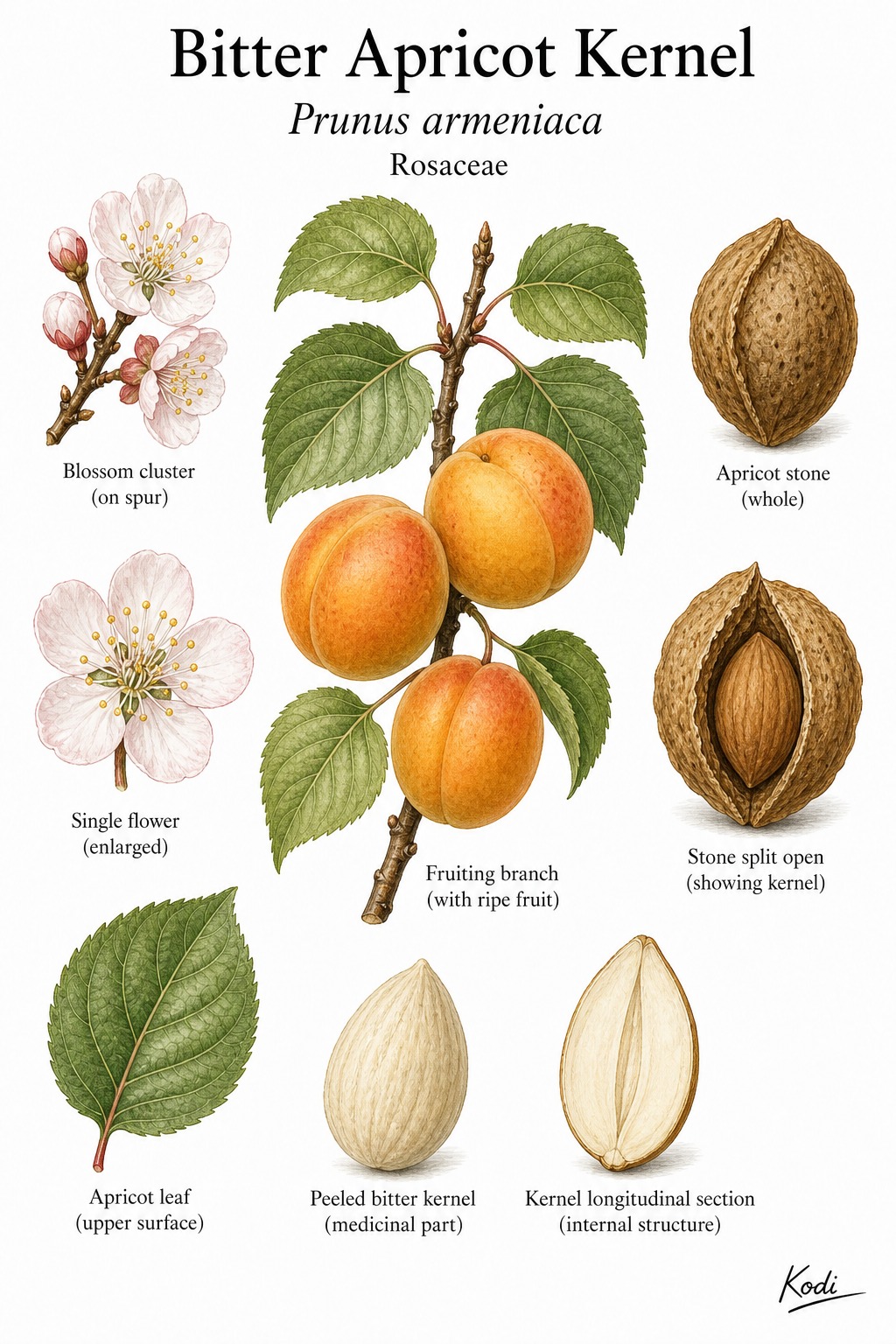
Known in TCM as Xing Ren (苦杏仁), this bitter, slightly warm herb enters the Lung and Large Intestine. Traditionally, it stops coughing and calms wheezing, most often applied for cough, asthma, and constipation. Modern research has identified Amygdalin (苦杏仁苷 Ku Xing Ren Zi) among its active constituents.
Part used: Seed
Also Known As
Latin: Semen Armeniacae | Pinyin: Xing Ren | Chinese: 苦杏仁
TCM Properties
- Taste
- bitter
- Temperature
- slightly warm
- Channels
- Lung, Large Intestine
Traditional Use
Primary Actions
- Stops coughing and calms wheezing … the most universally used single herb for cough and dyspnea in TCM; the bitter-descending action sends rebellious Lung Qi downward to stop cough; used in virtually all TCM cough formulas regardless of whether the pattern is Cold, Heat, Dry, or Damp
- Disperses Lung Qi … both Wind-Cold and Wind-Heat exterior patterns affecting the Lung; combined with warming herbs for Wind-Cold cough, cooling herbs for Wind-Heat or Wind-Dryness cough; the neutral-to-slightly-warm temperature allows versatile pairing across patterns
- Moistens the Intestines and moves bowels … Intestinal Dryness constipation from insufficient fluids or Lung Qi failing to descend; the rich oil content of the kernel lubricates the Large Intestine
Secondary Actions
- External antifungal and antiseptic … bitter apricot kernel oil applied topically for ringworm, tinea versicolor, and skin fungal infections; the amygdalin breakdown products create a locally hostile environment for fungi
- Anti-inflammatory analgesic (external) … kernel paste applied topically for joint pain and muscle aches in folk practice
Classic Formulas
- Ma Xing Shi Gan Tang (麻杏石甘汤) … foundational Lung Heat formula for cough and wheezing with Heat signs; Ma Huang, Xing Ren, Shi Gao, and Gan Cao; Xing Ren descends the Lung Qi while Ma Huang opens the Lung; from Shang Han Lun (Zhang Zhongjing); remains a frontline formula for bronchitis and asthma in TCM
- Sang Xing Tang (桑杏汤) … for Wind-Heat Dryness with fever, dry cough, and parched throat; Sang Ye, Xing Ren, Bei Sha Shen, Zhe Bei Mu, Dan Dou Chi, and Zhi Zi; the cooling-moistening companion to Ma Xing Shi Gan Tang; from Wen Bing Tiao Bian
- Ma Zi Ren Wan (麻子仁丸) … for Intestinal Dryness constipation from Spleen constraint; Xing Ren, Ma Zi Ren, Bai Shao, Zhi Shi, Hou Po, and Da Huang; lubricating and moving formula for dry pellet-like stools; from Jin Gui Yao Lue
- Xing Su San (杏苏散) … for cool-dry season Wind-Cold Dryness cough with slight chills; Xing Ren combined with Su Ye, Qian Hu, Jie Geng, Bei Mu, Fu Ling, Chen Pi, and Gan Cao
Classical References
- Shen Nong Ben Cao Jing: lists Xing He (apricot kernel) in the lower grade … 'bitter, warm, slightly toxic; principal actions on cough with rebellious Qi, throat obstruction, and intestinal dryness; used with care due to toxicity at large doses'
- Ben Cao Gang Mu (Li Shizhen): 'Xing Ren (杏仁) enters the Lung and Large Intestine … stops coughing, descends rebellious Lung Qi, disperses Wind-Cold and Wind-Heat, moistens the Intestines; slightly toxic from the amygdalin content … never use raw in large doses; cooking or processing eliminates most of the toxic HCN; the bitter kernel (Ku Xing Ren) is the TCM drug; the sweet kernel (Tian Xing Ren) is a food without the same descending-Qi medicinal strength'
Modern Research
Active Compounds
- Amygdalin (苦杏仁苷 Ku Xing Ren Zi) … cyanogenic glycoside; hydrolysed by gut β-glucosidase to benzaldehyde, glucose, and HCN; antitussive via central mechanism; antineoplastic in vitro at high concentrations; toxic in excess
- Fixed oils (~50% of kernel weight) … primarily oleic acid and linoleic acid; lubricant, anti-inflammatory; basis for intestinal moistening action
- Amygdalase and emulsin (β-glucosidases in kernel) … catalyse amygdalin hydrolysis; denatured by cooking, reducing HCN generation
- Prunasin (mono-glucoside of amygdalin) … cyanogenic precursor; minor fraction
- Phytosterols (β-sitosterol) and phospholipids … anti-inflammatory
Studied Effects
- Antitussive and antiasthmatic: amygdalin hydrolysis product benzaldehyde and trace HCN exert central antitussive effects by suppressing the cough reflex arc in the medulla; animal studies confirm dose-dependent cough suppression; bitter apricot kernel extract reduces airway hyperresponsiveness in ovalbumin-sensitised asthma models, validating the classical cough-calming indication
- Laxative and intestinal lubricant: high fixed oil content (>50% of kernel) softens stool and reduces colonic transit time in both animal models and clinical trials; the mechanism is purely physical lubricant … validates the classical Intestinal Dryness constipation indication; clinical evidence supports Ma Zi Ren Wan (containing Xing Ren) for functional constipation
- Amygdalin toxicity and therapeutic range: the LD50 for amygdalin in rodents corresponds to approximately 60 bitter apricot kernels consumed raw; standard TCM decoction dose (3–9 g, ~10 kernels) boiled for 20+ minutes destroys most amygdalase enzyme and reduces free HCN to <10% of raw levels; however raw kernel ingestion in children at 5–10 kernels has caused acute HCN poisoning cases in China
Safety & Interactions
Contraindications
- Yin Deficiency cough with dry throat and scanty sputum … the slightly warm, bitter-drying nature is less appropriate than moistening Lung herbs (Bei Sha Shen, Bai He) for pure Yin Deficiency Dryness
- Diarrhea and loose stools … lubricating action worsens Deficiency Cold diarrhea
Cautions
- Standard dose: 3–9 g dried kernel in decoction (boiled ≥20 minutes); ~10 kernels; ALWAYS cook … raw consumption significantly raises HCN exposure
- AMYGDALIN TOXICITY: raw bitter apricot kernels contain 0.5–3 mg HCN equivalent per kernel; 20 raw kernels can cause HCN poisoning in children; symptoms: nausea, vomiting, headache, dizziness, dyspnea, convulsions; antidote: IV hydroxocobalamin + sodium thiosulfate
- Distinguish from sweet apricot kernel (Tian Xing Ren / Nan Xing Ren) … the sweet variety (confectionery almond substitute) has 100-fold less amygdalin; some Chinese stores label sweet kernels as 'apricot kernel'; bitter variety for TCM, sweet for food
- Children: especially vulnerable to amygdalin poisoning; keep raw kernels away from children
Drug Interactions
- ACE inhibitors (enalapril, ramipril, lisinopril) … ACE inhibitor cough is a bradykinin-mediated adverse effect; Xing Ren's antitussive mechanism does not address this cause; clinical evidence does not support Xing Ren for ACE inhibitor cough; use may mask the indication to switch antihypertensive class
- Opioid antitussives and respiratory depressants (codeine, morphine, benzodiazepines) … additive respiratory depression risk at supraTherapeutic Xing Ren doses via amygdalin → HCN respiratory suppression pathway
Conditions
- Cough Research ★★★★★ JSON
- Asthma Traditional ★★★☆☆ JSON
- Constipation Research ★★★☆☆ JSON
- Bronchitis Traditional ★★★☆☆ JSON
- Upper Respiratory Infection Traditional ★★★☆☆ JSON
Frequently Asked Questions
What is Bitter Apricot Kernel used for?
Bitter Apricot Kernel is traditionally used to Stops coughing and calms wheezing … the most universally used single herb for cough and dyspnea in TCM; the bitter-descending action sends rebellious Lung Qi downward to stop cough; used in virtually all TCM cough formulas regardless of whether the pattern is Cold, Heat, Dry, or Damp, Disperses Lung Qi … both Wind-Cold and Wind-Heat exterior patterns affecting the Lung; combined with warming herbs for Wind-Cold cough, cooling herbs for Wind-Heat or Wind-Dryness cough; the neutral-to-slightly-warm temperature allows versatile pairing across patterns, Moistens the Intestines and moves bowels … Intestinal Dryness constipation from insufficient fluids or Lung Qi failing to descend; the rich oil content of the kernel lubricates the Large Intestine. Research has investigated its effects on: Antitussive and antiasthmatic: amygdalin hydrolysis product benzaldehyde and trace HCN exert central antitussive effects by suppressing the cough reflex arc in the medulla; animal studies confirm dose-dependent cough suppression; bitter apricot kernel extract reduces airway hyperresponsiveness in ovalbumin-sensitised asthma models, validating the classical cough-calming indication; Laxative and intestinal lubricant: high fixed oil content (>50% of kernel) softens stool and reduces colonic transit time in both animal models and clinical trials; the mechanism is purely physical lubricant … validates the classical Intestinal Dryness constipation indication; clinical evidence supports Ma Zi Ren Wan (containing Xing Ren) for functional constipation.
What are other names for Bitter Apricot Kernel?
Bitter Apricot Kernel is also known as Armeniaca. In TCM: 苦杏仁 (Xing Ren); Semen Armeniacae.
Is Bitter Apricot Kernel safe during pregnancy?
The safety of Bitter Apricot Kernel during pregnancy has not been established. Consult a qualified healthcare provider before use.
What are the contraindications for Bitter Apricot Kernel?
Bitter Apricot Kernel should not be used in: Yin Deficiency cough with dry throat and scanty sputum … the slightly warm, bitter-drying nature is less appropriate than moistening Lung herbs (Bei Sha Shen, Bai He) for pure Yin Deficiency Dryness; Diarrhea and loose stools … lubricating action worsens Deficiency Cold diarrhea. Consult a qualified practitioner before use.
Does Bitter Apricot Kernel interact with any medications?
Bitter Apricot Kernel may interact with: ACE inhibitors (enalapril, ramipril, lisinopril) … ACE inhibitor cough is a bradykinin-mediated adverse effect; Xing Ren's antitussive mechanism does not address this cause; clinical evidence does not support Xing Ren for ACE inhibitor cough; use may mask the indication to switch antihypertensive class; Opioid antitussives and respiratory depressants (codeine, morphine, benzodiazepines) … additive respiratory depression risk at supraTherapeutic Xing Ren doses via amygdalin → HCN respiratory suppression pathway. Always inform your healthcare provider of any herbal supplements you are taking.