Armand Clematis Stem
- Chinese
- 川木通
- Pinyin
- Chuan Mu Tong
- Latin
- Caulis Clematidis Armandii
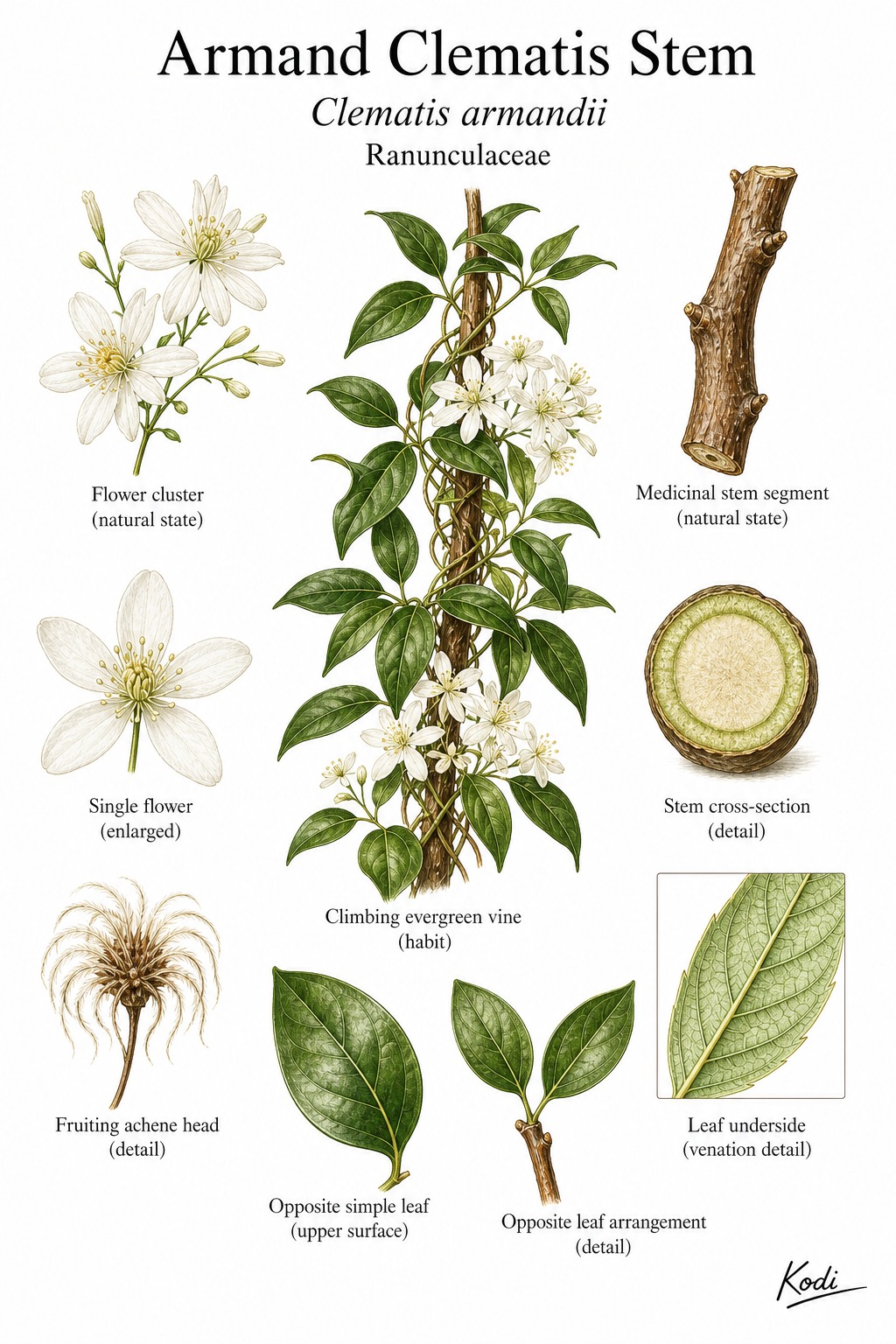
Known in TCM as Chuan Mu Tong (川木通), this bitter, cold herb enters the Heart, Small Intestine, and Urinary Bladder. Traditionally, it clears Heat and promotes urination, most often applied for urinary tract infection, amenorrhea, and rheumatism. Modern research has identified Clematosides A and B (triterpenoid saponins) among its active constituents.
Part used: Stem
Also Known As
Latin: Caulis Clematidis Armandii | Pinyin: Chuan Mu Tong | Chinese: 川木通
TCM Properties
- Taste
- bitter
- Temperature
- cold
- Channels
- Heart, Small Intestine, Urinary Bladder
Traditional Use
Primary Actions
- Clears Heat and promotes urination … urinary tract infection, dysuria, and burning painful urination (Re Lin, Heat Strangury) from Damp-Heat in the Urinary Bladder; the primary channel-clearing, Dampness-draining action; combined with Qu Mai, Hua Shi, and Bian Xu in Ba Zheng San
- Drains Heart Fire through the Small Intestine … oral ulcers, mouth sores, tongue sores, and restlessness-insomnia from Heart Fire descending along the Heart-Small Intestine axis; Dao Chi San is the foundational formula using this mechanism
- Promotes lactation … insufficient lactation from blocked channels and Qi obstruction; opens the Chong vessel and milk ducts; combined with Wang Bu Liu Xing and Chuan Shan Jia
- Opens channels and unblocks Bi syndrome … Wind-Damp Bi syndrome with joint obstruction, numbness, and pain; the 'Mu Tong' (wood-through) action penetrates and unblocks obstructed channels
Secondary Actions
- Promotes menstruation … amenorrhea from Heat-Damp obstruction in the Chong vessel; bitter-cold descending action opens blocked menstruation
- Anti-edema … edema from Qi and fluid stagnation; promotes urination and Triple Jiao fluid metabolism
Classic Formulas
- Ba Zheng San (八正散) … the definitive UTI formula in TCM; Mu Tong combined with Qu Mai, Hua Shi, Bian Xu, Zhi Zi, Da Huang, Deng Xin Cao, and Gan Cao; clears Damp-Heat from Urinary Bladder; from Tai Ping Hui Min He Ji Ju Fang; remains the foundational TCM formula for acute urinary tract infection
- Dao Chi San (导赤散) … for Heart-Small Intestine Fire axis with mouth sores, dark and burning urine, and restlessness; Mu Tong combined with Sheng Di Huang, Dan Zhu Ye, and Gan Cao; the most elegant small formula for Heart-Small Intestine Heat; from Xiao Er Yao Zheng Zhi Jue (Qian Yi)
- Tong Ru Dan (通乳丹) … for insufficient lactation; Mu Tong combined with Wang Bu Liu Xing, Chuan Shan Jia, and Bei Mu to unblock the milk channels
Classical References
- Ben Cao Gang Mu (Li Shizhen): 'Mu Tong (木通) … bitter, cold; enters Heart, Small Intestine, and Urinary Bladder; clears Heart Fire, drains Dampness via urination, opens channels, promotes lactation; the name Mu Tong (木通, wood-through) reflects the hollow stem structure through which Qi and fluids flow … used to open obstructions in channels'
- CRITICAL SAFETY NOTE … ARISTOLOCHIC ACID SUBSTITUTION: The historical TCM drug 'Mu Tong' included Guan Mu Tong (关木通, Caulis Aristolochiae Manshuriensis) from Aristolochia manshuriensis … which contains aristolochic acid I and II. Aristolochic acid is an IARC Group 1 carcinogen (urothelial carcinoma) and causes irreversible aristolochic acid nephropathy (AAN) with progressive renal fibrosis and end-stage renal failure. Guan Mu Tong was implicated in hundreds of cases of AAN internationally and was banned and removed from Chinese Pharmacopoeia 2005. Chuan Mu Tong (川木通, Caulis Clematidis Armandii) from Clematis armandii is the current Pharmacopoeia-approved replacement … it does NOT contain aristolochic acid and is considered safe. ALWAYS verify: any formula or product using 'Mu Tong' must specify Caulis Clematidis Armandii (Chuan Mu Tong) … if the Latin is Caulis Aristolochiae or the Chinese is 关木通 (Guan Mu Tong), it is the toxic variety and must not be dispensed.
Modern Research
Active Compounds
- Clematosides A and B (triterpenoid saponins) … anti-inflammatory, diuretic
- Clematichinenoside AR (hederagenin saponin) … anti-inflammatory, antinociceptive
- Oleanolic acid and hederagenin (pentacyclic triterpenoids) … anti-inflammatory
- Rutin, kaempferol-3-glucoside (flavonoids) … antioxidant, anti-inflammatory
- Clematiside C … novel triterpenoid with antiplatelet activity
Studied Effects
- Diuretic: Caulis Clematidis Armandii aqueous extracts significantly increase urine output in animal models; the diuretic mechanism involves increased glomerular filtration rate and reduced tubular reabsorption; validates the classical Ba Zheng San UTI-treating, urination-promoting indication
- Anti-inflammatory: clematis saponins inhibit COX-2, reduce PGE2 production, and suppress NF-κB activation in macrophage models; anti-inflammatory activity validates both the Bi syndrome (arthralgia) and Heat-clearing classical indications
- Safety vs Aristolochia: multiple chemical analyses confirm Caulis Clematidis Armandii contains NO detectable aristolochic acid (below LC-MS detection limits of 0.01 ppm); validates the safety of Chuan Mu Tong as a Guan Mu Tong substitute; WHO, Chinese Pharmacopoeia, and international regulatory bodies accept Chuan Mu Tong as safe
Safety & Interactions
Contraindications
- Pregnancy … bitter-cold, diuretic, and channel-opening action; risk of excessive fluid loss and downward-forcing Qi movement; avoid in all trimesters at therapeutic doses
- Spleen-Stomach Deficiency Cold … cold nature injures digestive Yang in Cold-deficient patients
Cautions
- Standard dose: 3–6 g in decoction; use Chuan Mu Tong (Caulis Clematidis Armandii) only … NEVER Guan Mu Tong (Aristolochia source); always verify Latin species name on dispensed formulas
- CRITICAL: Do NOT substitute Guan Mu Tong (关木通, Caulis Aristolochiae Manshuriensis) … it contains aristolochic acid, a nephrotoxin and Group 1 carcinogen; banned in China (2005) and many other countries
- Formulas: always check that 'Mu Tong' in prescriptions specifies Chuan Mu Tong; older formula texts and some pharmacies may still use the banned Aristolochia source; verify the supply chain
Conditions
- Urinary Tract Infection Traditional ★★★★☆ JSON
- Amenorrhea Traditional ★★★☆☆ JSON
- Rheumatism Traditional ★★☆☆☆ JSON
- Mastitis Traditional ★★☆☆☆ JSON
Frequently Asked Questions
What is Armand Clematis Stem used for?
Armand Clematis Stem is traditionally used to Clears Heat and promotes urination … urinary tract infection, dysuria, and burning painful urination (Re Lin, Heat Strangury) from Damp-Heat in the Urinary Bladder; the primary channel-clearing, Dampness-draining action; combined with Qu Mai, Hua Shi, and Bian Xu in Ba Zheng San, Drains Heart Fire through the Small Intestine … oral ulcers, mouth sores, tongue sores, and restlessness-insomnia from Heart Fire descending along the Heart-Small Intestine axis; Dao Chi San is the foundational formula using this mechanism, Promotes lactation … insufficient lactation from blocked channels and Qi obstruction; opens the Chong vessel and milk ducts; combined with Wang Bu Liu Xing and Chuan Shan Jia, Opens channels and unblocks Bi syndrome … Wind-Damp Bi syndrome with joint obstruction, numbness, and pain; the 'Mu Tong' (wood-through) action penetrates and unblocks obstructed channels. Research has investigated its effects on: Diuretic: Caulis Clematidis Armandii aqueous extracts significantly increase urine output in animal models; the diuretic mechanism involves increased glomerular filtration rate and reduced tubular reabsorption; validates the classical Ba Zheng San UTI-treating, urination-promoting indication; Anti-inflammatory: clematis saponins inhibit COX-2, reduce PGE2 production, and suppress NF-κB activation in macrophage models; anti-inflammatory activity validates both the Bi syndrome (arthralgia) and Heat-clearing classical indications.
What are other names for Armand Clematis Stem?
Armand Clematis Stem is also known as Clematidis. In TCM: 川木通 (Chuan Mu Tong); Caulis Clematidis Armandii.
Is Armand Clematis Stem safe during pregnancy?
Armand Clematis Stem is not recommended during pregnancy.
What are the contraindications for Armand Clematis Stem?
Armand Clematis Stem should not be used in: Pregnancy … bitter-cold, diuretic, and channel-opening action; risk of excessive fluid loss and downward-forcing Qi movement; avoid in all trimesters at therapeutic doses; Spleen-Stomach Deficiency Cold … cold nature injures digestive Yang in Cold-deficient patients. Consult a qualified practitioner before use.