Auricularia (Black Wood Ear)
- Chinese
- 黑木耳
- Pinyin
- Hei Mu Er
- Latin
- Auricularia auricula-judae
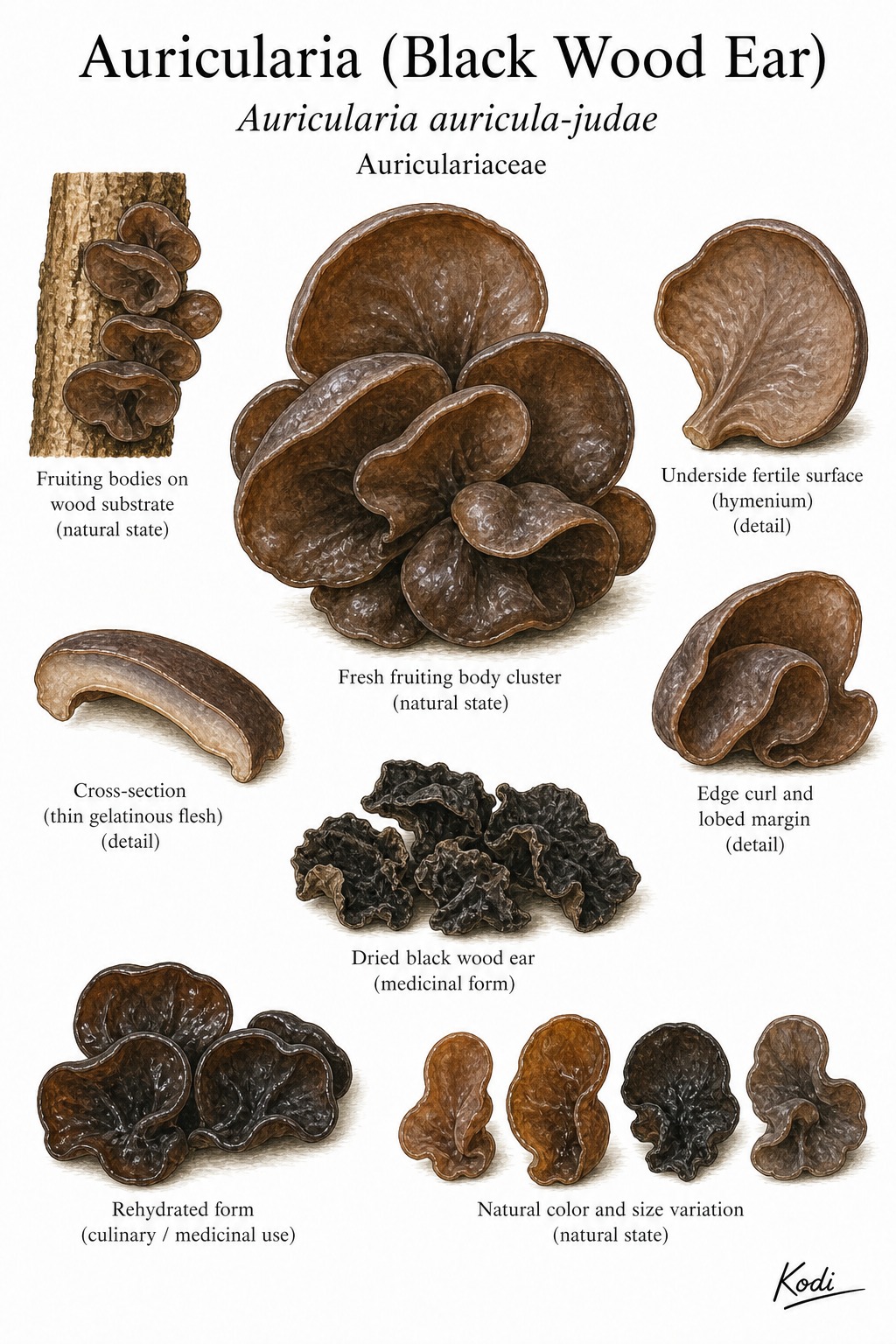
Known in TCM as Hei Mu Er (黑木耳), this sweet, neutral herb enters the Lung, Stomach, Liver, Spleen, Kidney, and Large Intestine. Traditionally, it cools Blood and stops bleeding, most often applied for constipation, hemorrhoids, and blood stasis. Modern research has identified Auricularia polysaccharides (AAPs) among its active constituents.
Part used: Fruiting body (fungus)
Also Known As
Latin: Auricularia auricula-judae | Pinyin: Hei Mu Er | Chinese: 黑木耳
TCM Properties
- Taste
- sweet
- Temperature
- neutral
- Channels
- Lung, Stomach, Liver, Spleen, Kidney, Large Intestine
Traditional Use
Primary Actions
- Cools Blood and stops bleeding … used for hemorrhoids, hematuria, uterine bleeding, and other mild bleeding patterns where an edible hemostatic is appropriate
- Nourishes Blood and gently dispels Blood stasis … commonly used in postpartum or traumatic recovery when deficiency and mild stasis coexist
- Moistens the Intestines and unblocks the bowels … addresses dry constipation, especially in the elderly or after illness
Secondary Actions
- Food-medicine support for vascular circulation … often incorporated into soups and stir-fries rather than used as a strong standalone decoction herb
- Provides gentle fluid and Yin support through diet therapy while remaining light enough for long-term culinary use
Classical References
- IMPORT NOTE: The source XLSX imported this entry as 'aruicularia' and the stub English name as 'Aruicularia'. The correct botanical spelling is Auricularia auricula-judae; the slug is retained unchanged for source continuity.
- FOOD-MEDICINE NOTE: Hei Mu Er (黑木耳, black wood ear) is not a root herb but the fruiting body of an edible fungus; it is widely used in Chinese diet therapy for Blood nourishment, gentle Blood movement, and bowel moistening.
- Materia medica and later food-therapy traditions distinguish Hei Mu Er from Bai Mu Er/Yin Er (white wood ear): the black fungus is used more for Blood and bowel indications, while the white fungus is used more for Lung and Stomach Yin nourishment.
Modern Research
Active Compounds
- Auricularia polysaccharides (AAPs) … major bioactive heteropolysaccharides with immunomodulatory and metabolic activity
- Beta-glucans and dietary fiber
- Melanin pigments
- Phenolic compounds
- Adenosine and related nucleosides
Studied Effects
- Hypoglycemic and antiglycation … degraded Auricularia polysaccharides inhibited advanced glycation end-product formation and improved glucose-handling models under high-sugar stress (PMID 32450039)
- Wound-healing and anti-inflammatory … Auricularia polysaccharides accelerated fibroblast migration and re-epithelialization in skin-repair models (PMID 33806146)
- Functional-food antioxidant and immunomodulatory activity … review literature identifies polysaccharides as the main contributors to antioxidant, lipid-lowering, and immune-regulating effects (PMID 33543932)
PubMed References
- Hypoglycemic Effect of the Degraded Polysaccharides from the Wood Ear Medicinal Mushroom Auricularia auricula-judae (Agaricomycetes) (2019)
- Skin Wound-Healing Potential of Polysaccharides from Medicinal Mushroom Auricularia auricula-judae (Bull.) (2021)
- Review on Auricularia auricula-judae as a Functional Food: Growth, Chemical Composition, and Biological Activities (2021)
Safety & Interactions
Contraindications
- Spleen deficiency with loose stools or active diarrhea
Cautions
- Use with caution when Dampness or chronic loose stool predominates … the slippery, moistening food-fungus nature may aggravate these patterns
- MSK page not found … drug interaction data not available from Memorial Sloan Kettering integrative medicine database
Conditions
- Constipation Traditional ★★★☆☆ JSON
- Hemorrhoids Traditional ★★★☆☆ JSON
- Blood Stasis Traditional ★★☆☆☆ JSON
- Diabetes Research ★★☆☆☆ JSON
Frequently Asked Questions
What is Auricularia (Black Wood Ear) used for?
Auricularia (Black Wood Ear) is traditionally used to Cools Blood and stops bleeding … used for hemorrhoids, hematuria, uterine bleeding, and other mild bleeding patterns where an edible hemostatic is appropriate, Nourishes Blood and gently dispels Blood stasis … commonly used in postpartum or traumatic recovery when deficiency and mild stasis coexist, Moistens the Intestines and unblocks the bowels … addresses dry constipation, especially in the elderly or after illness. Research has investigated its effects on: Hypoglycemic and antiglycation … degraded Auricularia polysaccharides inhibited advanced glycation end-product formation and improved glucose-handling models under high-sugar stress (PMID 32450039); Wound-healing and anti-inflammatory … Auricularia polysaccharides accelerated fibroblast migration and re-epithelialization in skin-repair models (PMID 33806146).
What are other names for Auricularia (Black Wood Ear)?
Auricularia (Black Wood Ear) is also known as Auricularia. In TCM: 黑木耳 (Hei Mu Er); Auricularia auricula-judae.
Is Auricularia (Black Wood Ear) safe during pregnancy?
The safety of Auricularia (Black Wood Ear) during pregnancy has not been established. Consult a qualified healthcare provider before use.
What are the contraindications for Auricularia (Black Wood Ear)?
Auricularia (Black Wood Ear) should not be used in: Spleen deficiency with loose stools or active diarrhea. Consult a qualified practitioner before use.