Balloonflower Root
- Chinese
- 桔梗
- Pinyin
- Jie Geng
- Latin
- Radix Platycodi
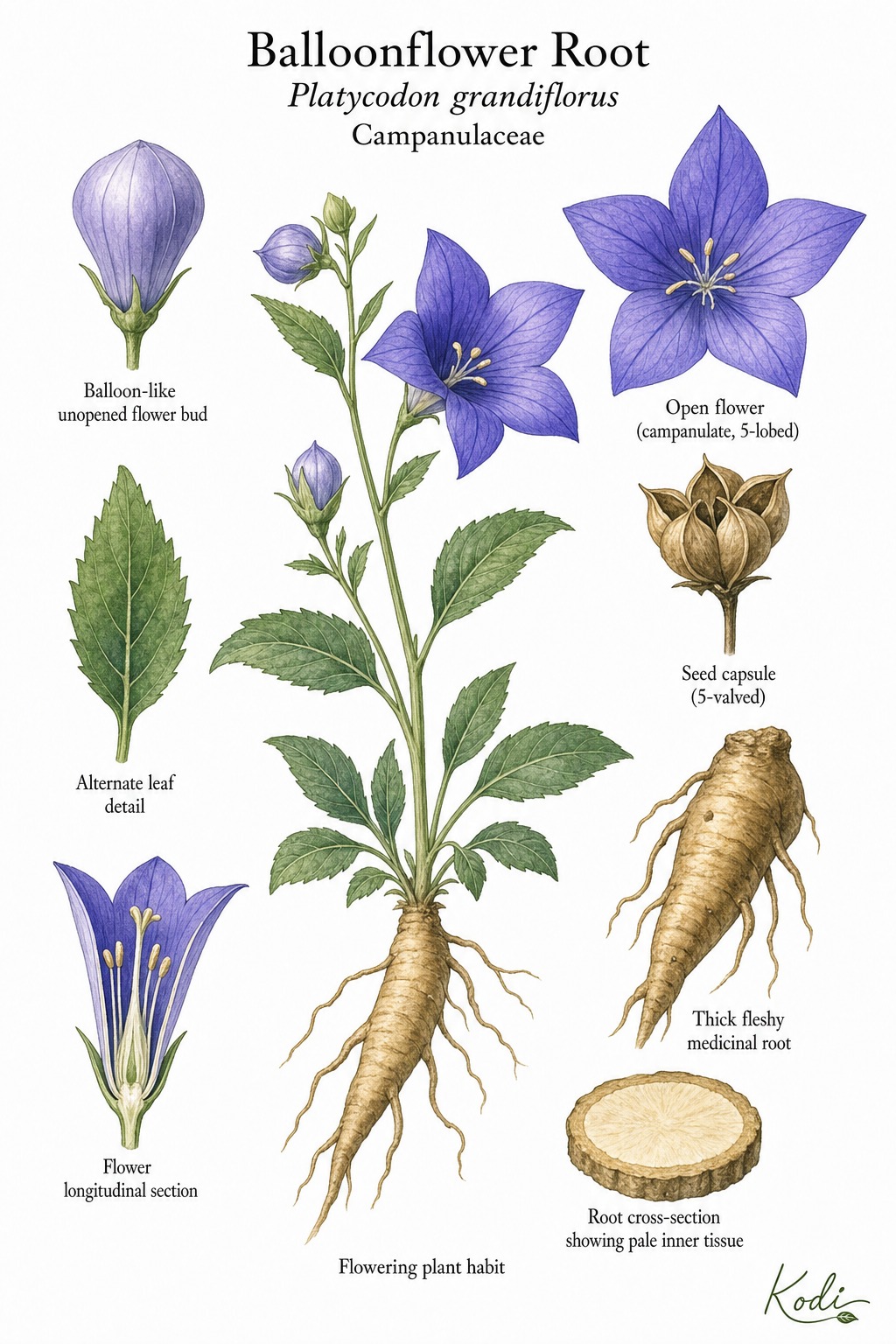
Known in TCM as Jie Geng (桔梗), this bitter and acrid, neutral herb enters the Lung and Stomach. Traditionally, it opens and disseminates Lung Qi while transforming phlegm - used for cough, wheezing, chest oppression, and copious sputum in both wind-cold and wind-heat patterns that obstruct the Lung, most often applied for cough, productive cough, and pharyngitis. Modern research has identified Platycodin among its active constituents.
Part used: Root
Also Known As
Latin: Radix Platycodi | Pinyin: Jie Geng | Chinese: 桔梗
TCM Properties
- Taste
- bitter, acrid
- Temperature
- neutral
- Channels
- Lung, Stomach
Traditional Use
Primary Actions
- Opens and disseminates Lung Qi while transforming phlegm - used for cough, wheezing, chest oppression, and copious sputum in both wind-cold and wind-heat patterns that obstruct the Lung.
- Benefits the throat and restores the voice - classically chosen for sore throat, hoarseness, painful swallowing, and loss of voice when phlegm, wind-heat, or toxicity blocks the throat gate.
- Expels pus and opens the Lung - a key herb for Lung abscess, throat suppuration, and toxic phlegm-heat with chest pain, fever, foul sputum, or blood-streaked expectoration.
- Guides the actions of other herbs upward to the chest and throat - frequently included to lift clear Lung Qi, facilitate formula delivery to the upper burner, and support cases with prolapse or diarrhea when clear Yang fails to rise.
Secondary Actions
- Used in respiratory formulas that need both diffusion and descent: it opens the Lung while companion herbs transform phlegm or clear Heat.
- Because Jie Geng is also a traditional medicine-food root in East Asia, moderate oral use is often considered gentler than its strong upward-directing action might suggest.
Classic Formulas
- Zhi Sou San (止嗽散) - from Yi Xue Xin Wu, where Jie Geng opens Lung Qi and helps stop lingering cough with phlegm after an external pathogen has not fully resolved.
- Yin Qiao San (银翘散) - from Wen Bing Tiao Bian, using Jie Geng to benefit the throat and ventilate the Lung in wind-heat sore throat, fever, and early febrile disease.
- Pu Ji Xiao Du Yin (普济消毒饮) - a classic toxin-clearing throat formula in which Jie Geng helps direct the action to the upper burner, relieving swollen painful throat and epidemic Heat-toxin presentations.
Classical References
- ALT-NAME NOTE: Sacred Lotus lists Bai Jie Geng as an alternate market name for the standard drug Jie Geng rather than as a distinct herb. The source XLSX imported the alternate name as the primary pinyin; this record corrects the main pinyin to Jie Geng while retaining the underlying slug.
- Shen Nong Ben Cao Jing and later materia medica traditions record Jie Geng for chest fullness, throat obstruction, and disorders where the Lung's diffusion and descent are impaired.
- Ben Cao Gang Mu and later formula traditions emphasize Jie Geng's special upward-guiding ability, explaining why it appears in both cough formulas and formulas that direct medicinals to the throat and chest.
Modern Research
Active Compounds
- Platycodin D (oleanane-type triterpenoid saponin) - signature expectorant and anti-inflammatory constituent of Jie Geng
- Platycodin D3 and related platycosides (triterpenoid saponins) - contribute immunomodulatory and respiratory effects
- Platycoside E (triterpenoid saponin precursor) - biotransforms toward more active platycodin metabolites
- Polygalacin D (triterpenoid saponin) - studied for anti-inflammatory and metabolic activity
- Lobetyolin (polyacetylene) - associated with anti-inflammatory and antitumor research interest
- Platycodon polysaccharides (heteropolysaccharides) - contribute immune and metabolic support effects
Studied Effects
- Comprehensive review literature describes anti-inflammatory, immunostimulatory, antitumor, antioxidant, antidiabetic, anti-obesity, hepatoprotective, and cardiovascular activities across extracts and isolated compounds (PMID 25666431)
- Macrophage inflammation modulation - platycodin D and platycodin D3 altered nitric oxide production and TNF-alpha secretion in activated RAW 264.7 cells, supporting mechanistic anti-inflammatory activity (PMID 15222978)
- Antitussive and expectorant effects - the platycoside fraction of Platycodonis Radix showed cough-suppressing and phlegm-resolving activity linked to active microbial metabolites (PMID 35245842)
- Renal protection research - platycodin D ameliorated cisplatin-induced nephrotoxicity in mice, extending the herb's modern pharmacology beyond respiratory indications (PMID 22617354)
PubMed References
- Platycodon grandiflorus - an ethnopharmacological, phytochemical and pharmacological review (2015)
- Platycodin D and D3 isolated from the root of Platycodon grandiflorum modulate the production of nitric oxide and secretion of TNF-alpha in activated RAW 264.7 cells (2004)
- Active microbial metabolites study on antitussive and expectorant effects and metabolic mechanisms of platycosides fraction of Platycodonis Radix (2022)
- Platycodin D, a triterpenoid sapoinin from Platycodon grandiflorum, ameliorates cisplatin-induced nephrotoxicity in mice (2012)
Safety & Interactions
Contraindications
- Chronic cough due to Yin deficiency
- Coughing or spitting blood due to Yin-deficient Fire
- Upward-rebellious Stomach Qi with significant nausea or vomiting
Cautions
- Excess dosage can cause nausea, vomiting, gastric irritation, sweating, or restlessness because of the herb's strongly ascending and saponin-rich nature
- Intravenous or parenteral use is contraindicated because platycodon saponins have hemolytic activity outside the digestive tract
- MSK page not found - drug interaction data not available from Memorial Sloan Kettering integrative medicine database
Conditions
- Cough Traditional ★★★★★ JSON
- Productive Cough Traditional ★★★★★ JSON
- Pharyngitis Traditional ★★★★☆ JSON
- Tonsillitis Traditional ★★★☆☆ JSON
- Pneumonia Traditional ★★★☆☆ JSON
Frequently Asked Questions
What is Balloonflower Root used for?
Balloonflower Root is traditionally used to Opens and disseminates Lung Qi while transforming phlegm - used for cough, wheezing, chest oppression, and copious sputum in both wind-cold and wind-heat patterns that obstruct the Lung., Benefits the throat and restores the voice - classically chosen for sore throat, hoarseness, painful swallowing, and loss of voice when phlegm, wind-heat, or toxicity blocks the throat gate., Expels pus and opens the Lung - a key herb for Lung abscess, throat suppuration, and toxic phlegm-heat with chest pain, fever, foul sputum, or blood-streaked expectoration., Guides the actions of other herbs upward to the chest and throat - frequently included to lift clear Lung Qi, facilitate formula delivery to the upper burner, and support cases with prolapse or diarrhea when clear Yang fails to rise.. Research has investigated its effects on: Comprehensive review literature describes anti-inflammatory, immunostimulatory, antitumor, antioxidant, antidiabetic, anti-obesity, hepatoprotective, and cardiovascular activities across extracts and isolated compounds (PMID 25666431); Macrophage inflammation modulation - platycodin D and platycodin D3 altered nitric oxide production and TNF-alpha secretion in activated RAW 264.7 cells, supporting mechanistic anti-inflammatory activity (PMID 15222978).
What are other names for Balloonflower Root?
Balloonflower Root is also known as Platycodi. In TCM: 桔梗 (Jie Geng); Radix Platycodi.
Is Balloonflower Root safe during pregnancy?
The safety of Balloonflower Root during pregnancy has not been established. Consult a qualified healthcare provider before use.
What are the contraindications for Balloonflower Root?
Balloonflower Root should not be used in: Chronic cough due to Yin deficiency; Coughing or spitting blood due to Yin-deficient Fire; Upward-rebellious Stomach Qi with significant nausea or vomiting. Consult a qualified practitioner before use.