Bamboo Juice (Bamboo Sap)
- Chinese
- 竹沥
- Pinyin
- Zhu Li
- Latin
- Succus Bambusae
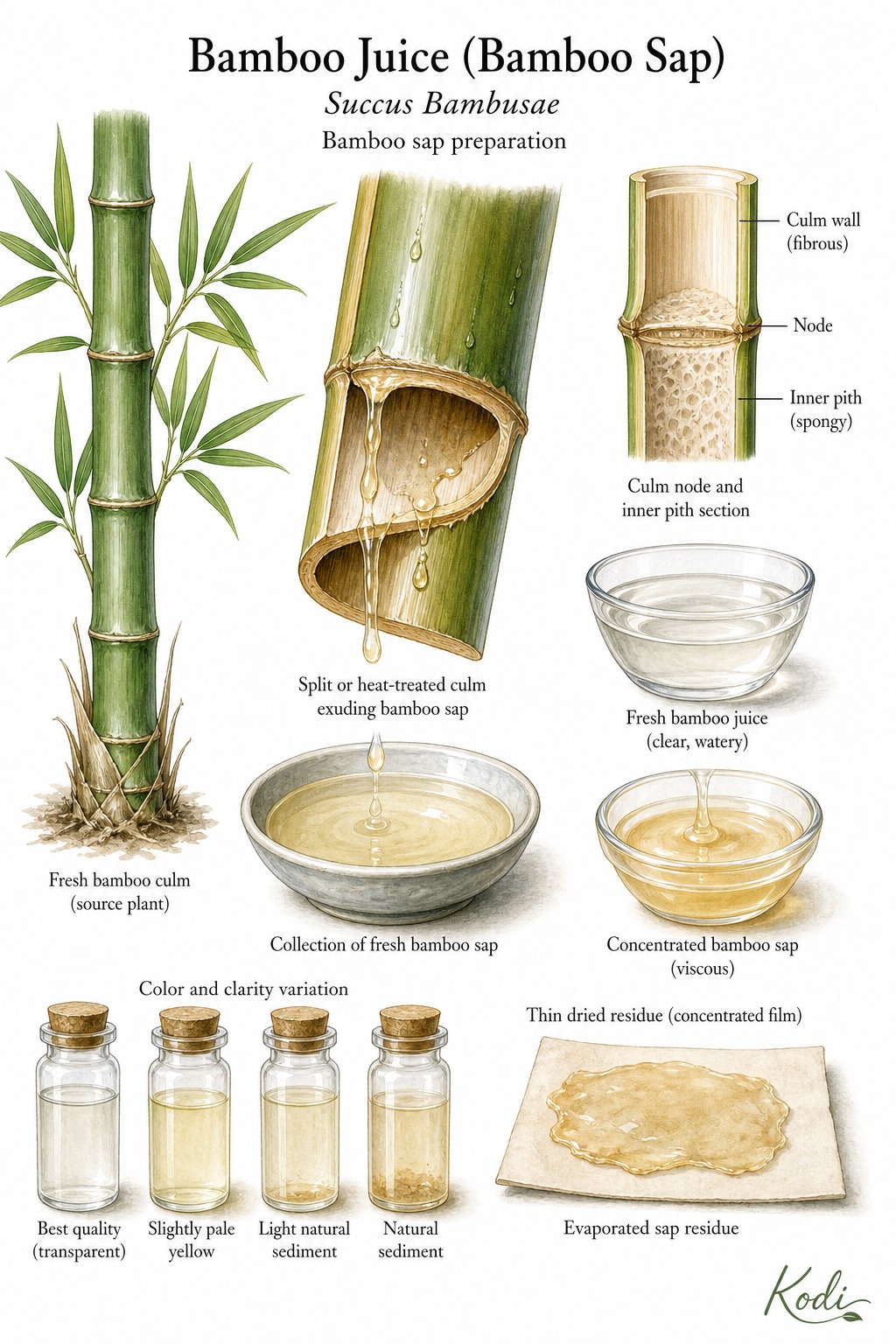
Known in TCM as Zhu Li (竹沥), this sweet and bitter, cold herb enters the Heart, Lung, and Stomach. Traditionally, it clears Heat and powerfully resolves phlegm - used for thick, sticky yellow sputum, chest oppression, wheezing, and severe phlegm-heat cough when milder bamboo medicinals such as Zhu Ru are not strong enough, most often applied for phlegm accumulation, productive cough, and bronchitis. Modern research has identified Carbohydrates among its active constituents.
Part used: Juice
Also Known As
Latin: Succus Bambusae | Pinyin: Zhu Li | Chinese: 竹沥
TCM Properties
- Taste
- sweet, bitter
- Temperature
- cold
- Channels
- Heart, Lung, Stomach
Traditional Use
Primary Actions
- Clears Heat and powerfully resolves phlegm - used for thick, sticky yellow sputum, chest oppression, wheezing, and severe phlegm-heat cough when milder bamboo medicinals such as Zhu Ru are not strong enough.
- Opens the orifices in phlegm-heat obstruction - classically selected for sudden unconsciousness, aphasia, locked jaw, or collapse patterns in which hot phlegm mists the Heart and blocks clear sensory function.
- Settles fright and stops convulsions - employed in pediatric febrile convulsions, epilepsy, or internal wind presentations where Heat and phlegm combine to agitate the spirit and channels.
- Penetrates the channels and collaterals - used for post-stroke paralysis, limb spasms, and stubborn phlegm lodged beyond the chest because its slippery sap is understood to travel where ordinary phlegm herbs do not.
Secondary Actions
- Moistens dryness while thinning difficult sputum, which makes it especially useful when hot phlegm is both tenacious and hard to expectorate.
- Is traditionally combined with fresh ginger juice so its extreme coldness does not injure the Stomach and its channel-penetrating action is enhanced.
Classic Formulas
- Ding Xian Wan (定痫丸) - a classical antiepileptic formula in which Zhu Li may be taken with ginger juice to address phlegm-heat, convulsions, and obstruction of the orifices.
- Qing Gong Tang (清宫汤) - warm-disease formula traditions add Zhu Li and pear juice when heat-phlegm clouds the Pericardium with agitation, delirium, or blocked consciousness.
- Qing Fei Tang (清肺汤) - respiratory heat-phlegm formula traditions use Zhu Li to dissolve stubborn phlegm, open the chest, and help descend constrained Lung Qi.
Classical References
- Ming Yi Bie Lu records Zhu Li as sweet, greatly cold, and non-toxic, indicating it for sudden wind-stroke, vexation, great Heat in the chest, and disorders of phlegm obstruction.
- Ben Cao Yan Yi praised Zhu Li as a substance able to treat phlegm lodged anywhere in the body, including the chest, limbs, organs, channels, and membranes, which underlies its channel-penetrating reputation.
- Danxi lineage teaching emphasized that Zhu Li should be taken with ginger juice because without ginger it does not effectively travel through the channels to reach lodged phlegm.
Modern Research
Active Compounds
- Carbohydrates (major soluble fraction) - the dominant identified component class in bamboo juice oral liquids and likely responsible for much of the product matrix
- Amino acids (small-molecule nutrient fraction) - repeatedly identified in constituent surveys and relevant to nutritional and medicinal quality control
- Flavonoids (polyphenolic constituents) - minor bioactive compounds referenced in modern compositional reviews of Succus Bambusae
- Volatile constituents (aromatic low-molecular compounds) - used as quality markers in GC/MS fingerprinting studies of commercial oral liquids
- Organic acids including salicylic acid and benzoic acid - small acidic constituents relevant to preservative overlap and product safety interpretation
Studied Effects
- Respiratory-use product profiling - bamboo juice oral liquids are widely marketed in China for cough and phlegm, and NMR plus UPLC-Q-TOF-MS work identified 26 main compounds while also detecting potentially excessive added preservatives in some products (PMID 33184510)
- Constituent review work - a PubMed-indexed review found abundant volatile ingredients, amino acids, flavonoids, trace elements, and vitamins in Succus Bambusae, underscoring its medicinal-edible profile while also highlighting weak quality standards (PMID 34296572)
- Quality consistency research - GC/MS fingerprinting of 40 oral-liquid batches identified 29 volatiles and six proposed quality markers, showing major intermanufacturer variability that may affect safety and effectiveness in practice (PMID 34532912)
- Modern pharmaceutical use in cough-phlegm preparations - mass spectrometric profiling of Fufang Xianzhuli Ye identified 106 constituents in a classical bamboo-juice-based respiratory oral liquid used clinically for cough and phlegm (PMID 36289055)
PubMed References
- Identification and quantitation of the actual active components in bamboo juice and its oral liquid by NMR and UPLC-Q-TOF-MS (2021)
- [Research progress on chemical constituents and quality control methods of Succus Bambusae] (2021)
- Quality assessment of Succus Bambusae oral liquids based on gas chromatography/mass spectrometry fingerprints and chemometrics (2021)
- Ultra-high-performance liquid chromatography quadrupole time-of-flight tandem mass spectrometry coupled with three-step data post-processing techniques for comprehensive profiling of the multiple components in Fufang Xianzhuli Ye (2022)
Safety & Interactions
Contraindications
- Cold-phlegm or damp-phlegm patterns without Heat
- Spleen deficiency with loose stools or chronic diarrhea
- Cough due to wind-cold exterior invasion without interior heat transformation
Cautions
- Because Zhu Li is very cold and slippery, it can injure the Stomach and intestines in patients with weak digestion, cold constitution, or chronic loose stools
- Commercial xian zhu li oral liquids may contain preservatives such as benzoic acid, sorbic acid, or ethylparaben, so product quality matters more than with ordinary crude herbs
- MSK page not found - drug interaction data not available from Memorial Sloan Kettering integrative medicine database
Conditions
- Phlegm Accumulation Traditional ★★★★★ JSON
- Productive Cough Traditional ★★★★☆ JSON
- Bronchitis Traditional ★★★☆☆ JSON
- Stroke Traditional ★★★☆☆ JSON
- Pneumonia Traditional ★★☆☆☆ JSON
Frequently Asked Questions
What is Bamboo Juice (Bamboo Sap) used for?
Bamboo Juice (Bamboo Sap) is traditionally used to Clears Heat and powerfully resolves phlegm - used for thick, sticky yellow sputum, chest oppression, wheezing, and severe phlegm-heat cough when milder bamboo medicinals such as Zhu Ru are not strong enough., Opens the orifices in phlegm-heat obstruction - classically selected for sudden unconsciousness, aphasia, locked jaw, or collapse patterns in which hot phlegm mists the Heart and blocks clear sensory function., Settles fright and stops convulsions - employed in pediatric febrile convulsions, epilepsy, or internal wind presentations where Heat and phlegm combine to agitate the spirit and channels., Penetrates the channels and collaterals - used for post-stroke paralysis, limb spasms, and stubborn phlegm lodged beyond the chest because its slippery sap is understood to travel where ordinary phlegm herbs do not.. Research has investigated its effects on: Respiratory-use product profiling - bamboo juice oral liquids are widely marketed in China for cough and phlegm, and NMR plus UPLC-Q-TOF-MS work identified 26 main compounds while also detecting potentially excessive added preservatives in some products (PMID 33184510); Constituent review work - a PubMed-indexed review found abundant volatile ingredients, amino acids, flavonoids, trace elements, and vitamins in Succus Bambusae, underscoring its medicinal-edible profile while also highlighting weak quality standards (PMID 34296572).
What are other names for Bamboo Juice (Bamboo Sap)?
Bamboo Juice (Bamboo Sap) is also known as Bambusa. In TCM: 竹沥 (Zhu Li); Succus Bambusae.
Is Bamboo Juice (Bamboo Sap) safe during pregnancy?
The safety of Bamboo Juice (Bamboo Sap) during pregnancy has not been established. Consult a qualified healthcare provider before use.
What are the contraindications for Bamboo Juice (Bamboo Sap)?
Bamboo Juice (Bamboo Sap) should not be used in: Cold-phlegm or damp-phlegm patterns without Heat; Spleen deficiency with loose stools or chronic diarrhea; Cough due to wind-cold exterior invasion without interior heat transformation. Consult a qualified practitioner before use.