Bark of Largeleaf Chinese Ash
- Chinese
- 秦皮
- Pinyin
- Qin Pi
- Latin
- Cortex Fraxini
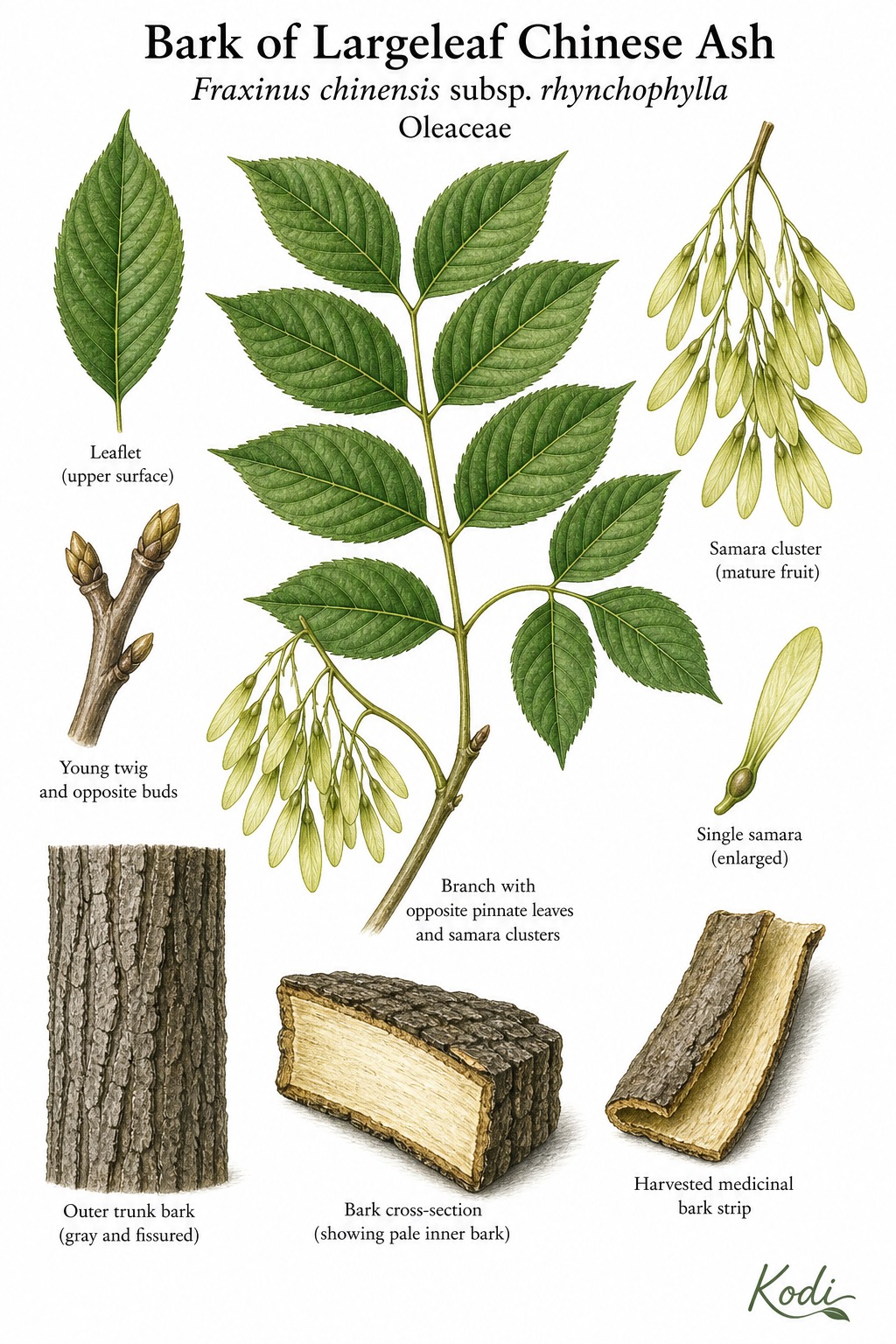
Known in TCM as Qin Pi (秦皮), this bitter, cold herb enters the Gallbladder, Stomach, Large Intestine, and Liver. Traditionally, it clears damp-heat from the intestines - a classic bark for diarrhea, dysentery, abdominal urgency, and foul stools when heat and dampness lodge in the Large Intestine, most often applied for diarrhea, dysentery, and leukorrhea. Modern research has identified Esculin among its active constituents.
Part used: Bark
Also Known As
Latin: Cortex Fraxini | Pinyin: Qin Pi | Chinese: 秦皮
TCM Properties
- Taste
- bitter
- Temperature
- cold
- Channels
- Gallbladder, Stomach, Large Intestine, Liver
Traditional Use
Primary Actions
- Clears damp-heat from the intestines - a classic bark for diarrhea, dysentery, abdominal urgency, and foul stools when heat and dampness lodge in the Large Intestine.
- Astringes and contains damp-heat discharge - used for leukorrhea and chronic damp-heat seepage where the herb's bitter, cooling, and mildly restraining qualities help dry and hold at the same time.
- Clears Liver heat and improves vision - classically valued for red, swollen, painful eyes or hot eye discharge, especially when intestinal damp-heat and liver heat coexist.
- Resolves toxic-heat irritation without the harshness of more drastic purgatives - useful when heat must be dried and cleared but the patient still needs some containment rather than strong downward draining.
Secondary Actions
- Often decocted as an external wash for hot, irritated eyes, extending its use beyond internal gastrointestinal patterns.
- Because it is both cold and somewhat astringent, Qin Pi is frequently chosen in lingering intestinal or genital damp-heat rather than in very acute excess that needs a stronger purgative strategy.
Classic Formulas
- Bai Tou Weng Tang (白头翁汤) - from Shang Han Lun, where Qin Pi assists in clearing toxic-heat dysentery with abdominal pain, tenesmus, and blood or pus in the stool.
- Qin Pi Tang (秦皮汤) - later traditional decoction variants built around Qin Pi for either damp-heat dysentery or red painful eye disease, reflecting the herb's dual intestinal and ophthalmic roles.
- Classical eye-wash preparations frequently combine Qin Pi with Ju Hua and other cooling herbs when damp-heat or Liver heat inflames the eyes.
Classical References
- Shen Nong Ben Cao Jing lists Qin Pi among the bitter-cold heat-clearing barks, a foundation for its later use in dysentery and hot eye disease.
- TCM Wiki and Me & Qi both preserve the standard profile of Qin Pi as bitter and cold, entering the intestines and liver-related channels to clear damp-heat while also addressing ocular inflammation.
- Later clinical traditions emphasize that Qin Pi is especially useful when damp-heat diarrhea and lower-burner discharge persist long enough to require both clearing and a light restraining quality.
Modern Research
Active Compounds
- Esculin (coumarin glycoside) - one of the best-known marker compounds in Qin Pi bark with anti-inflammatory relevance
- Esculetin (coumarin aglycone) - widely studied for anti-inflammatory, antioxidant, and dermatologic effects
- Fraxin (coumarin glycoside) - contributes anti-inflammatory and antimicrobial activity
- Fraxetin (coumarin derivative) - linked with antioxidant and vascular-protective research
- Fraxicoumarin and related isocoumarins - recently characterized bark constituents with anti-inflammatory activity
Studied Effects
- Recent review literature summarizes antibacterial, anti-inflammatory, antioxidant, anticancer, neuroprotective, and anti-hyperuricemic activities across the medicinal Fraxinus species recognized in Chinese pharmacopoeia (PMID 40067772)
- Anti-inflammatory bark constituents - fraxicoumarin and related isocoumarins from Fraxinus chinensis subsp. rhynchophylla inhibited nitric oxide, iNOS, and COX-2 signaling in activated macrophages (PMID 31960706)
- Esculetin from Fraxinus rhynchophylla attenuated atopic skin inflammation and reduced inflammatory cytokine expression in experimental dermatitis models (PMID 29656211)
- Antimicrobial studies on bark-derived coumarins support the traditional use of Qin Pi in heat-toxin and damp-heat disorders involving microbial overgrowth (PMID 28976788)
PubMed References
- Phytochemical Constituents and Pharmacological Properties of Fraxinus spp.: A Review (2025)
- Anti-inflammatory isocoumarins from the bark of Fraxinus chinensis subsp. rhynchophylla (2021)
- Esculetin from Fraxinus rhynchophylla attenuates atopic skin inflammation by inhibiting the expression of inflammatory cytokines (2018)
- Antimicrobial Effects of 7,8-Dihydroxy-6-Methoxycoumarin and 7-Hydroxy-6-Methoxycoumarin Analogues against Foodborne Pathogens and the Antimicrobial Mechanisms Associated with Membrane Permeability (2017)
Safety & Interactions
Contraindications
- Spleen and Stomach deficiency-cold with chronic loose stools
- Absence of damp-heat or liver-heat signs
Cautions
- Its bitter-cold nature can weaken appetite or aggravate cold digestion if used too long in depleted patients
- Because Qin Pi has a mild astringing quality, it is better matched to damp-heat dysentery than to early external-stage disorders that still need pathogen release
- MSK page not found - drug interaction data not available from Memorial Sloan Kettering integrative medicine database
Conditions
- Diarrhea Traditional ★★★★☆ JSON
- Dysentery Traditional ★★★★★ JSON
- Leukorrhea Traditional ★★★☆☆ JSON
- Urinary Tract Infection Traditional ★★☆☆☆ JSON
Frequently Asked Questions
What is Bark of Largeleaf Chinese Ash used for?
Bark of Largeleaf Chinese Ash is traditionally used to Clears damp-heat from the intestines - a classic bark for diarrhea, dysentery, abdominal urgency, and foul stools when heat and dampness lodge in the Large Intestine., Astringes and contains damp-heat discharge - used for leukorrhea and chronic damp-heat seepage where the herb's bitter, cooling, and mildly restraining qualities help dry and hold at the same time., Clears Liver heat and improves vision - classically valued for red, swollen, painful eyes or hot eye discharge, especially when intestinal damp-heat and liver heat coexist., Resolves toxic-heat irritation without the harshness of more drastic purgatives - useful when heat must be dried and cleared but the patient still needs some containment rather than strong downward draining.. Research has investigated its effects on: Recent review literature summarizes antibacterial, anti-inflammatory, antioxidant, anticancer, neuroprotective, and anti-hyperuricemic activities across the medicinal Fraxinus species recognized in Chinese pharmacopoeia (PMID 40067772); Anti-inflammatory bark constituents - fraxicoumarin and related isocoumarins from Fraxinus chinensis subsp. rhynchophylla inhibited nitric oxide, iNOS, and COX-2 signaling in activated macrophages (PMID 31960706).
What are other names for Bark of Largeleaf Chinese Ash?
Bark of Largeleaf Chinese Ash is also known as Fraxini. In TCM: 秦皮 (Qin Pi); Cortex Fraxini.
Is Bark of Largeleaf Chinese Ash safe during pregnancy?
The safety of Bark of Largeleaf Chinese Ash during pregnancy has not been established. Consult a qualified healthcare provider before use.
What are the contraindications for Bark of Largeleaf Chinese Ash?
Bark of Largeleaf Chinese Ash should not be used in: Spleen and Stomach deficiency-cold with chronic loose stools; Absence of damp-heat or liver-heat signs. Consult a qualified practitioner before use.