Bark of Shrubalthea
- Chinese
- 木槿皮
- Pinyin
- Mu Jin Pi
- Latin
- Cortex Hibisci
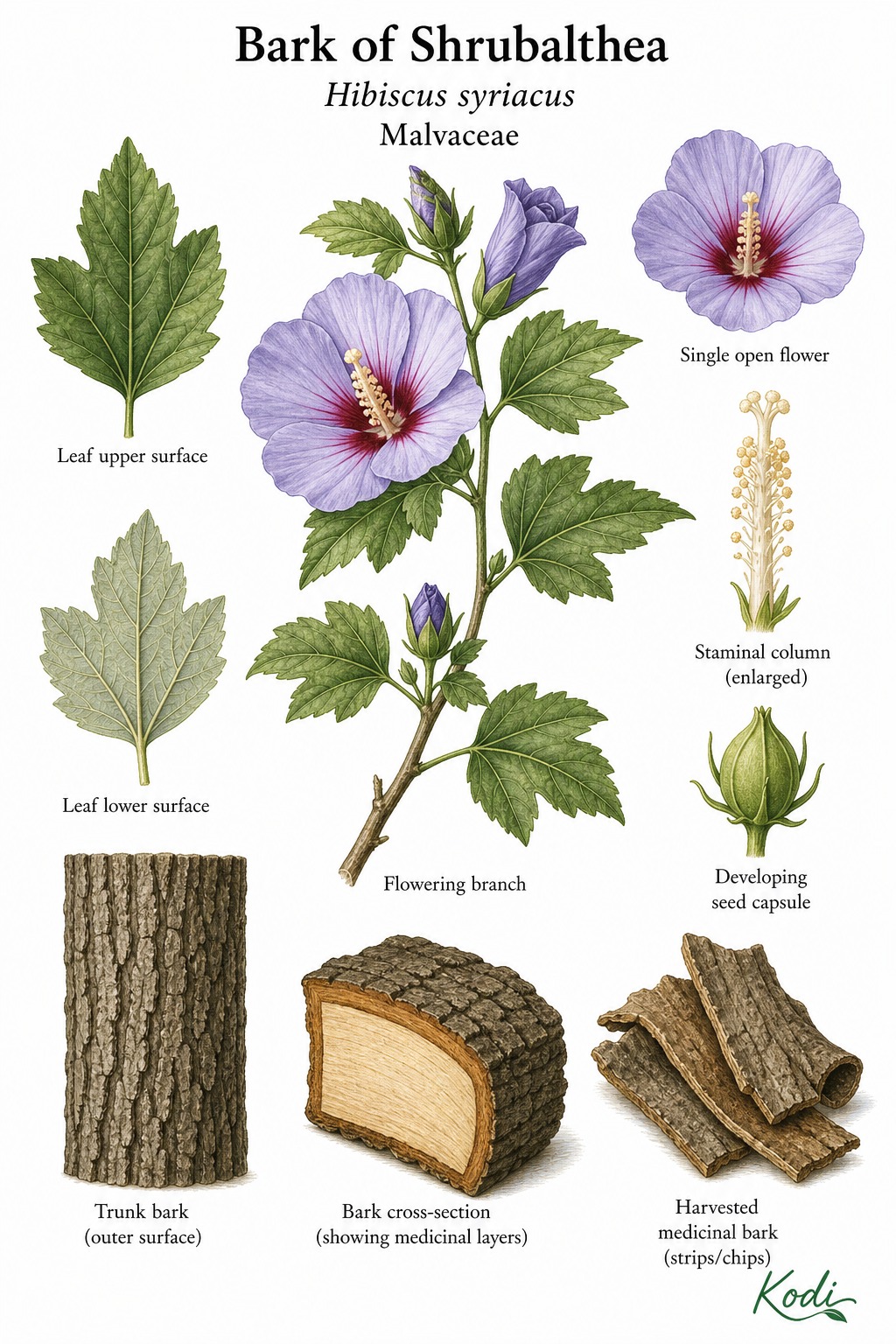
Known in TCM as Mu Jin Pi (木槿皮), this bitter and sweet, cool herb enters the Large Intestine, Liver, and Spleen. Traditionally, it clears damp-heat from the intestines - used for dysenteric diarrhea and lingering damp-heat bowel disorders when heat, mucus, and tenesmus are present but a harsh purgative is unnecessary, most often applied for diarrhea, leukorrhea, and fungal infection. Modern research has identified Nonanoic among its active constituents.
Part used: Bark
Also Known As
Latin: Cortex Hibisci | Pinyin: Mu Jin Pi | Chinese: 木槿皮
TCM Properties
- Taste
- bitter, sweet
- Temperature
- cool
- Channels
- Large Intestine, Liver, Spleen
Traditional Use
Primary Actions
- Clears damp-heat from the intestines - used for dysenteric diarrhea and lingering damp-heat bowel disorders when heat, mucus, and tenesmus are present but a harsh purgative is unnecessary.
- Kills parasites and relieves itching - a classic choice for scabies, tinea, vaginal itching, and damp skin lesions, especially when used externally as a wash or soak.
- Dries dampness and addresses lower-burner discharge - used for leukorrhea and genital itching when damp-heat creates irritating secretions or localized inflammation.
- Resolves hemorrhoidal or perineal damp-heat irritation - later practice extends Mu Jin Pi to hot, swollen, itchy lesions around the anal or vulvar region.
Secondary Actions
- External use is especially important in this herb's tradition, and many regional prescriptions rely on decocted washes rather than internal use alone.
- Compared with more famous heat-clearing antipruritics such as Ku Shen, Mu Jin Pi is often chosen when dampness, itching, and bowel heat overlap.
Classic Formulas
- Mu Jin Pi wash preparations (木槿皮洗方) - traditional decocted washes for scabies, damp itching, tinea, and genital irritation, often combined with other bitter antipruritic herbs.
- Regional damp-heat intestinal prescriptions combine Mu Jin Pi with Qin Pi, Huang Bai, or Ku Shen for dysentery and leukorrhea rather than relying on one universally canonical early formula.
- Later folk prescriptions also use powdered or wine-processed bark externally for hemorrhoids, itching skin eruptions, and chronic moist lesions.
Classical References
- Later materia medica and teaching compendia describe Mu Jin Pi as a cool, bitter-sweet bark that kills parasites, stops itching, and clears damp-heat from both the intestines and lower burner.
- The herb is more prominent in regional and practical dermatologic-gynecologic tradition than in the earliest Shang Han Lun formula canon, which explains the relative scarcity of famous named classical prescriptions.
- Traditional usage repeatedly stresses the value of external washing methods, especially for fungal, parasitic, or moist itching lesions.
Modern Research
Active Compounds
- Nonanoic acid (fatty acid) - isolated from root bark as an antifungal constituent relevant to the herb's traditional topical use
- Azelaic acid or nonanedioic acid (dicarboxylic acid) - part of the fatty-acid-rich fraction associated with anti-inflammatory skin effects
- Betulin (triterpenoid) - identified in bark studies and linked with anti-inflammatory and wound-supportive activity
- Erythrotriol (triterpenoid alcohol) - contributes to the triterpenoid profile of the bark
- Lignan glycosides and phenolic constituents - support antioxidant and anti-inflammatory effects in broader Hibiscus bark research
Studied Effects
- Classical bark chemistry studies identified betulin, erythrotriol, and related constituents from Hibiscus syriacus bark, establishing a defined phytochemical basis for the crude drug (PMID 8323683)
- Nonanoic acid isolated from Hibiscus syriacus root bark showed antifungal activity, directly supporting the traditional topical use of Mu Jin Pi for fungal and itching skin disease (PMID 22870060)
- A fatty-acid-rich fraction of Hibiscus syriacus alleviated atopic dermatitis-like skin lesions by reducing inflammatory and barrier-disrupting signals in experimental models (PMID 40805794)
- Taken together, modern data fit the traditional emphasis on topical anti-inflammatory and antipruritic application better than on heavy systemic use.
PubMed References
- Chemical constituents from the bark of Hibiscus syriacus (1993)
- Studies on isolation of naturally occurring biologically active principles. IV. Antifungal constituents in the root bark of Hibiscus syriacus L. (2012)
- Fatty Acid-Rich Fraction of Hibiscus syriacus L. Alleviates Atopic Dermatitis-like Skin Lesions by Regulating Skin Barrier and Inflammasome Pathways (2024)
Safety & Interactions
Contraindications
- Spleen and Stomach deficiency-cold without damp-heat signs
- Dry, non-itching skin conditions without fungal, parasitic, or damp components
Cautions
- Internal use is usually secondary to topical or short-course treatment and can be overly cooling for weak digestive patients if used casually
- When used externally, avoid highly abraded skin unless the preparation has been properly diluted and tolerated
- MSK page not found - drug interaction data not available from Memorial Sloan Kettering integrative medicine database
Conditions
- Diarrhea Traditional ★★★☆☆ JSON
- Leukorrhea Traditional ★★★☆☆ JSON
- Fungal Infection Traditional ★★★★☆ JSON
- Eczema Traditional ★★★★☆ JSON
- Hemorrhoids Traditional ★★☆☆☆ JSON
Frequently Asked Questions
What is Bark of Shrubalthea used for?
Bark of Shrubalthea is traditionally used to Clears damp-heat from the intestines - used for dysenteric diarrhea and lingering damp-heat bowel disorders when heat, mucus, and tenesmus are present but a harsh purgative is unnecessary., Kills parasites and relieves itching - a classic choice for scabies, tinea, vaginal itching, and damp skin lesions, especially when used externally as a wash or soak., Dries dampness and addresses lower-burner discharge - used for leukorrhea and genital itching when damp-heat creates irritating secretions or localized inflammation., Resolves hemorrhoidal or perineal damp-heat irritation - later practice extends Mu Jin Pi to hot, swollen, itchy lesions around the anal or vulvar region.. Research has investigated its effects on: Classical bark chemistry studies identified betulin, erythrotriol, and related constituents from Hibiscus syriacus bark, establishing a defined phytochemical basis for the crude drug (PMID 8323683); Nonanoic acid isolated from Hibiscus syriacus root bark showed antifungal activity, directly supporting the traditional topical use of Mu Jin Pi for fungal and itching skin disease (PMID 22870060).
What are other names for Bark of Shrubalthea?
Bark of Shrubalthea is also known as Hibisci. In TCM: 木槿皮 (Mu Jin Pi); Cortex Hibisci.
Is Bark of Shrubalthea safe during pregnancy?
The safety of Bark of Shrubalthea during pregnancy has not been established. Consult a qualified healthcare provider before use.
What are the contraindications for Bark of Shrubalthea?
Bark of Shrubalthea should not be used in: Spleen and Stomach deficiency-cold without damp-heat signs; Dry, non-itching skin conditions without fungal, parasitic, or damp components. Consult a qualified practitioner before use.