Bark of Silktree Albizzia
- Chinese
- 合欢皮
- Pinyin
- He Huan Pi
- Latin
- Cortex Albiziae
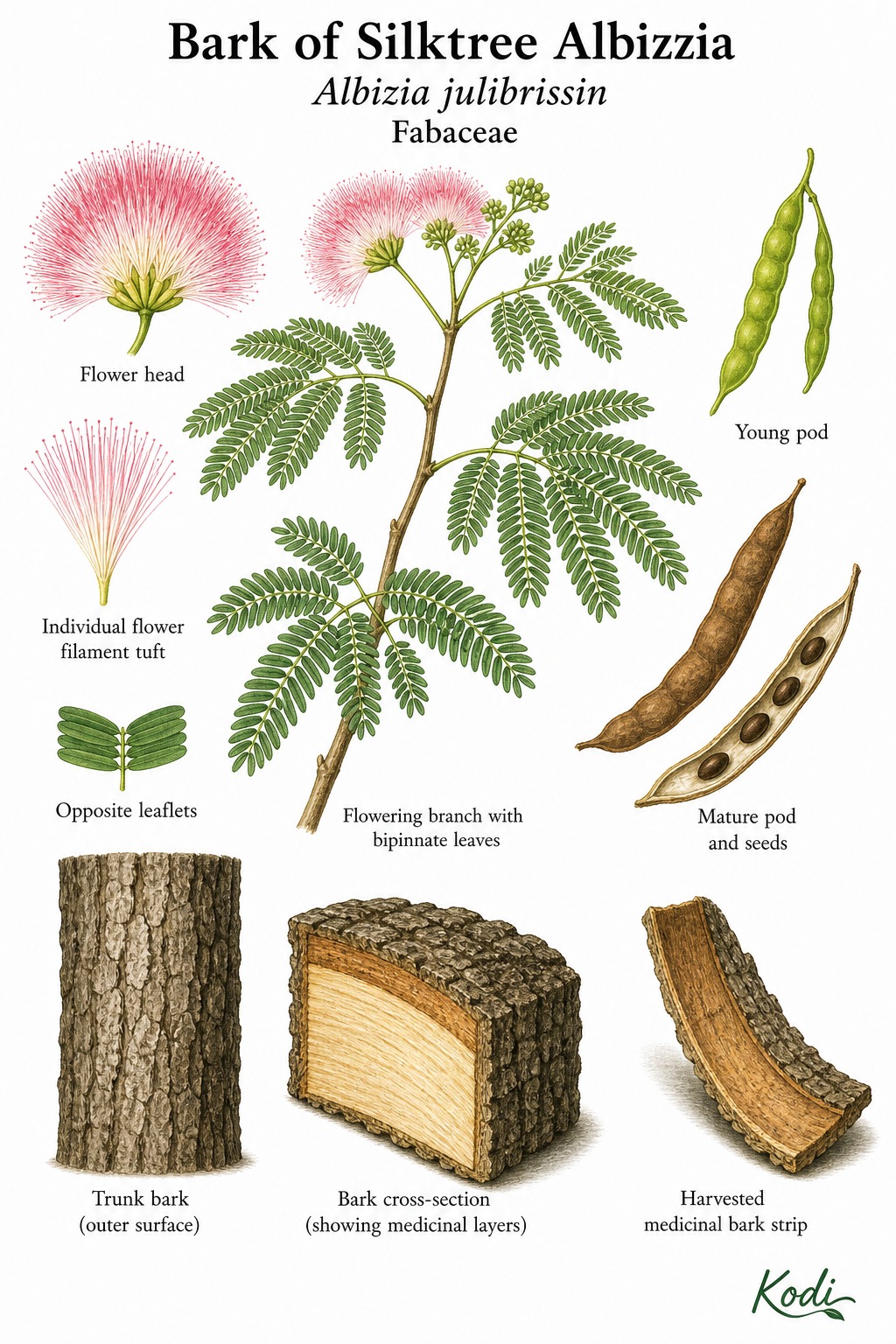
Known in TCM as He Huan Pi (合欢皮), this sweet, neutral herb enters the Heart, Liver, and Lung. Traditionally, it calms the spirit and relieves emotional constraint - the signature bark herb for depression, anxiety, insomnia, irritability, grief, and constrained Liver-Heart disharmony when the Shen cannot rest, most often applied for insomnia, anxiety, and depression. Modern research has identified Julibroside among its active constituents.
Part used: Bark
Also Known As
Latin: Cortex Albiziae | Pinyin: He Huan Pi | Chinese: 合欢皮
TCM Properties
- Taste
- sweet
- Temperature
- neutral
- Channels
- Heart, Liver, Lung
Traditional Use
Primary Actions
- Calms the spirit and relieves emotional constraint - the signature bark herb for depression, anxiety, insomnia, irritability, grief, and constrained Liver-Heart disharmony when the Shen cannot rest.
- Invigorates Blood and reduces swelling - used for traumatic injury, pain from bruising or fracture, and localized swelling where emotional trauma and physical trauma may coexist.
- Unblocks the collaterals and promotes healing - later tradition extends He Huan Pi to sinew and bone recovery when tenderness, pain, and constrained circulation slow repair.
- Relieves constraint gently rather than heavily sedating - especially valued when emotional symptoms are driven by stagnation, rumination, or sadness rather than strong heat or phlegm-fire excess.
Secondary Actions
- May be used for Lung abscess and suppurative chest conditions in later formula traditions, reflecting its ability to relieve constraint while moving Blood and reducing swelling.
- Because it is sweet and neutral, it is often integrated into longer emotional-support formulas more easily than strongly bitter sedative herbs.
Classic Formulas
- Huang Hun Tang (黄昏汤) - a classical single-herb or bark-centered use of He Huan Pi recorded in Qian Jin Fang for Lung abscess and internal suppurative heat.
- Modified Xiao Yao San-type prescriptions (逍遥散加减) - later clinical tradition often adds He Huan Pi when Liver constraint presents with depression, insomnia, or persistent emotional agitation.
- Trauma and swelling formulas may combine He Huan Pi with Ru Xiang, Mo Yao, and other blood-moving herbs when emotional upset accompanies bruising or injury.
Classical References
- Shen Nong Ben Cao Jing records He Huan Pi as bringing joy and easing constraint, the classical root of its enduring use for sadness, worry, and disturbed sleep.
- Ben Cao Yan Yi Bu Yi and related later texts describe He Huan Pi as treating injury from falls, reconnecting sinews and bones, and reducing swelling after trauma.
- Modern Me & Qi teaching materials preserve both sides of the tradition: He Huan Pi for emotional disorders and for physical injury with swelling or pain.
Modern Research
Active Compounds
- Julibroside C1 and related julibrosides (triterpenoid saponins) - the best-known bark constituents linked with anxiolytic, antidepressant, and cytotoxic research
- Quercitrin and related flavonoids (flavonoids) - contribute antioxidant and neuroprotective effects
- Syringaresinol glycosides (lignan glycosides) - implicated in central nervous system activity and serotonin-related mechanisms
- Pinoresinol-type lignans (lignans) - support anti-inflammatory and neuroactive research
- Phenolic glycosides and polysaccharide fractions - broaden the bark's antioxidant and immunomodulatory profile
Studied Effects
- Bark extracts showed anxiolytic-like effects in the elevated plus-maze in rats, and the response was linked to serotonergic signaling through 5-HT1A mechanisms (PMID 15464830)
- A recent Hehuan flower-versus-bark review summarized traditional use, phytochemistry, antidepressant, anxiolytic, anti-inflammatory, and tissue-repair pharmacology for He Huan Pi specifically as the trauma-calming bark drug (PMID 36509253)
- Albizia julibrissin preparations ameliorated insomnia-associated memory loss and modulated gut-microbiota and inflammatory pathways in experimental models, consistent with the herb's traditional sleep-calming reputation (PMID 31057652)
- Broader species-level review literature also connects Albizia julibrissin to depression treatment through monoaminergic, BDNF, and HPA-axis regulation, aligning with the bark's traditional Shen-calming role.
PubMed References
- Anxiolytic-like effects of extracts from Albizzia julibrissin bark in the elevated plus-maze in rats (2004)
- A comparison review of Hehuan flowers and Hehuan bark on the traditional applications, phytochemistry and pharmacological effects (2023)
- Albizia julibrissin Ameliorates Memory Loss Induced by Insomnia in Drosophila (2019)
Safety & Interactions
Cautions
- Potential additive drowsiness is plausible when He Huan Pi is combined with sedative medications or other strong Shen-calming herbs, so monitor sensitive patients carefully
- Use with caution in pregnancy when high doses are employed chiefly for trauma or blood-moving purposes rather than gentle emotional support
- MSK page not found - drug interaction data not available from Memorial Sloan Kettering integrative medicine database
Conditions
- Insomnia Research ★★★☆☆ JSON
- Anxiety Research ★★★☆☆ JSON
- Depression Research ★★★☆☆ JSON
- Traumatic Injury Traditional ★★★☆☆ JSON
Frequently Asked Questions
What is Bark of Silktree Albizzia used for?
Bark of Silktree Albizzia is traditionally used to Calms the spirit and relieves emotional constraint - the signature bark herb for depression, anxiety, insomnia, irritability, grief, and constrained Liver-Heart disharmony when the Shen cannot rest., Invigorates Blood and reduces swelling - used for traumatic injury, pain from bruising or fracture, and localized swelling where emotional trauma and physical trauma may coexist., Unblocks the collaterals and promotes healing - later tradition extends He Huan Pi to sinew and bone recovery when tenderness, pain, and constrained circulation slow repair., Relieves constraint gently rather than heavily sedating - especially valued when emotional symptoms are driven by stagnation, rumination, or sadness rather than strong heat or phlegm-fire excess.. Research has investigated its effects on: Bark extracts showed anxiolytic-like effects in the elevated plus-maze in rats, and the response was linked to serotonergic signaling through 5-HT1A mechanisms (PMID 15464830); A recent Hehuan flower-versus-bark review summarized traditional use, phytochemistry, antidepressant, anxiolytic, anti-inflammatory, and tissue-repair pharmacology for He Huan Pi specifically as the trauma-calming bark drug (PMID 36509253).
What are other names for Bark of Silktree Albizzia?
Bark of Silktree Albizzia is also known as Albizia. In TCM: 合欢皮 (He Huan Pi); Cortex Albiziae.
Is Bark of Silktree Albizzia safe during pregnancy?
The safety of Bark of Silktree Albizzia during pregnancy has not been established. Consult a qualified healthcare provider before use.