Beeswax
- Chinese
- 蜂蜡
- Pinyin
- Feng La
- Latin
- Cera Flava
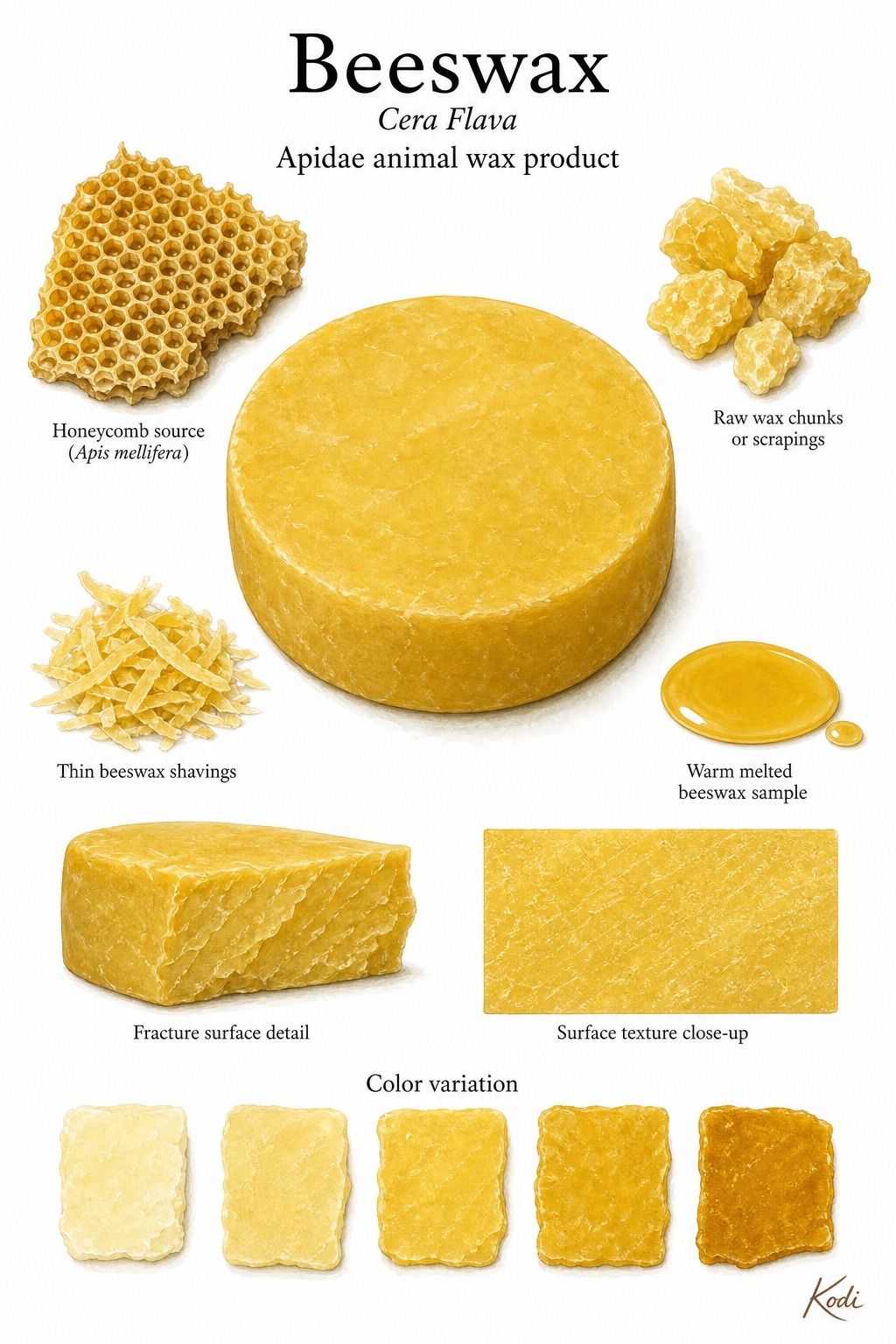
Known in TCM as Feng La (蜂蜡), this sweet, warm herb enters the Spleen. Traditionally, it arrests discharge and seals ulcers - classically used for sores, erosions, and chronic wounds that ooze, fail to close, or remain painful because the surface cannot consolidate, most often applied for skin burns, traumatic injury, and eczema. Modern research has identified Long-chain among its active constituents.
Part used: Wax
Also Known As
Latin: Cera Flava | Pinyin: Feng La | Chinese: 蜂蜡
TCM Properties
- Taste
- sweet
- Temperature
- warm
- Channels
- Spleen
Traditional Use
Primary Actions
- Arrests discharge and seals ulcers - classically used for sores, erosions, and chronic wounds that ooze, fail to close, or remain painful because the surface cannot consolidate.
- Promotes tissue regeneration and relieves pain - melted or ointment-based Feng La is applied to burns, scalds, traumatic skin injury, and difficult ulcers to protect the surface while encouraging new flesh.
- Acts as a protective external carrier - beyond its own mild medicinal action, beeswax stabilizes plasters and ointments so blood-moving or toxin-resolving herbs can remain on damaged tissue longer.
- Historically had limited internal use in bowel irritation - older notes describe combinations with oil and egg yolk for diarrhea or dysenteric irritation, but modern TCM use is predominantly external.
Secondary Actions
- Because Feng La is mild and demulcent rather than strongly pharmacologically aggressive, it is valued as much for wound environment support as for direct herb-like action.
- Modern external medicine frequently uses beeswax as the structure-forming base in burn, ulcer, fissure, and skin-repair pastes.
Classic Formulas
- Dang Gui Gao (当归膏) - from Tai Ping Hui Min He Ji Ju Fang, a classic external paste of Dang Gui, sesame oil, and beeswax for burns, scalds, painful wounds, and non-healing ulcerative lesions where flesh generation is needed.
- Zi Yun Gao (紫云膏) - a later purple external ointment built on a similar beeswax-and-oil base, used for burns, fissures, dry ulcerations, and skin damage needing moist protected healing.
Classical References
- Me and Qi classifies Feng La among herbs for external application, emphasizing detoxifying, stopping discharge, promoting wound healing, generating tissue, and relieving pain.
- American Dragon records its standard topical indications as ulcers, wounds, burns, scalds, and ulcerated trauma, while also noting an older internal recommendation with olive oil and egg yolk for diarrhea and dysenteric inflammation.
- Song-dynasty external medicine texts preserve beeswax as a key ointment base because it seals the medicated oil onto the tissue while protecting the wound from drying and friction.
Modern Research
Active Compounds
- Long-chain wax esters such as myricyl palmitate (wax esters) - the major structural lipids responsible for the protective occlusive character of beeswax
- Long-chain saturated hydrocarbons such as heptacosane and nonacosane (hydrocarbons) - contribute to barrier formation and physical stability of topical preparations
- Free fatty acids including palmitic and cerotic acid derivatives (fatty acids) - part of the emollient and film-forming chemistry of natural beeswax
- Long-chain alcohols such as melissyl alcohol (fatty alcohols) - contribute to texture and semi-solid topical behavior
- Minor pollen, resin, and aromatic trace constituents (trace bioactive admixture) - vary with processing and may contribute small antimicrobial or immunologic effects
Studied Effects
- Atopic-dermatitis model benefit - topical Cera Flava improved skin moisture, reduced scratching, lowered IgE and histamine, and modulated inflammatory cytokines through TLR2/MyD88/TRAF6/ERK signaling in a mouse AD model (PMID 34299150)
- Burn-wound support in a controlled clinical study - a beeswax, olive oil, and Alkanna mixture accelerated epithelization, reduced dressing pain, and shortened hospitalization in second-degree burns (PMID 28917377)
- Barrier and wound-matrix potential - recent beeswax-based nano-formulation work demonstrated enhanced chronic wound-healing and antibacterial performance in preclinical testing (PMID 41788341)
- Topical symptom relief in anorectal lesions - a honey, olive oil, and beeswax mixture improved pain, bleeding, and itching in hemorrhoids and anal fissure in a pilot study, supporting beeswax's longstanding protective-external role (PMID 17369999)
PubMed References
- Cera Flava Alleviates Atopic Dermatitis by Activating Skin Barrier Function via Immune Regulation. (2021)
- The effect of a beeswax, olive oil and Alkanna tinctoria (L.) Tausch mixture on burn injuries: An experimental study with a control group. (2017)
- Synergistic beeswax-based nano-formulation for enhanced chronic wound healing and antibacterial potency. (2026)
- The safety and efficacy of a mixture of honey, olive oil, and beeswax for the management of hemorrhoids and anal fissure: a pilot study. (2007)
Safety & Interactions
Contraindications
- Use on deep, heavily infected, or clearly necrotic wounds without appropriate medical management
- Known hypersensitivity to beeswax or related bee products
Cautions
- Most traditional use is external; internal use should not be extrapolated casually from topical safety
- Patients with allergy to bee products, propolis residues, or fragranced wax preparations may develop local irritation or dermatitis
- MSK page not found - drug interaction data not available from Memorial Sloan Kettering integrative medicine database
Conditions
- Skin Burns Traditional ★★★★☆ JSON
- Traumatic Injury Traditional ★★★☆☆ JSON
- Eczema Research ★★★☆☆ JSON
- Hemorrhoids Research ★★☆☆☆ JSON
Frequently Asked Questions
What is Beeswax used for?
Beeswax is traditionally used to Arrests discharge and seals ulcers - classically used for sores, erosions, and chronic wounds that ooze, fail to close, or remain painful because the surface cannot consolidate., Promotes tissue regeneration and relieves pain - melted or ointment-based Feng La is applied to burns, scalds, traumatic skin injury, and difficult ulcers to protect the surface while encouraging new flesh., Acts as a protective external carrier - beyond its own mild medicinal action, beeswax stabilizes plasters and ointments so blood-moving or toxin-resolving herbs can remain on damaged tissue longer., Historically had limited internal use in bowel irritation - older notes describe combinations with oil and egg yolk for diarrhea or dysenteric irritation, but modern TCM use is predominantly external.. Research has investigated its effects on: Atopic-dermatitis model benefit - topical Cera Flava improved skin moisture, reduced scratching, lowered IgE and histamine, and modulated inflammatory cytokines through TLR2/MyD88/TRAF6/ERK signaling in a mouse AD model (PMID 34299150); Burn-wound support in a controlled clinical study - a beeswax, olive oil, and Alkanna mixture accelerated epithelization, reduced dressing pain, and shortened hospitalization in second-degree burns (PMID 28917377).
What are other names for Beeswax?
Beeswax is also known as Flava. In TCM: 蜂蜡 (Feng La); Cera Flava.
Is Beeswax safe during pregnancy?
The safety of Beeswax during pregnancy has not been established. Consult a qualified healthcare provider before use.
What are the contraindications for Beeswax?
Beeswax should not be used in: Use on deep, heavily infected, or clearly necrotic wounds without appropriate medical management; Known hypersensitivity to beeswax or related bee products. Consult a qualified practitioner before use.