Benzoin
- Chinese
- 安息香
- Pinyin
- An Xi Xiang
- Latin
- Benzoinum
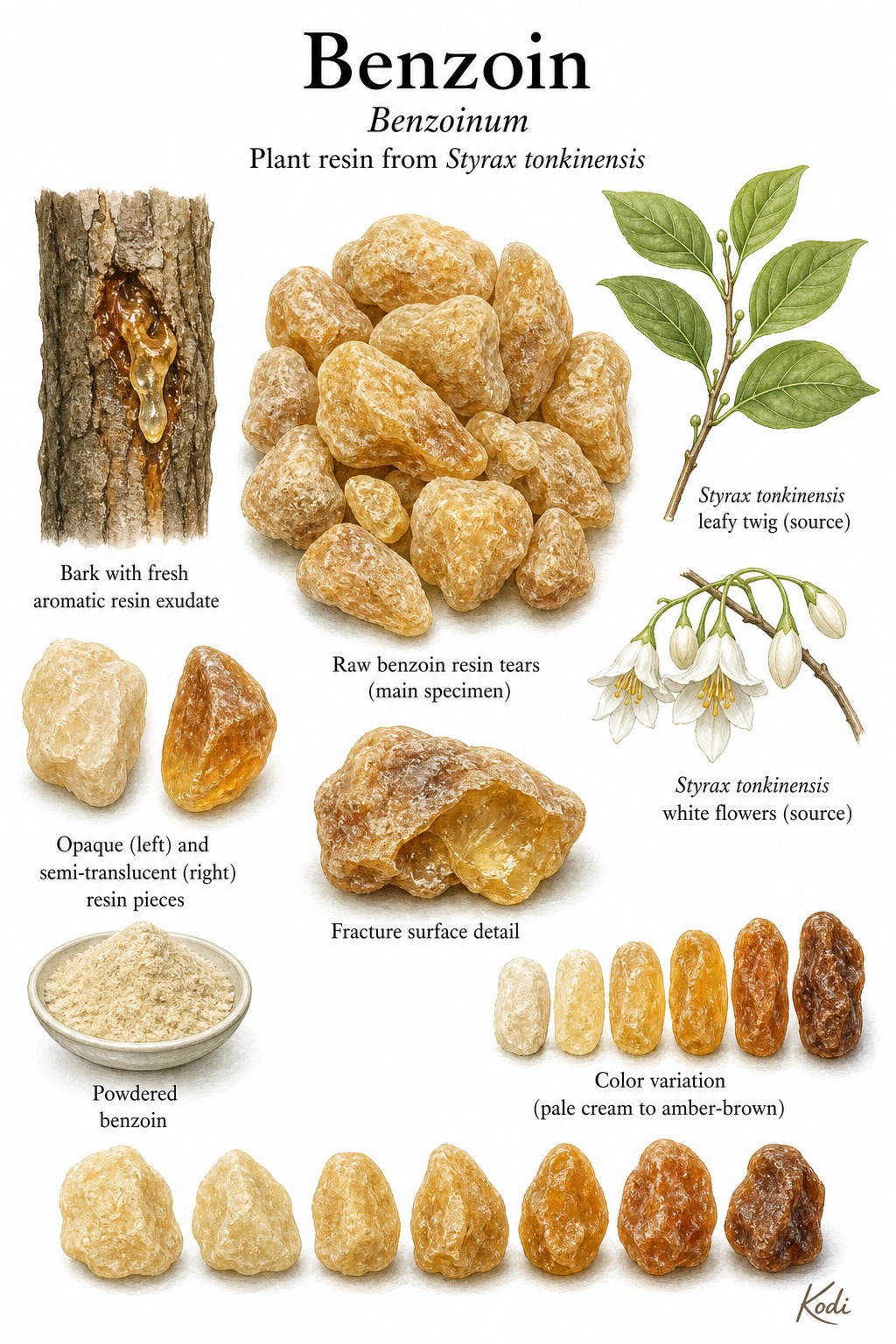
Known in TCM as An Xi Xiang (安息香), this acrid and bitter, neutral herb enters the Heart, Liver, and Spleen. Traditionally, it opens the orifices and revives consciousness - used for cold-type closure, phlegm obstruction, sudden collapse, and loss of consciousness when aromatic penetrating resins are needed to restore awareness, most often applied for stroke, chest pain, and abdominal pain. Modern research has identified Benzoic among its active constituents.
Part used: Benzoin resin
TCM Properties
- Taste
- acrid, bitter
- Temperature
- neutral
- Channels
- Heart, Liver, Spleen
Traditional Use
Primary Actions
- Opens the orifices and revives consciousness - used for cold-type closure, phlegm obstruction, sudden collapse, and loss of consciousness when aromatic penetrating resins are needed to restore awareness.
- Dispels turbidity and foul obstruction - applied when filthy or turbid pathogenic factors cloud the Heart orifices, including cold-phlegm presentations with clenched jaw, chest oppression, and altered consciousness.
- Invigorates Blood, moves Qi, and alleviates pain - especially valued for sudden chest pain and abdominal pain from cold congealing, qi stagnation, and blood stasis.
- Can extend to channel obstruction and phlegm-related respiratory states - some modern usage includes bronchitic or phlegm-laden presentations where aromatic opening and qi movement are clinically relevant.
Secondary Actions
- An Xi Xiang is usually taken as powder, pill, paste, or tincture rather than standard decoction because the resin does not dissolve well in water and direct fire damages its aroma.
- The herb sits between orifice-opening resins and blood-moving aromatics, making it especially useful when cold phlegm closure and pain-stasis coexist.
Classic Formulas
- Su He Xiang Wan (苏合香丸) - classic cold-closure emergency pill in which An Xi Xiang joins other aromatic resins to open the orifices, dispel turbidity, and revive consciousness in sudden collapse.
- Guan Xin Su He Wan (冠心苏合丸) - later chest-pain formula using the aromatic opening and qi-blood-moving properties of An Xi Xiang for cold-type anginal chest pain and chest impediment.
- Zhi Bao Dan (至宝丹) - emergency pill tradition in which prepared An Xi Xiang paste serves as a binding and aromatic opening component.
Classical References
- Me and Qi describes An Xi Xiang as a Tang-dynasty-recorded aromatic resin primarily used for emergency loss of consciousness, chest and abdominal pain, postpartum fainting, and childhood convulsions.
- American Dragon lists its actions as opening the orifices, resolving phlegm, awakening the spirit, invigorating Blood, promoting the movement of Qi, and alleviating pain, with dosage mainly in pills and powders rather than decoction.
- Classical processing guidance warns against strong direct heating and instead favors powdering, warm alcohol dissolution, or wine-steamed paste preparation for pill formulas.
Modern Research
Active Compounds
- Benzoic acid and benzoate esters (balsamic acids and esters) - core aromatic-acid constituents long used as quality markers for benzoin resin
- Cinnamic acid and cinnamate esters (phenylpropanoid acids and esters) - major fragrant resin constituents associated with the balsamic profile
- Benzyl benzoate and benzyl cinnamate (aromatic esters) - representative volatile and semi-volatile molecules contributing to fragrance and bioactivity interest
- Styraxolanes A-C and related norlignans (norlignans) - newly reported anti-inflammatory constituents from Styrax tonkinensis resin
- Triterpenoid and lignan fractions (resin secondary metabolites) - part of the broader modern phytochemical profile summarized in recent benzoin reviews
Studied Effects
- Modern pharmacognosy review - a comprehensive 2023 overview summarized benzoin's phytochemistry, traditional circulation-pain indications, and modern anti-inflammatory, antimicrobial, and quality-control research directions (PMID 37653893)
- Anti-inflammatory constituent discovery - newly isolated styraxolane norlignans from Styrax tonkinensis resin significantly suppressed nitric oxide production in activated macrophages (PMID 41434718)
- Antibacterial activity - Styrax benzoin resin extract showed promising activity against Staphylococcus aureus alongside GC-MS phytochemical profiling and docking work (PMID 36214683)
- Species-authentication relevance - DNA-based work demonstrated that commercial benzoin in trade commonly derives from Styrax tonkinensis and Styrax japonicus, highlighting identity-control issues for a resin drug with variable sourcing (PMID 36808137)
PubMed References
- Benzoin Resin: An Overview on Its Production Process, Phytochemistry, Traditional Use and Quality Control. (2023)
- Three unusual norlignans with anti-inflammatory from the resin of Styrax tonkinensis (Pierre) Craib ex Hart. (2025)
- Phytochemical characterization of Styrax benzoin resin extract, molecular docking, ADME, and antibacterial activity study. (2024)
- Successful identification of the species of the semipetrified amber medicinal resin benzoin using molecular diagnostic technology. (2023)
Safety & Interactions
Contraindications
- Yin deficiency with effulgent Fire
- Marked Excess Fire or heat agitation without cold-phlegm obstruction
- Qi deficiency collapse without true turbid closure pattern
Cautions
- Do not decoct in the standard way because the resin is poorly water-soluble and excessive heat can damage its aromatic opening quality
- Because it is a concentrated resin used in very small doses, sourcing, purification, and dose precision matter more than with bulk decoction herbs
- MSK page not found - drug interaction data not available from Memorial Sloan Kettering integrative medicine database
Conditions
- Stroke Traditional ★★★☆☆ JSON
- Chest Pain Traditional ★★★☆☆ JSON
- Abdominal Pain Traditional ★★★☆☆ JSON
- Bronchitis Traditional ★★☆☆☆ JSON
Frequently Asked Questions
What is Benzoin used for?
Benzoin is traditionally used to Opens the orifices and revives consciousness - used for cold-type closure, phlegm obstruction, sudden collapse, and loss of consciousness when aromatic penetrating resins are needed to restore awareness., Dispels turbidity and foul obstruction - applied when filthy or turbid pathogenic factors cloud the Heart orifices, including cold-phlegm presentations with clenched jaw, chest oppression, and altered consciousness., Invigorates Blood, moves Qi, and alleviates pain - especially valued for sudden chest pain and abdominal pain from cold congealing, qi stagnation, and blood stasis., Can extend to channel obstruction and phlegm-related respiratory states - some modern usage includes bronchitic or phlegm-laden presentations where aromatic opening and qi movement are clinically relevant.. Research has investigated its effects on: Modern pharmacognosy review - a comprehensive 2023 overview summarized benzoin's phytochemistry, traditional circulation-pain indications, and modern anti-inflammatory, antimicrobial, and quality-control research directions (PMID 37653893); Anti-inflammatory constituent discovery - newly isolated styraxolane norlignans from Styrax tonkinensis resin significantly suppressed nitric oxide production in activated macrophages (PMID 41434718).
Is Benzoin safe during pregnancy?
The safety of Benzoin during pregnancy has not been established. Consult a qualified healthcare provider before use.
What are the contraindications for Benzoin?
Benzoin should not be used in: Yin deficiency with effulgent Fire; Marked Excess Fire or heat agitation without cold-phlegm obstruction; Qi deficiency collapse without true turbid closure pattern. Consult a qualified practitioner before use.