Bergenin
- Chinese
- 岩白菜素
- Pinyin
- Yan Bai Cai Su
- Latin
- Bergeninum
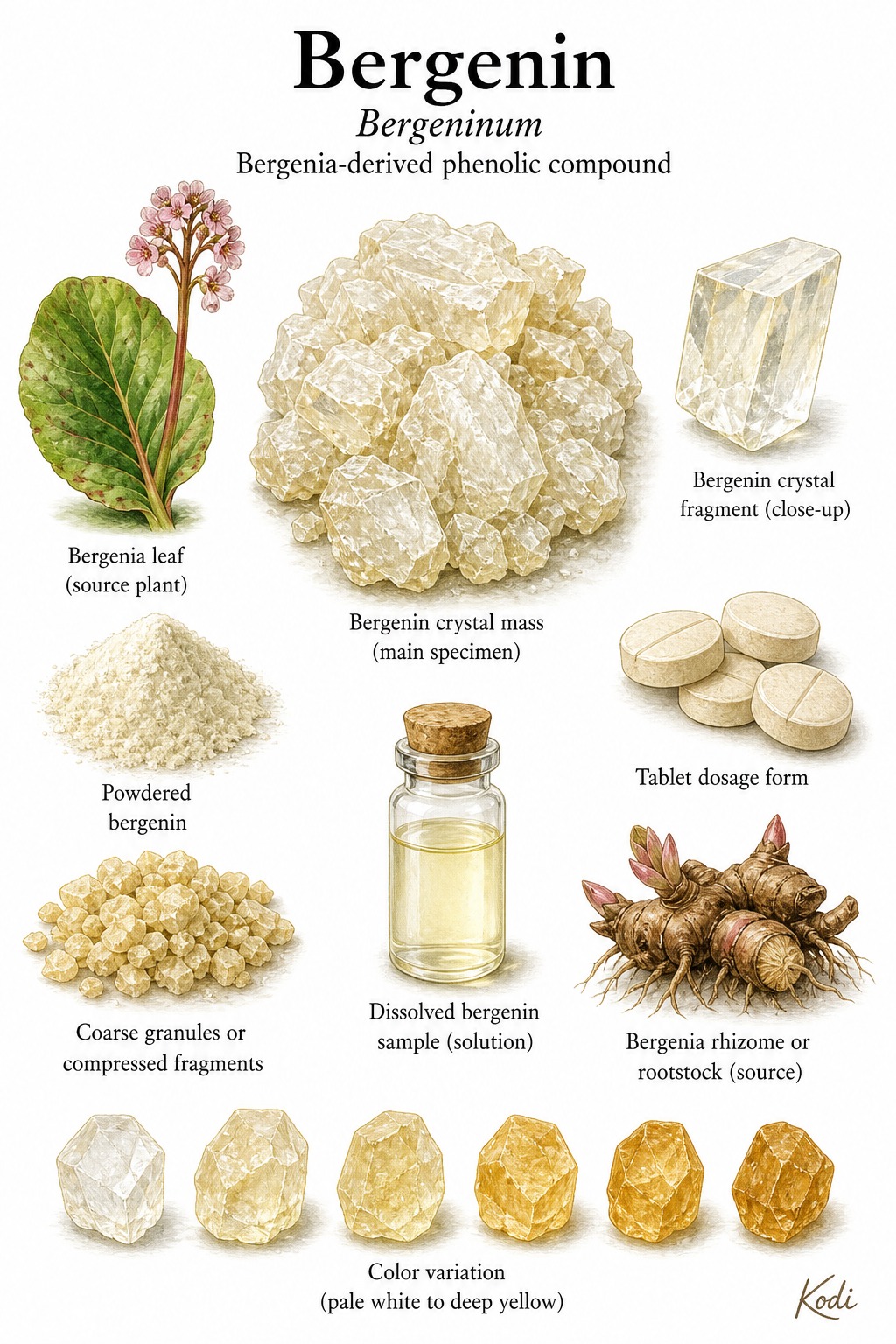
Known in TCM as Yan Bai Cai Su (岩白菜素), this bitter and sweet, cool herb enters the Lung, Liver, and Spleen. Traditionally, it relieves cough and facilitates phlegm resolution - modern Chinese use centers on chronic bronchitis, persistent cough, and phlegm-laden respiratory irritation, especially in tablet form, most often applied for bronchitis, productive cough, and gastric ulcer. Modern research has identified Bergenin among its active constituents.
Also Known As
Latin: Bergeninum | Pinyin: Yan Bai Cai Su | Chinese: 岩白菜素
TCM Properties
- Taste
- bitter, sweet
- Temperature
- cool
- Channels
- Lung, Liver, Spleen
Traditional Use
Primary Actions
- Relieves cough and facilitates phlegm resolution - modern Chinese use centers on chronic bronchitis, persistent cough, and phlegm-laden respiratory irritation, especially in tablet form.
- Moderates inflammatory irritation in the Lung - the compound-level record reflects the long use of bergenin-containing source herbs for chronic inflamed airway states rather than acute exterior pathogens.
- Bridges source-herb tradition and standardized manufacture - Yan Bai Cai Su is valued because it converts the cough-relieving activity of the Yan Bai Cai lineage into a measured single-ingredient or compound pharmaceutical.
- Has broader anti-inflammatory extension beyond the Lung - modern work has expanded interest into intestinal, hepatic, and airway inflammatory models, although these are not classical stand-alone indications for the isolated compound.
Secondary Actions
- This record represents an isolated constituent rather than a classical raw herb; its TCM profile is therefore inferred transparently from the Yan Bai Cai and Bergenia-derived medicinal lineage instead of being treated as an ancient independent materia medica entry.
- In modern practice, bergenin is far more likely to appear in tablets and standardized respiratory products than in traditional decoction prescriptions.
Classic Formulas
- Yan Bai Cai Su Pian (岩白菜素片) - standardized bergenin tablet used in modern Chinese respiratory practice for cough and chronic bronchitic irritation.
- Fu Fang Yan Bai Cai Su Pian (复方岩白菜素片) - compound bergenin tablet widely used for chronic bronchitis, reflecting the modern pharmaceutical rather than ancient decoction use of this record.
Classical References
- IMPORT NOTE: The source spreadsheet imported the isolated compound Yan Bai Cai Su rather than the parent herb Yan Bai Cai. This file is therefore handled like a modern compound-level respiratory record, not a classical single-herb entry.
- Chinese herb sources for Yan Bai Cai describe the parent medicinal as sweet and astringent, cool, and entering the Liver, Lung, and Spleen, with cough-relieving and hemostatic actions; bergenin is one of its major active constituents.
- Modern Chinese product literature treats bergenin as a principal active ingredient in antitussive and chronic-bronchitis preparations, which explains why this import record appears as a stand-alone substance.
Modern Research
Active Compounds
- Bergenin (C-glycoside of 4-O-methyl gallic acid) - the principal bioactive compound represented by this record and a key standardized antitussive ingredient in China
- Norbergenin (bergenin analogue) - a demethylated related phenolic reported alongside bergenin in source-plant chemistry work
- Galloylated bergenin derivatives (phenolic derivatives) - related analogues used to map structure-activity relationships around the bergenin scaffold
- Arbutin (co-occurring glycoside in source herbs) - part of the broader chemical background of Bergenia-derived medicinal materials
- Catechin and gallic acid (co-occurring phenolics) - supporting compounds commonly discussed in source-herb chemistry alongside bergenin
Studied Effects
- Respiratory inflammation control - bergenin reduced pulmonary edema, inflammatory-cell infiltration, cytokine release, and NF-kappaB pathway signaling in an acute lung injury model, supporting its respiratory-medicine reputation (PMID 28192201)
- Asthma-related airway remodeling benefit - bergenin improved airway inflammation and remodeling by activating SIRT1 in macrophages and limiting NF-kappaB-driven cytokine production (PMID 36313381)
- Systemic anti-inflammatory effect - bergenin ameliorated experimental colitis through PPARgamma and SIRT1-linked suppression of NF-kappaB-mediated macrophage activation (PMID 29375382)
- Interaction-relevant pharmacology - in vitro work showed inhibition of CYP3A4, CYP2E1, and CYP2C9, suggesting that even a seemingly simple isolated compound may carry meaningful co-medication considerations (PMID 31070542)
PubMed References
- The natural product bergenin ameliorates lipopolysaccharide-induced acute lung injury by inhibiting NF-kappaB activition. (2017)
- Bergenin ameliorates airway inflammation and remodeling in asthma by activating SIRT1 in macrophages to regulate the NF-κB pathway. (2022)
- Bergenin, Acting as an Agonist of PPARγ, Ameliorates Experimental Colitis in Mice through Improving Expression of SIRT1, and Therefore Inhibiting NF-κB-Mediated Macrophage Activation. (2018)
- In vitro inhibitory effects of bergenin on human liver cytochrome P450 enzymes. (2019)
Safety & Interactions
Contraindications
- Patternless long-term self-treatment of chronic cough without clinical evaluation
- Use in patients taking narrow-therapeutic-index drugs without medication review
Cautions
- Because this is an isolated compound record rather than a food-grade crude herb, dose form and product standardization matter substantially
- In vitro data suggest bergenin can inhibit CYP3A4, CYP2E1, and CYP2C9, so coadministration with heavily metabolized medications warrants caution even though no MSK monograph was found
- MSK page not found - drug interaction data not available from Memorial Sloan Kettering integrative medicine database
Conditions
- Bronchitis Research ★★★☆☆ JSON
- Productive Cough Traditional ★★★☆☆ JSON
- Gastric Ulcer Research ★★☆☆☆ JSON
Frequently Asked Questions
What is Bergenin used for?
Bergenin is traditionally used to Relieves cough and facilitates phlegm resolution - modern Chinese use centers on chronic bronchitis, persistent cough, and phlegm-laden respiratory irritation, especially in tablet form., Moderates inflammatory irritation in the Lung - the compound-level record reflects the long use of bergenin-containing source herbs for chronic inflamed airway states rather than acute exterior pathogens., Bridges source-herb tradition and standardized manufacture - Yan Bai Cai Su is valued because it converts the cough-relieving activity of the Yan Bai Cai lineage into a measured single-ingredient or compound pharmaceutical., Has broader anti-inflammatory extension beyond the Lung - modern work has expanded interest into intestinal, hepatic, and airway inflammatory models, although these are not classical stand-alone indications for the isolated compound.. Research has investigated its effects on: Respiratory inflammation control - bergenin reduced pulmonary edema, inflammatory-cell infiltration, cytokine release, and NF-kappaB pathway signaling in an acute lung injury model, supporting its respiratory-medicine reputation (PMID 28192201); Asthma-related airway remodeling benefit - bergenin improved airway inflammation and remodeling by activating SIRT1 in macrophages and limiting NF-kappaB-driven cytokine production (PMID 36313381).
What are other names for Bergenin?
Bergenin is also known as Bergeninum. In TCM: 岩白菜素 (Yan Bai Cai Su); Bergeninum.
Is Bergenin safe during pregnancy?
The safety of Bergenin during pregnancy has not been established. Consult a qualified healthcare provider before use.
What are the contraindications for Bergenin?
Bergenin should not be used in: Patternless long-term self-treatment of chronic cough without clinical evaluation; Use in patients taking narrow-therapeutic-index drugs without medication review. Consult a qualified practitioner before use.