Black Lead
- Chinese
- 黑锡
- Pinyin
- Hei Xi
- Latin
- Plumbum
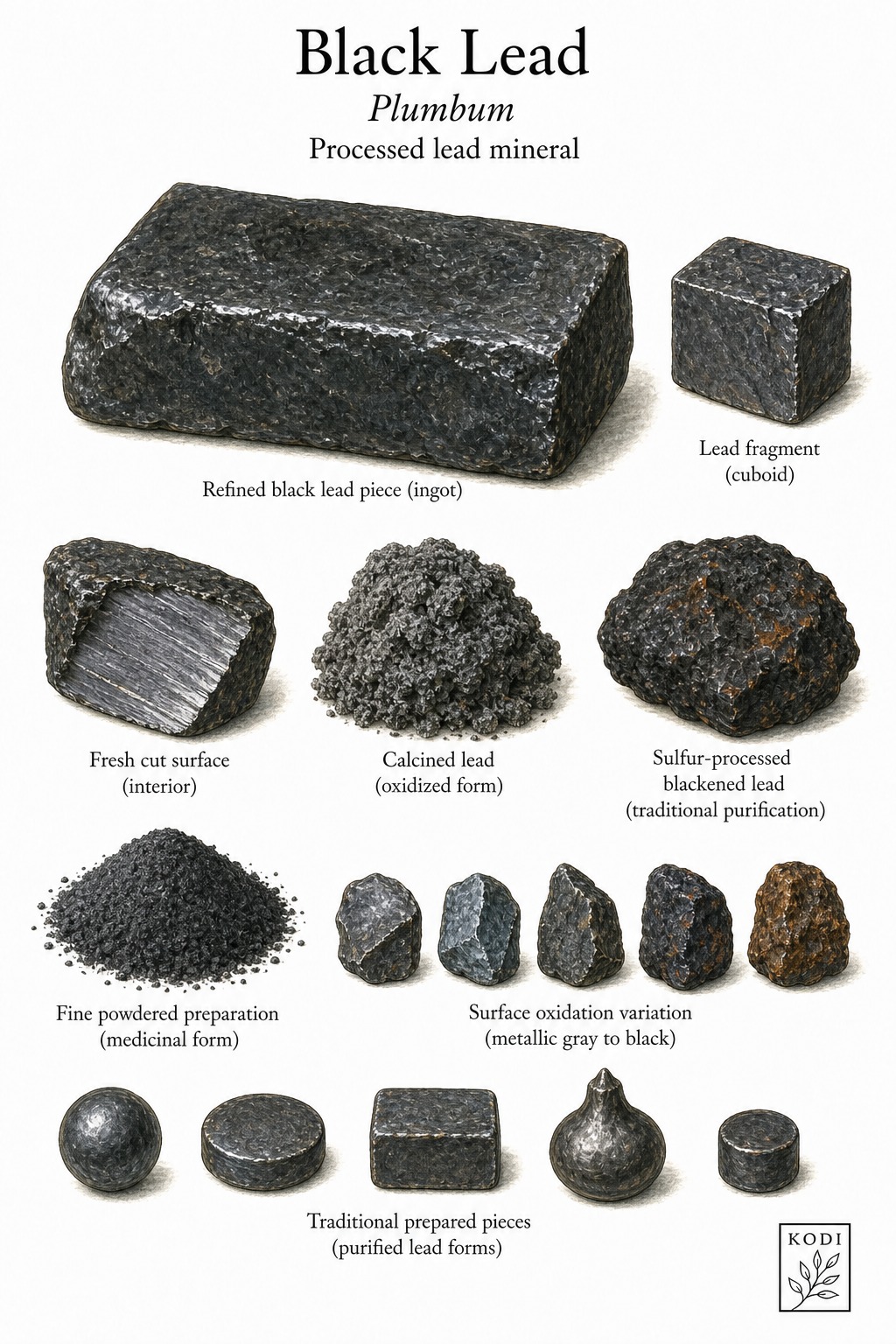
Known in TCM as Hei Xi (黑锡), this sweet, cold herb enters the Liver and Kidney. Traditionally, it suppresses counterflow and strongly descends rebellious Qi - classically used for severe wheezing, dyspnea, and upper excess/lower deficiency patterns in which the Kidneys fail to grasp Qi and the breath rises upward, most often applied for asthma, palpitations, and epilepsy. Modern research has identified Elemental among its active constituents.
Part used: Lead
Also Known As
Latin: Plumbum | Pinyin: Hei Xi | Chinese: 黑锡
TCM Properties
- Taste
- sweet
- Temperature
- cold
- Channels
- Liver, Kidney
Traditional Use
Primary Actions
- Suppresses counterflow and strongly descends rebellious Qi - classically used for severe wheezing, dyspnea, and upper excess/lower deficiency patterns in which the Kidneys fail to grasp Qi and the breath rises upward.
- Anchors floating Yang - used when depleted Kidney Yang cannot hold Yang at the root, producing agitation above with cold weakness below, often alongside palpitations, anxiety, or false-heat manifestations.
- Transforms phlegm and opens obstructed upper pathways in formulas that address phlegm clouding with sudden collapse, epilepsy, or severe chest and throat obstruction.
- Serves as a drastic emergency mineral within rescue-style formulas - its heavy descending action is never used casually and is traditionally balanced with strong warming Yang restoratives.
Secondary Actions
- Despite the imported slug and Latin field originally implying tin, the classical medicinal identity of Hei Xi is black lead (Plumbum), not culinary or metallic tin.
- Traditional processing combines repeated refining with sulfur and calcination, but this reduces rather than eliminates the intrinsic toxicity of the lead substrate.
Classic Formulas
- Hei Xi Dan (黑锡丹) - from Tai Ping Hui Min He Ji Ju Fang, the defining formula for Hei Xi, pairing lead with sulfur and warming Kidney-Yang herbs to anchor floating Yang and descend wheezing from upper excess and lower deficiency.
Classical References
- Modern TCM materia medica summaries such as Me & Qi describe Hei Xi as sweet and cold, entering the Liver and Kidney channels to descend counterflow Qi, anchor floating Yang, transform phlegm, and assist severe Kidney failure to grasp Qi.
- Ben Cao Gang Mu notes a historical confusion between lead and tin in earlier materia medica transmission; that identity problem appears to be reflected in this import record's original English and Latin labels.
- Classical cautionary sources including Ben Cao Jing Shu and Ben Jing Feng Yuan warn that Hei Xi is unsuitable in weak digestion, pure Yang collapse without floating counterflow, or when processing is inadequate.
Modern Research
Active Compounds
- Elemental lead (Pb) - the core toxic heavy-metal substrate historically used as Hei Xi
- Lead sulfide and related calcined lead-sulfur matrices (processing-derived lead compounds) - formed or enriched when Hei Xi is refined with sulfur in classical preparations such as Hei Xi Dan
- Lead oxides and surface oxidation products - potential byproducts of heating, refining, and storage that contribute to toxicology concerns
- Trace mineral impurities - variable contaminants that further complicate safety and standardization
Studied Effects
- Modern indexed literature treats Hei Xi primarily as a toxicology concern rather than a therapeutic research subject; case reports and reviews document severe lead poisoning associated with traditional Chinese medicines and other traditional remedies (PMID 14992070; PMID 18690981; PMID 22564879; PMID 29081456)
- Because lead is a cumulative neurotoxic and nephrotoxic metal with no safe chronic exposure threshold, there is no meaningful modern pharmacology case for routine internal use outside historical context.
PubMed References
- Lead poisoning after ingestion of home-made Chinese medicines (2003)
- Lead encephalopathy due to traditional medicines (2008)
- Childhood lead poisoning associated with traditional Chinese medicine: a case report and the subsequent lead source inquiry (2012)
- Lead Poisoning Caused by Traditional Chinese Medicine: A Case Report and Literature Review (2017)
Safety & Interactions
Contraindications
- Pregnancy
- Children or infants because of marked developmental neurotoxicity risk from lead exposure
- Spleen and Stomach deficiency Cold with weak digestion
- Kidney or liver impairment, or any situation requiring prolonged use
Cautions
- Hei Xi is a lead-based mineral with serious cumulative toxicity and should be understood as a historical emergency medicinal rather than a routine contemporary internal herb
- Classical processing and sulfur-combining methods reduce but do not eliminate lead exposure risk, so even short-term use demands expert supervision
- MSK page not found - drug interaction data not available from Memorial Sloan Kettering integrative medicine database
Conditions
Frequently Asked Questions
What is Black Lead used for?
Black Lead is traditionally used to Suppresses counterflow and strongly descends rebellious Qi - classically used for severe wheezing, dyspnea, and upper excess/lower deficiency patterns in which the Kidneys fail to grasp Qi and the breath rises upward., Anchors floating Yang - used when depleted Kidney Yang cannot hold Yang at the root, producing agitation above with cold weakness below, often alongside palpitations, anxiety, or false-heat manifestations., Transforms phlegm and opens obstructed upper pathways in formulas that address phlegm clouding with sudden collapse, epilepsy, or severe chest and throat obstruction., Serves as a drastic emergency mineral within rescue-style formulas - its heavy descending action is never used casually and is traditionally balanced with strong warming Yang restoratives.. Research has investigated its effects on: Modern indexed literature treats Hei Xi primarily as a toxicology concern rather than a therapeutic research subject; case reports and reviews document severe lead poisoning associated with traditional Chinese medicines and other traditional remedies (PMID 14992070; PMID 18690981; PMID 22564879; PMID 29081456); Because lead is a cumulative neurotoxic and nephrotoxic metal with no safe chronic exposure threshold, there is no meaningful modern pharmacology case for routine internal use outside historical context..
What are other names for Black Lead?
Black Lead is also known as Plumbum. In TCM: 黑锡 (Hei Xi); Plumbum.
Is Black Lead safe during pregnancy?
Black Lead is not recommended during pregnancy.
What are the contraindications for Black Lead?
Black Lead should not be used in: Pregnancy; Children or infants because of marked developmental neurotoxicity risk from lead exposure; Spleen and Stomach deficiency Cold with weak digestion; Kidney or liver impairment, or any situation requiring prolonged use. Consult a qualified practitioner before use.