Dragon's Blood Resin
- Chinese
- 血竭
- Pinyin
- Xue Jie
- Latin
- Sanguis Draconis
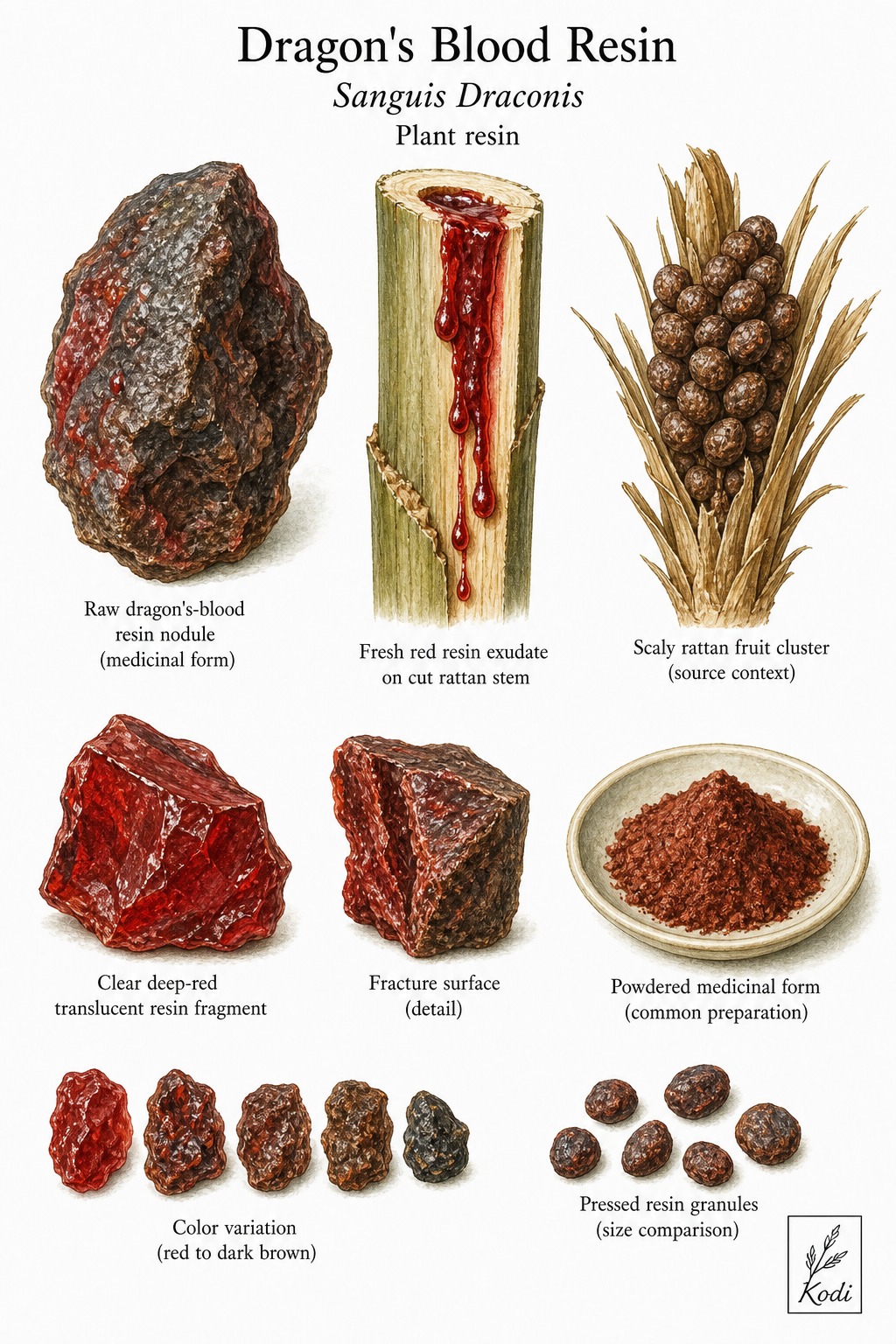
Known in TCM as Xue Jie (血竭), this sweet and salty, neutral herb enters the Heart and Liver. Traditionally, it invigorates Blood and alleviates pain - classically used for trauma, bruising, fixed pain, and menstrual pain when Blood stasis obstructs the collaterals, most often applied for traumatic injury, dysmenorrhea, and amenorrhea. Modern research has identified Dracorhodin among its active constituents.
Part used: Blood
Also Known As
Latin: Sanguis Draconis | Pinyin: Xue Jie | Chinese: 血竭
TCM Properties
- Taste
- sweet, salty
- Temperature
- neutral
- Channels
- Heart, Liver
Traditional Use
Primary Actions
- Invigorates Blood and alleviates pain - classically used for trauma, bruising, fixed pain, and menstrual pain when Blood stasis obstructs the collaterals.
- Dispels stasis and stops bleeding - especially valued for traumatic bleeding, ulcerated lesions, and selected internal bleeding presentations where stasis and tissue damage coexist.
- Promotes tissue regeneration and heals sores - applied externally to chronic non-healing wounds, ulcers, hemorrhoids, and suppurative lesions that need both protection and faster repair.
Secondary Actions
- Xue Jie is almost always used as a fine powder, pill ingredient, or topical dusting agent rather than as a long-decocted herb because the resin does not dissolve well in water.
- Its best-known clinical partnerships are with Ru Xiang and Mo Yao, which strengthen the pain-relieving, swelling-reducing, and tissue-healing profile in trauma formulas.
Classic Formulas
- Qi Li San (七厘散) - classic trauma powder in which Xue Jie serves as the chief Blood-moving, pain-relieving, and hemostatic resin for injuries, bruising, and swelling.
- Die Da Wan (跌打丸) - trauma-pill traditions use Xue Jie to move Blood, relieve pain, and assist tissue repair after blunt injury.
- Xue Jie with Ru Xiang and Mo Yao - a classic resin pairing strategy for fixed pain, traumatic swelling, and chronic sores that need both movement of stasis and regeneration of flesh.
Classical References
- Me & Qi and Sacred Lotus agree that Xue Jie is sweet, salty, and neutral, enters the Heart and Liver channels, and is prized for moving Blood, stopping bleeding, relieving pain, and generating flesh.
- Sacred Lotus specifically highlights trauma, amenorrhea, dysmenorrhea, hemorrhoids, and chronic ulcers, while Me & Qi emphasizes that Xue Jie is one of the key resin medicinals in trauma recovery and wound care.
- SOURCE NOTE: modern Chinese medicine uses more than one botanical source under the broader dragon's-blood idea. Me & Qi centers the imported Daemonorops draco resin, while Chinese domestic literature often studies Dracaena-based dragon's-blood materials. This record keeps the traditional medicinal identity broad and makes the plant-source variation explicit rather than pretending the literature is perfectly uniform.
Modern Research
Active Compounds
- Dracorhodin (anthocyanin-like red phenolic pigment) - one of the best-known marker compounds in dragon's-blood quality control and wound-healing research
- Dracorhodin perchlorate (stabilized dracorhodin derivative) - widely studied as a bioactive wound-healing surrogate for the native resin pigment
- Phenolic platelet-inhibitory constituents (polyphenolic compounds) - part of the resin fraction relevant to circulation-focused pharmacology
- Taspine and related bioactive resin compounds - constituents linked with anti-inflammatory, antimicrobial, and pro-proliferative activity in Daemonorops draco studies
Studied Effects
- Anti-inflammatory, antimicrobial, and pro-proliferative activity - compounds isolated from Daemonorops draco resin inhibited NF-kappaB signaling, activated Nrf2, promoted fibroblast and keratinocyte proliferation, and suppressed common microbes in vitro, directly matching the traditional wound-healing niche (PMID 33301918)
- Wound-healing signaling support - dracorhodin perchlorate enhanced keratinocyte wound-healing pathways through beta-catenin, ERK/p38, and AKT signaling, helping explain why Xue Jie remains closely associated with skin repair and ulcer healing (PMID 34131445)
- Chronic diabetic wound interest - modern work on dragon blood from Daemonorops draco found therapeutic potential in diabetic wound models through effects on proliferation and fibrinolytic signaling pathways (PMID 38842634)
- Platelet-inhibitory chemistry - phenolic constituents isolated from Daemonorops draco fruits showed platelet-inhibitory activity, providing a biochemical correlate for the herb's long association with Blood stasis and traumatic circulation disorders (PMID 37054821)
PubMed References
- Anti-inflammatory, pro-proliferative and antimicrobial potential of the compounds isolated from Daemonorops draco (Willd.) Blume (2021)
- Dracorhodin perchlorate enhances wound healing via beta-catenin, ERK/p38, and AKT signaling in human HaCaT keratinocytes (2021)
- Novel therapeutic activities of dragon blood from palm tree Daemonorops draco for the treatment of chronic diabetic wounds (2024)
- Platelet-inhibitory phenolic constituents from the fruits of Daemonorops draco (2023)
Safety & Interactions
Contraindications
- Pregnancy
- Bleeding presentations without Blood stasis, trauma, or ulcerative tissue damage
- Use during active menstrual bleeding when strong Blood movement is not appropriate
Cautions
- Xue Jie is a potent Blood-moving resin and is traditionally contraindicated in pregnancy
- Because the dragon's-blood trade is frequently adulterated and may come from several plant sources, authenticated medicinal-grade material matters
- The resin is normally taken in small powdered doses or used externally; casual high-dose internal use is not traditional practice
- MSK page not found - drug interaction data not available from Memorial Sloan Kettering integrative medicine database
Conditions
- Traumatic Injury Traditional ★★★★★ JSON
- Dysmenorrhea Traditional ★★★★☆ JSON
- Amenorrhea Traditional ★★☆☆☆ JSON
- Hemorrhoids Traditional ★★★☆☆ JSON
- Gastric Ulcer Traditional ★☆☆☆☆ JSON
Frequently Asked Questions
What is Dragon's Blood Resin used for?
Dragon's Blood Resin is traditionally used to Invigorates Blood and alleviates pain - classically used for trauma, bruising, fixed pain, and menstrual pain when Blood stasis obstructs the collaterals., Dispels stasis and stops bleeding - especially valued for traumatic bleeding, ulcerated lesions, and selected internal bleeding presentations where stasis and tissue damage coexist., Promotes tissue regeneration and heals sores - applied externally to chronic non-healing wounds, ulcers, hemorrhoids, and suppurative lesions that need both protection and faster repair.. Research has investigated its effects on: Anti-inflammatory, antimicrobial, and pro-proliferative activity - compounds isolated from Daemonorops draco resin inhibited NF-kappaB signaling, activated Nrf2, promoted fibroblast and keratinocyte proliferation, and suppressed common microbes in vitro, directly matching the traditional wound-healing niche (PMID 33301918); Wound-healing signaling support - dracorhodin perchlorate enhanced keratinocyte wound-healing pathways through beta-catenin, ERK/p38, and AKT signaling, helping explain why Xue Jie remains closely associated with skin repair and ulcer healing (PMID 34131445).
What are other names for Dragon's Blood Resin?
Dragon's Blood Resin is also known as Draconis. In TCM: 血竭 (Xue Jie); Sanguis Draconis.
Is Dragon's Blood Resin safe during pregnancy?
Dragon's Blood Resin is not recommended during pregnancy. Xue Jie is a potent Blood-moving resin and is traditionally contraindicated in pregnancy
What are the contraindications for Dragon's Blood Resin?
Dragon's Blood Resin should not be used in: Pregnancy; Bleeding presentations without Blood stasis, trauma, or ulcerative tissue damage; Use during active menstrual bleeding when strong Blood movement is not appropriate. Consult a qualified practitioner before use.