Camphor
- Chinese
- 樟脑
- Pinyin
- Zhang Nao
- Latin
- Camphora
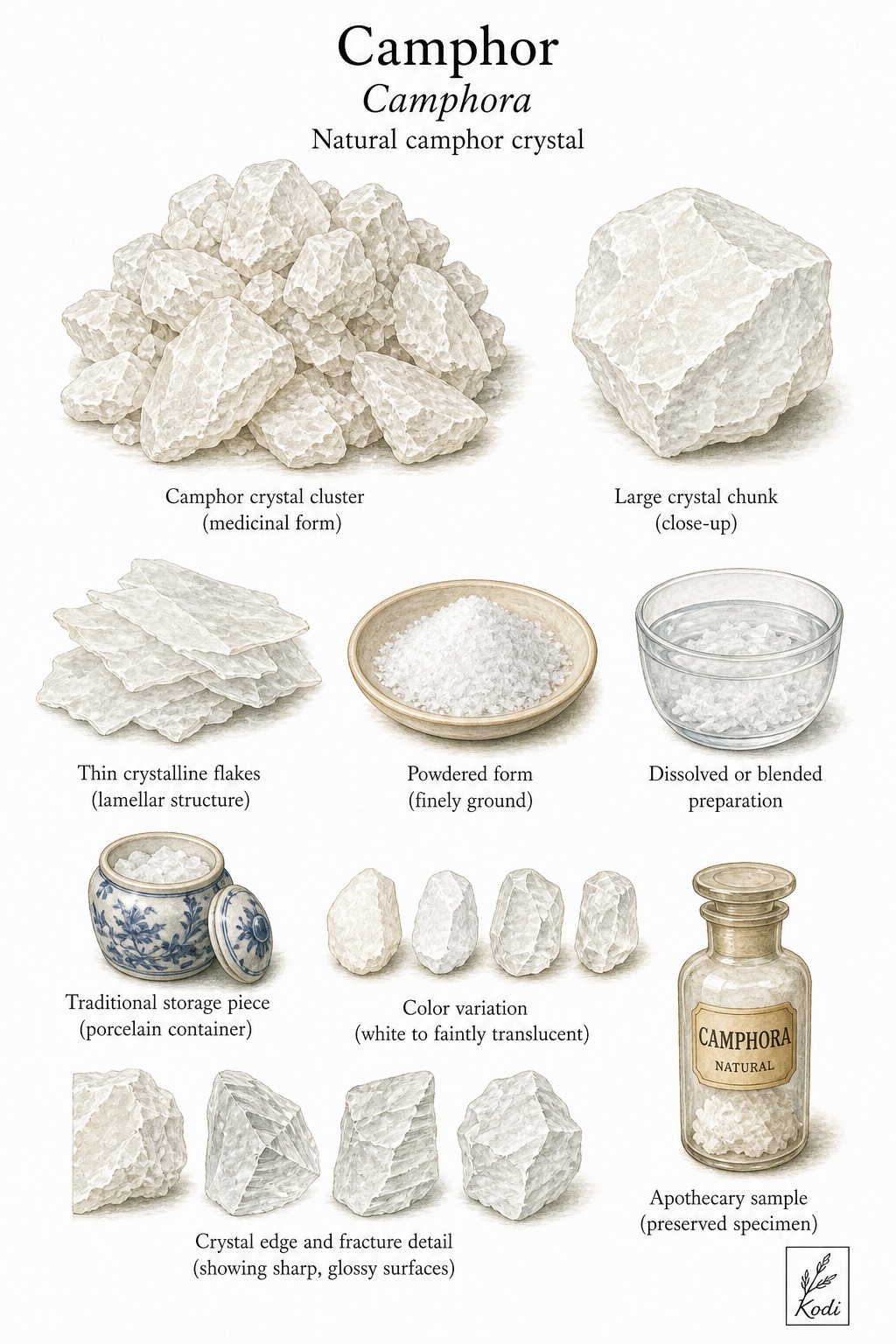
Known in TCM as Zhang Nao (樟脑), this acrid, hot herb enters the Heart and Spleen. Traditionally, it opens the orifices and dispels turbidity - historically used in tiny supervised doses for fainting, heatstroke, and sudden collapse when foul turbidity clouds the sensory openings, most often applied for fungal infection, skin burns, and traumatic injury. Modern research has identified Camphor among its active constituents.
Part used: Camphor
TCM Properties
- Taste
- acrid
- Temperature
- hot
- Channels
- Heart, Spleen
Traditional Use
Primary Actions
- Opens the orifices and dispels turbidity - historically used in tiny supervised doses for fainting, heatstroke, and sudden collapse when foul turbidity clouds the sensory openings.
- Kills parasites and stops itching - the most common traditional use today, especially topically for scabies, ringworm, and intensely itchy skin lesions.
- Reduces swelling and alleviates pain - applied to sprains, bruises, toothache, insect bites, and cold-type painful lesions that benefit from aromatic penetration and local counterirritation.
- Warms the middle and relieves sudden abdominal pain - a smaller historical internal use for cold-damp or foul summer complaints with cramping, vomiting, and diarrhea.
Secondary Actions
- Zhang Nao is mostly an external-use aromatic now because its toxic window is much narrower than the cooler and more clinically flexible borneol lineage.
- It must not be decocted because the volatile aromatic compound would be lost and uncontrolled oral exposure is unsafe.
Classic Formulas
- Zhang Nao with Liu Huang - classic antiparasitic topical pairing for scabies, ringworm, and stubborn itchy fungal lesions.
- Zhang Nao with Ru Xiang - pain-relieving topical combination for trauma, swelling, and local stagnation.
- Zhang Nao with Xiong Huang - stronger toxic-dispersing external strategy for chronic ulcerated or stubborn skin lesions.
Classical References
- Me & Qi classifies Zhang Nao as a hot, acrid aromatic derived product that opens the orifices, kills parasites, stops itching, and relieves pain, with modern use focused mainly on topical application.
- The same source repeatedly contrasts camphor with Bing Pian: Zhang Nao is hotter, harsher, and more toxic, while Bing Pian is cooler and preferred for inflamed heat conditions.
- IDENTITY NOTE: medicinal camphor should not be confused with naphthalene mothballs or casually substituted with synthetic household products.
Modern Research
Active Compounds
- Camphor (bicyclic monoterpene ketone) - the defining aromatic and toxicologically active constituent
- Natural dextrorotatory camphor - the preferred medicinal form in traditional sourcing discussions
- Synthetic racemic camphor - a common commercial substitute with overlapping but not identical sourcing implications
- Oxidative metabolites of camphor - part of the systemic metabolic burden underlying toxicity
Studied Effects
- Mechanistic work on sensory ion channels found that camphor activates and strongly desensitizes TRPV1-related pathways, helping explain its long-standing local counterirritant, antipruritic, and analgesic reputation (PMID 22314297).
- Direct antifungal research showed that camphor has anticandidal and antivirulence activity in vitro, supporting the older external use for fungal and itchy skin disorders (PMID 33418931).
- Modern toxicology remains the dominant concern: observational and case-report literature repeatedly documents nausea, agitation, seizures, arrhythmias, and other serious poisoning effects after ingestion or heavy exposure (PMID 28363129; PMID 26065546).
PubMed References
- Pore helix domain is critical to camphor sensitivity of transient receptor potential vanilloid 1 channel (2012)
- Camphor and Eucalyptol-Anticandidal Spectrum, Antivirulence Effect, Efflux Pumps Interference and Cytotoxicity (2021)
- Severe camphor poisoning, a seven-year observational study (2017)
- Camphor: an herbal medicine causing grand mal seizures (2015)
Safety & Interactions
Contraindications
- Pregnancy
- Infants and very young children
- Epilepsy or seizure disorders
- Unsupervised internal use
Cautions
- Camphor is only slightly toxic in classical classification but can cause serious neurologic toxicity, including seizures, at relatively low multiples of the medicinal dose
- Do not apply concentrated preparations to large open wounds, broken skin, or infant skin because systemic absorption can be dangerous
- Internal dosing is tiny and highly restricted; never add camphor to boiling decoctions
- MSK page not found - drug interaction data not available from Memorial Sloan Kettering integrative medicine database
Conditions
- Fungal Infection Traditional ★★★★☆ JSON
- Skin Burns Traditional ★★★☆☆ JSON
- Traumatic Injury Traditional ★★★☆☆ JSON
- Abdominal Pain Traditional ★★☆☆☆ JSON
- Nausea Traditional ★★☆☆☆ JSON
Frequently Asked Questions
What is Camphor used for?
Camphor is traditionally used to Opens the orifices and dispels turbidity - historically used in tiny supervised doses for fainting, heatstroke, and sudden collapse when foul turbidity clouds the sensory openings., Kills parasites and stops itching - the most common traditional use today, especially topically for scabies, ringworm, and intensely itchy skin lesions., Reduces swelling and alleviates pain - applied to sprains, bruises, toothache, insect bites, and cold-type painful lesions that benefit from aromatic penetration and local counterirritation., Warms the middle and relieves sudden abdominal pain - a smaller historical internal use for cold-damp or foul summer complaints with cramping, vomiting, and diarrhea.. Research has investigated its effects on: Mechanistic work on sensory ion channels found that camphor activates and strongly desensitizes TRPV1-related pathways, helping explain its long-standing local counterirritant, antipruritic, and analgesic reputation (PMID 22314297).; Direct antifungal research showed that camphor has anticandidal and antivirulence activity in vitro, supporting the older external use for fungal and itchy skin disorders (PMID 33418931)..
Is Camphor safe during pregnancy?
Camphor is not recommended during pregnancy.
What are the contraindications for Camphor?
Camphor should not be used in: Pregnancy; Infants and very young children; Epilepsy or seizure disorders; Unsupervised internal use. Consult a qualified practitioner before use.