Cassia Seed
- Chinese
- 决明子
- Pinyin
- Jue Ming Zi
- Latin
- Semen Cassiae
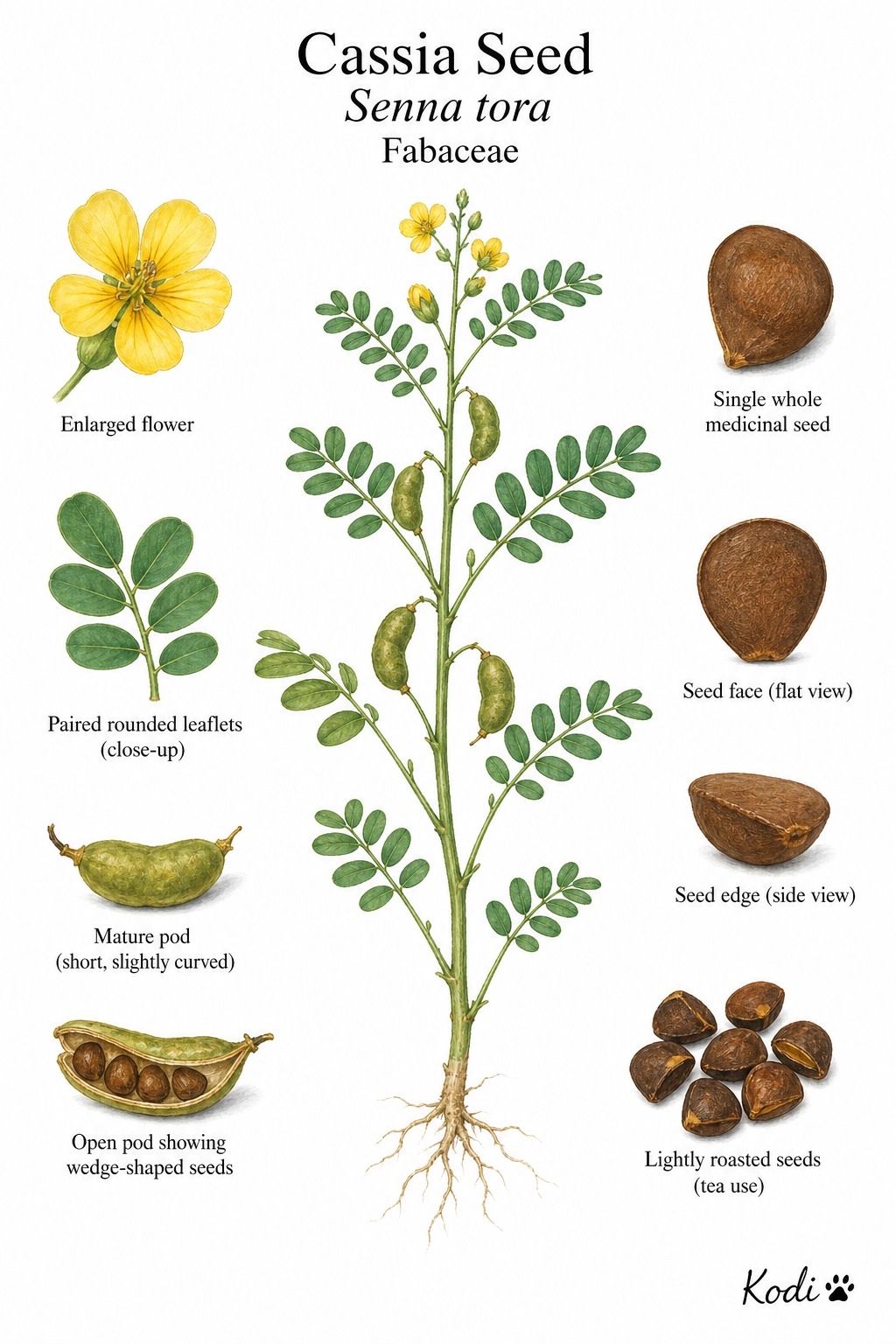
Known in TCM as Jue Ming Zi (决明子), this bitter and sweet and salty, cool herb enters the Liver and Large Intestine. Traditionally, it clears Liver Heat and brightens the eyes - Jue Ming Zi is one of the classic eye herbs for red, swollen, painful, photophobic, or chronically strained eyes when Liver Fire, Wind-Heat, or residual Heat disturbs the visual orifices, most often applied for hypertension, constipation, and conjunctivitis. Modern research has identified Aurantio-obtusin among its active constituents.
Part used: Seed
Also Known As
Latin: Semen Cassiae | Pinyin: Jue Ming Zi | Chinese: 决明子
TCM Properties
- Taste
- bitter, sweet, salty
- Temperature
- cool
- Channels
- Liver, Large Intestine
Traditional Use
Primary Actions
- Clears Liver Heat and brightens the eyes - Jue Ming Zi is one of the classic eye herbs for red, swollen, painful, photophobic, or chronically strained eyes when Liver Fire, Wind-Heat, or residual Heat disturbs the visual orifices.
- Calms Liver Yang and draws excess upward movement downward - it is widely chosen for dizziness, headache, irritability, and high-blood-pressure patterns that present with red eyes or clear signs of upward-rushing Liver Fire.
- Moistens the Intestines and eases dry constipation - the seed's oily nature lubricates while its bitter-cool profile clears Heat, making it useful when constipation appears together with internal Heat signs rather than pure cold deficiency.
- Benefits Liver and Kidney systems while clearing - Jue Ming Zi is milder than shell or mineral sedatives and can therefore be combined in long-view formulas for aging vision, chronic eye fatigue, and mixed excess-deficiency patterns.
Secondary Actions
- Roasted Jue Ming Zi is commonly preferred in tea and long-course use because processing reduces the harsher laxative anthraquinone effect while preserving the eye-brightening and Yang-calming profile.
- The herb is often paired rather than used alone: Ju Hua broadens wind-heat coverage, Gou Qi Zi deepens Yin support, and Gou Teng strengthens the descending Yang-calming action.
Classic Formulas
- Shi Hu Ye Guang Wan (石斛夜光丸) - famous eye formula in which Jue Ming Zi helps clear residual Liver Heat and brighten vision while richer ingredients nourish the Liver and Kidneys.
- Jue Ming Zi tea with Ju Hua and Gou Qi Zi - a long-standing food-herb pattern for red or tired eyes, blurry vision, and mild headache from prolonged eye strain or Liver Heat.
- Jue Ming Zi with Gou Teng and Xia Ku Cao - classic-caliber pairing pattern for red eyes, dizziness, and hypertension presentations marked by rising Liver Yang or Fire.
Classical References
- Me and Qi records Jue Ming Zi as a top-grade herb first noted in the Shen Nong Ben Cao Jing and emphasizes its reputation for eye health, Liver-Heat clearing, Yang-calming, and bowel moistening.
- Traditional comparison literature repeatedly contrasts Jue Ming Zi with Shi Jue Ming: both brighten the eyes, but Jue Ming Zi is lighter, less mineral-heavy, and uniquely moistens the bowels.
- IDENTITY NOTE: the Chinese Pharmacopoeia tradition recognizes the seeds of Senna obtusifolia and Senna tora under the Cassiae Semen identity; the older stub Latin `Semen Sennae` has been normalized here to `Semen Cassiae`.
Modern Research
Active Compounds
- Aurantio-obtusin (anthraquinone) - a principal quality marker and one of the best-studied Cassiae Semen constituents
- Obtusifolin, obtusin, and chryso-obtusin (anthraquinones) - prominent seed compounds linked to lipid, vascular, and anti-inflammatory research
- Chrysophanol, emodin, aloe-emodin, and physcion (anthraquinones) - classic bioactive molecules associated with laxative and antioxidant pharmacology
- Rubrofusarin and toralactone-type naphthopyrones - important non-anthraquinone phytochemicals in the seed
- Volatile oil and seed-oil fractions - support both phytochemical complexity and the traditional oily bowel-moistening rationale
Studied Effects
- A comprehensive 2017 review of Cassiae Semen summarized phytochemistry and broad preclinical pharmacology, highlighting antihyperlipidemic, antidiabetic, hypotensive, hepatoprotective, antibacterial, antioxidant, and neuroprotective activity (PMID 28677746).
- In a diabetic-rat model, Cassiae Semen extract improved glucose and lipid handling while reducing oxidative stress and kidney injury markers, giving modern support to its use in metabolic-vascular patterns (PMID 31022564).
- A randomized double-blind placebo-controlled crossover study of Cassia tora supplementation in healthy adults examined safety and beneficial effects in human use, reflecting modern interest in the seed as a functional food-herb bridge (PMID 29165093).
PubMed References
- Cassiae semen: A review of its phytochemistry and pharmacology (Review) (2017)
- Anti-diabetic and renoprotective effects of Cassiae Semen extract in the streptozotocin-induced diabetic rats (2019)
- A Randomized, Double Blind, Placebo Controlled, Crossover Study to Assess the Safety and Beneficial Effects of Cassia Tora Supplementation in Healthy Adults (2017)
Safety & Interactions
Contraindications
- Pregnancy
- Chronic diarrhea or loose stools
- Spleen and Stomach deficiency cold
- Hypotension
Cautions
- Anthraquinone-rich seeds can be too laxative for people who are depleted, cold, or already having loose stools
- Prolonged excessive use may irritate the bowel, especially in raw form rather than dry-fried form
- MSK page not found - drug interaction data not available from Memorial Sloan Kettering integrative medicine database
Conditions
- Hypertension Research ★★★☆☆ JSON
- Constipation Traditional ★★★★☆ JSON
- Conjunctivitis Traditional ★★★★☆ JSON
- Hyperlipidemia Research ★★★☆☆ JSON
- Headache Traditional ★★★☆☆ JSON
Frequently Asked Questions
What is Cassia Seed used for?
Cassia Seed is traditionally used to Clears Liver Heat and brightens the eyes - Jue Ming Zi is one of the classic eye herbs for red, swollen, painful, photophobic, or chronically strained eyes when Liver Fire, Wind-Heat, or residual Heat disturbs the visual orifices., Calms Liver Yang and draws excess upward movement downward - it is widely chosen for dizziness, headache, irritability, and high-blood-pressure patterns that present with red eyes or clear signs of upward-rushing Liver Fire., Moistens the Intestines and eases dry constipation - the seed's oily nature lubricates while its bitter-cool profile clears Heat, making it useful when constipation appears together with internal Heat signs rather than pure cold deficiency., Benefits Liver and Kidney systems while clearing - Jue Ming Zi is milder than shell or mineral sedatives and can therefore be combined in long-view formulas for aging vision, chronic eye fatigue, and mixed excess-deficiency patterns.. Research has investigated its effects on: A comprehensive 2017 review of Cassiae Semen summarized phytochemistry and broad preclinical pharmacology, highlighting antihyperlipidemic, antidiabetic, hypotensive, hepatoprotective, antibacterial, antioxidant, and neuroprotective activity (PMID 28677746).; In a diabetic-rat model, Cassiae Semen extract improved glucose and lipid handling while reducing oxidative stress and kidney injury markers, giving modern support to its use in metabolic-vascular patterns (PMID 31022564)..
What are other names for Cassia Seed?
Cassia Seed is also known as Cassia. In TCM: 决明子 (Jue Ming Zi); Semen Cassiae.
Is Cassia Seed safe during pregnancy?
Cassia Seed is not recommended during pregnancy.
What are the contraindications for Cassia Seed?
Cassia Seed should not be used in: Pregnancy; Chronic diarrhea or loose stools; Spleen and Stomach deficiency cold; Hypotension. Consult a qualified practitioner before use.