Centipede
- Chinese
- 蜈蚣
- Pinyin
- Wu Gong
- Latin
- Scolopendra subspinipes mutilans
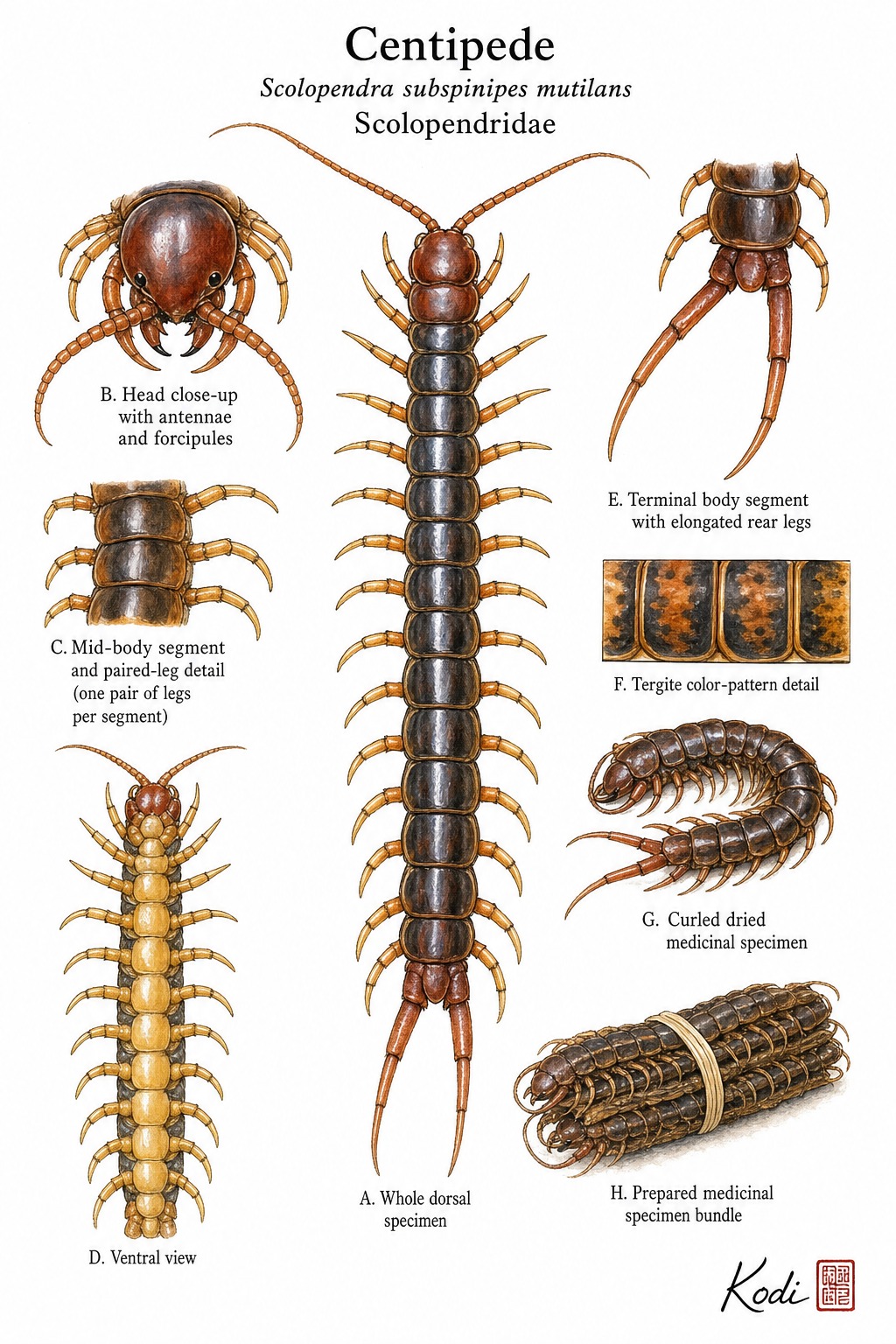
Known in TCM as Wu Gong (蜈蚣), this acrid, warm herb enters the Liver. Traditionally, it extinguishes wind and stops spasms - Wu Gong is one of the stronger animal medicinals for convulsions, tetanus, epilepsy, severe muscle spasm, and stubborn internal-wind disorders, and is traditionally considered more forceful than Quan Xie in this role, most often applied for epilepsy, migraine, and joint pain. Modern research has identified Scolopendrasin among its active constituents.
Also Known As
Latin: Scolopendra subspinipes mutilans | Pinyin: Wu Gong | Chinese: 蜈蚣
TCM Properties
- Taste
- acrid
- Temperature
- warm
- Channels
- Liver
Traditional Use
Primary Actions
- Extinguishes wind and stops spasms - Wu Gong is one of the stronger animal medicinals for convulsions, tetanus, epilepsy, severe muscle spasm, and stubborn internal-wind disorders, and is traditionally considered more forceful than Quan Xie in this role.
- Counteracts toxicity and dissipates nodules - it is classically used for sores, abscesses, scrofula, goiter, and toxic swellings, especially when the lesion is hard, painful, and resistant to milder treatment.
- Unblocks the collaterals and alleviates pain - Wu Gong is selected for severe wind-damp arthralgia, numbness, stubborn headache, and post-stroke channel obstruction when ordinary herbs have failed to penetrate deeply enough.
- Searches out stubborn, entrenched pathology - its strong penetrating nature makes it a medicine of refractory conditions rather than mild everyday use, whether the target is convulsive wind, painful obstruction, or fixed toxic masses.
Secondary Actions
- Wu Gong is commonly paired with Quan Xie, with centipede usually providing the more aggressive spasm-stopping and collateral-opening edge.
- Because it is warm and toxic, Wu Gong is usually given in small doses, often powdered or specially prepared, rather than in large decoction amounts.
Classic Formulas
- Zhi Jing San (止痉散) - classic convulsion-stopping powder pairing Wu Gong with Quan Xie for severe spasm, tetanus, and internal-wind presentations.
- Da Huo Luo Dan (大活络丹) - major collateral-unblocking formula in which Wu Gong contributes deep channel-opening action for wind-damp paralysis and post-stroke sequelae.
- Topical Wu Gong powder with tea leaves or other hardness-softening medicinals - traditional external approach for scrofula, abscesses, and stubborn nodules.
Classical References
- TCM Wiki records Wu Gong as pungent, warm, and toxic, entering the Liver channel and acting to extinguish wind, stop spasm, counteract toxin, dissipate nodules, unblock collaterals, and alleviate pain.
- The Shen Nong Ben Cao Jing tradition preserves Wu Gong as a recognized medicinal animal substance and later formula literature repeatedly pairs it with Quan Xie for severe convulsive or obstructive disorders.
- Traditional teaching repeatedly warns that Wu Gong is toxic and contraindicated in pregnancy, so dosage discipline is central to safe use.
Modern Research
Active Compounds
- Scolopendrasin IX (bioactive peptide) - centipede-derived antimicrobial peptide studied for anti-inflammatory and rheumatoid-arthritis effects
- Scolopentide (small peptide, sequence RAQNHYCK) - isolated antihepatoma peptide from Scolopendra subspinipes mutilans
- Ion-channel-active centipede toxins such as Ssm6a/SsTx families - venom peptides that help explain the animal's potent neuroactive profile
- Venom enzymes and polypeptide fractions - complex proteinaceous constituents involved in analgesic, inflammatory, and cytotoxic research
- Biogenic amines and small-molecule metabolites - support the broader pharmacologic complexity of animal-derived centipede extracts
Studied Effects
- A centipede-derived antimicrobial peptide, scolopendrasin IX, showed therapeutic effects in rheumatoid-arthritis models through formyl peptide receptor 2 signaling and inflammatory-cytokine regulation (PMID 30279454).
- Scolopendra subspinipes mutilans extract suppressed inflammatory and neuropathic pain in vitro and in vivo, supporting the traditional use of Wu Gong for stubborn painful obstruction and severe pain states (PMID 30647762).
- An antihepatoma peptide called scolopentide was isolated from Scolopendra subspinipes mutilans and shown to promote apoptosis-related antitumor activity in hepatocellular-cancer models (PMID 37032730).
PubMed References
- A novel antimicrobial peptide acting via formyl peptide receptor 2 shows therapeutic effects against rheumatoid arthritis (2018)
- Scolopendra subspinipes mutilans Extract Suppresses Inflammatory and Neuropathic Pain In Vitro and In Vivo (2019)
- Antihepatoma peptide, scolopentide, derived from the centipede scolopendra subspinipes mutilans (2023)
Safety & Interactions
Contraindications
- Pregnancy
- Known severe arthropod allergy
- Blood deficiency without wind, toxin, or obstruction pathology
- Any unsupervised internal use
Cautions
- Wu Gong is a toxic animal medicine and should be used only in very small supervised doses
- Potential risks include allergic reaction, mucosal irritation, and exaggerated neurologic or inflammatory responses in sensitive patients
- As with other animal medicinals, proper sourcing and processing are essential to reduce contamination and adulteration risks
- MSK page not found - drug interaction data not available from Memorial Sloan Kettering integrative medicine database
Conditions
Frequently Asked Questions
What is Centipede used for?
Centipede is traditionally used to Extinguishes wind and stops spasms - Wu Gong is one of the stronger animal medicinals for convulsions, tetanus, epilepsy, severe muscle spasm, and stubborn internal-wind disorders, and is traditionally considered more forceful than Quan Xie in this role., Counteracts toxicity and dissipates nodules - it is classically used for sores, abscesses, scrofula, goiter, and toxic swellings, especially when the lesion is hard, painful, and resistant to milder treatment., Unblocks the collaterals and alleviates pain - Wu Gong is selected for severe wind-damp arthralgia, numbness, stubborn headache, and post-stroke channel obstruction when ordinary herbs have failed to penetrate deeply enough., Searches out stubborn, entrenched pathology - its strong penetrating nature makes it a medicine of refractory conditions rather than mild everyday use, whether the target is convulsive wind, painful obstruction, or fixed toxic masses.. Research has investigated its effects on: A centipede-derived antimicrobial peptide, scolopendrasin IX, showed therapeutic effects in rheumatoid-arthritis models through formyl peptide receptor 2 signaling and inflammatory-cytokine regulation (PMID 30279454).; Scolopendra subspinipes mutilans extract suppressed inflammatory and neuropathic pain in vitro and in vivo, supporting the traditional use of Wu Gong for stubborn painful obstruction and severe pain states (PMID 30647762)..
What are other names for Centipede?
Centipede is also known as Scolopendra. In TCM: 蜈蚣 (Wu Gong); Scolopendra subspinipes mutilans.
Is Centipede safe during pregnancy?
Centipede is not recommended during pregnancy.
What are the contraindications for Centipede?
Centipede should not be used in: Pregnancy; Known severe arthropod allergy; Blood deficiency without wind, toxin, or obstruction pathology; Any unsupervised internal use. Consult a qualified practitioner before use.