Charred Areca Seed
- Chinese
- 焦槟榔
- Pinyin
- Jiao Bing Lang
- Latin
- Semen Arecae Praeparata
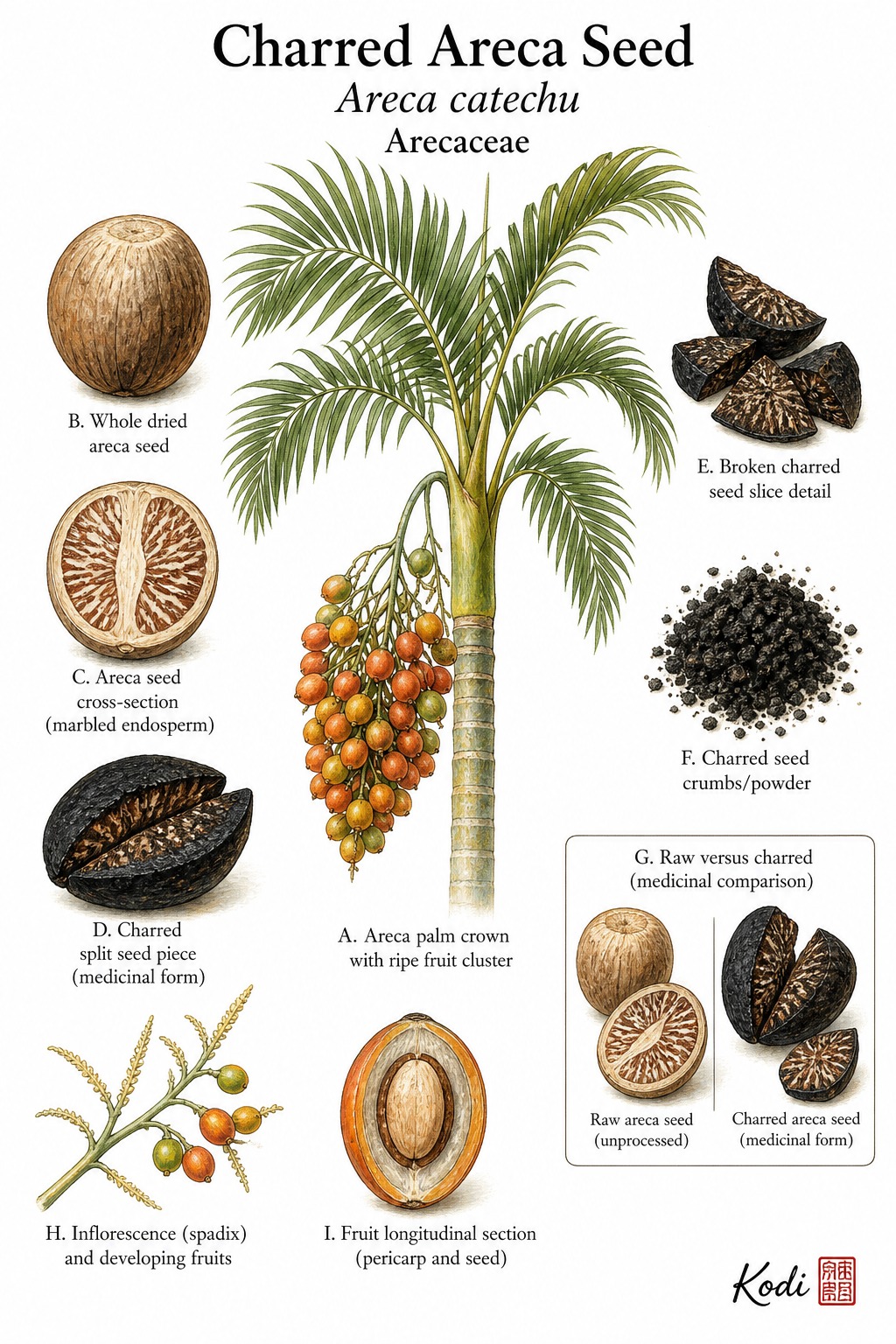
Known in TCM as Jiao Bing Lang (焦槟榔), this bitter and acrid, warm herb enters the Stomach and Large Intestine. Traditionally, it resolves food stagnation and guides turbidity downward - Jiao Bing Lang is the scorched digestant form of areca seed, used when overeating or retained food causes focal distension, fullness below the heart, belching, sour regurgitation, constipation, or difficult passage of stool and gas, most often applied for indigestion, abdominal distension, and diarrhea. Modern research has identified Arecoline among its active constituents.
Part used: Seed
Also Known As
Latin: Semen Arecae Praeparata | Pinyin: Jiao Bing Lang | Chinese: 焦槟榔
TCM Properties
- Taste
- bitter, acrid
- Temperature
- warm
- Channels
- Stomach, Large Intestine
Traditional Use
Primary Actions
- Resolves food stagnation and guides turbidity downward - Jiao Bing Lang is the scorched digestant form of areca seed, used when overeating or retained food causes focal distension, fullness below the heart, belching, sour regurgitation, constipation, or difficult passage of stool and gas.
- Moves Qi and harmonizes the Stomach with less harshness than raw Bing Lang - the charring process moderates the drastic Qi-breaking nature of the unprocessed seed while preserving its ability to break up stubborn middle-jiao stagnation and tenesmus-type abdominal oppression.
- Helps check diarrhea or dysenteric urgency when unresolved food retention is the root - compared with the raw form, Jiao Bing Lang is preferred when food stagnation is combined with loose stools, foul diarrhea, or dysenteric straining because the scorched preparation gains a mildly astringing bowel-stabilizing quality.
- Retains a downward-directing digestive action rather than serving as a primary anthelmintic - some parasite-expelling potential remains, but the processed form is chiefly chosen for middle-burner food accumulation rather than the stronger worm-expelling applications of raw Bing Lang.
Secondary Actions
- Jiao Bing Lang is commonly added when formulas such as Bao He Wan need a stronger downward-moving component for marked abdominal distension, pediatric food stagnation, or stubborn post-prandial fullness.
- In late traditional dispensing language, it often appears alongside Jiao Shan Zha, Jiao Shen Qu, and Jiao Mai Ya as part of the broader charred-digestant strategy sometimes called Jiao Si Xian, emphasizing food reduction over purgation.
Classic Formulas
- Jiao Si Xian (焦四仙) - charred hawthorn, charred medicated leaven, charred malt, and charred areca seed used together for stubborn food accumulation, bloating, foul stool, and pediatric or adult overeating patterns.
- Bao He Wan modifications with Jiao Bing Lang (保和丸加焦槟榔) - used when ordinary food-stagnation formulas need stronger downward movement for pronounced abdominal fullness, constipation, or tenesmus.
- Digestive formulas for dysenteric food stagnation - regional practice often adds Jiao Bing Lang when retained food, foul diarrhea, and incomplete evacuation occur together.
Classical References
- Me and Qi's Bing Lang processing notes state that Jiao Bing Lang further reduces the herb's drastic Qi-breaking and parasite-killing properties while enhancing digestive action for food accumulation, especially when diarrhea or dysentery with tenesmus is present.
- American Dragon distinguishes scorched areca from the raw and dry-fried forms, noting that Jiao Bing Lang primarily reduces and guides out to harmonize Stomach Qi and is generally used for middle-jiao food stagnation.
- PROCESSING NOTE: this entry intentionally distinguishes the scorched digestant form from raw Bing Lang, whose stronger parasite-expelling and edema-draining actions carry a harsher safety profile.
Modern Research
Active Compounds
- Arecoline (parasympathomimetic alkaloid) - the signature areca constituent linked to cholinergic GI-motility effects as well as dependence and toxicity concerns
- Arecaidine, guvacoline, and guvacine (areca alkaloids) - related alkaloids central to the seed's neuroactive and toxicologic profile
- Condensed tannins and procyanidin-type polyphenols - astringent seed constituents relevant to both traditional bowel effects and mucosal irritation concerns
- Catechin-like phenolics and flavanes - antioxidant-type constituents still detectable in areca seed research despite the dominant toxicology narrative
- Minor flavane derivatives from Areca catechu seed - newer seed-isolation studies suggest additional antibacterial and redox-active constituents beyond the classic alkaloids
Studied Effects
- A modern review of betel nut chemistry, pharmacology, and toxicology summarizes alkaloids such as arecoline, arecaidine, guvacoline, and guvacine while also emphasizing the seed's GI, neurologic, metabolic, and toxicologic effects rather than treating it as a benign food herb (PMID 34457017).
- A dedicated carcinogenicity review details how areca nut metabolites contribute to oral fibrosis, genotoxic stress, and tumor-promoting pathways, reinforcing why even processed medicinal areca deserves high-risk handling and only short supervised use (PMID 36961055).
- Experimental supplementation work in laying hens found that Areca catechu reduced fecal parasites and improved cecal histopathology, supporting the older antiparasitic reputation of raw Bing Lang while not overriding the processed form's main digestive use in TCM (PMID 35874604).
PubMed References
- Chemical Composition, Pharmacological, and Toxicological Effects of Betel Nut (2021)
- Carcinogenic Effects of Areca Nut and Its Metabolites: A Review of the Experimental Evidence (2023)
- Areca catechu L. and Anredera cordifolia (Ten) Steenis supplementation reduces faecal parasites and improves caecal histopathology in laying hens (2022)
Safety & Interactions
Contraindications
- Pregnancy
- Qi deficiency or prolapse without true food accumulation
- Known betel-nut-related oral submucosal fibrosis or prior areca-related mucosal disease
- Any long-term unsupervised internal use
Cautions
- Areca seed carries a modern carcinogenicity concern and should not be used as a casual food or wellness product simply because the TCM dose is smaller than recreational betel chewing
- Even the scorched form can provoke nausea, salivation, abdominal discomfort, dizziness, or cholinergic-type symptoms in sensitive users
- Processing moderates the harshness of raw Bing Lang but does not make the material non-toxic or appropriate for prolonged use
- MSK page not found - drug interaction data not available from Memorial Sloan Kettering integrative medicine database
Conditions
- Indigestion Traditional ★★★★☆ JSON
- Abdominal Distension Traditional ★★★★☆ JSON
- Diarrhea Traditional ★★★☆☆ JSON
- Dysentery Traditional ★★★☆☆ JSON
Frequently Asked Questions
What is Charred Areca Seed used for?
Charred Areca Seed is traditionally used to Resolves food stagnation and guides turbidity downward - Jiao Bing Lang is the scorched digestant form of areca seed, used when overeating or retained food causes focal distension, fullness below the heart, belching, sour regurgitation, constipation, or difficult passage of stool and gas., Moves Qi and harmonizes the Stomach with less harshness than raw Bing Lang - the charring process moderates the drastic Qi-breaking nature of the unprocessed seed while preserving its ability to break up stubborn middle-jiao stagnation and tenesmus-type abdominal oppression., Helps check diarrhea or dysenteric urgency when unresolved food retention is the root - compared with the raw form, Jiao Bing Lang is preferred when food stagnation is combined with loose stools, foul diarrhea, or dysenteric straining because the scorched preparation gains a mildly astringing bowel-stabilizing quality., Retains a downward-directing digestive action rather than serving as a primary anthelmintic - some parasite-expelling potential remains, but the processed form is chiefly chosen for middle-burner food accumulation rather than the stronger worm-expelling applications of raw Bing Lang.. Research has investigated its effects on: A modern review of betel nut chemistry, pharmacology, and toxicology summarizes alkaloids such as arecoline, arecaidine, guvacoline, and guvacine while also emphasizing the seed's GI, neurologic, metabolic, and toxicologic effects rather than treating it as a benign food herb (PMID 34457017).; A dedicated carcinogenicity review details how areca nut metabolites contribute to oral fibrosis, genotoxic stress, and tumor-promoting pathways, reinforcing why even processed medicinal areca deserves high-risk handling and only short supervised use (PMID 36961055)..
What are other names for Charred Areca Seed?
Charred Areca Seed is also known as Areca. In TCM: 焦槟榔 (Jiao Bing Lang); Semen Arecae Praeparata.
Is Charred Areca Seed safe during pregnancy?
Charred Areca Seed is not recommended during pregnancy.
What are the contraindications for Charred Areca Seed?
Charred Areca Seed should not be used in: Pregnancy; Qi deficiency or prolapse without true food accumulation; Known betel-nut-related oral submucosal fibrosis or prior areca-related mucosal disease; Any long-term unsupervised internal use. Consult a qualified practitioner before use.