Child's Urine
- Chinese
- 童便
- Pinyin
- Tong Bian
- Latin
- Urina Hominis
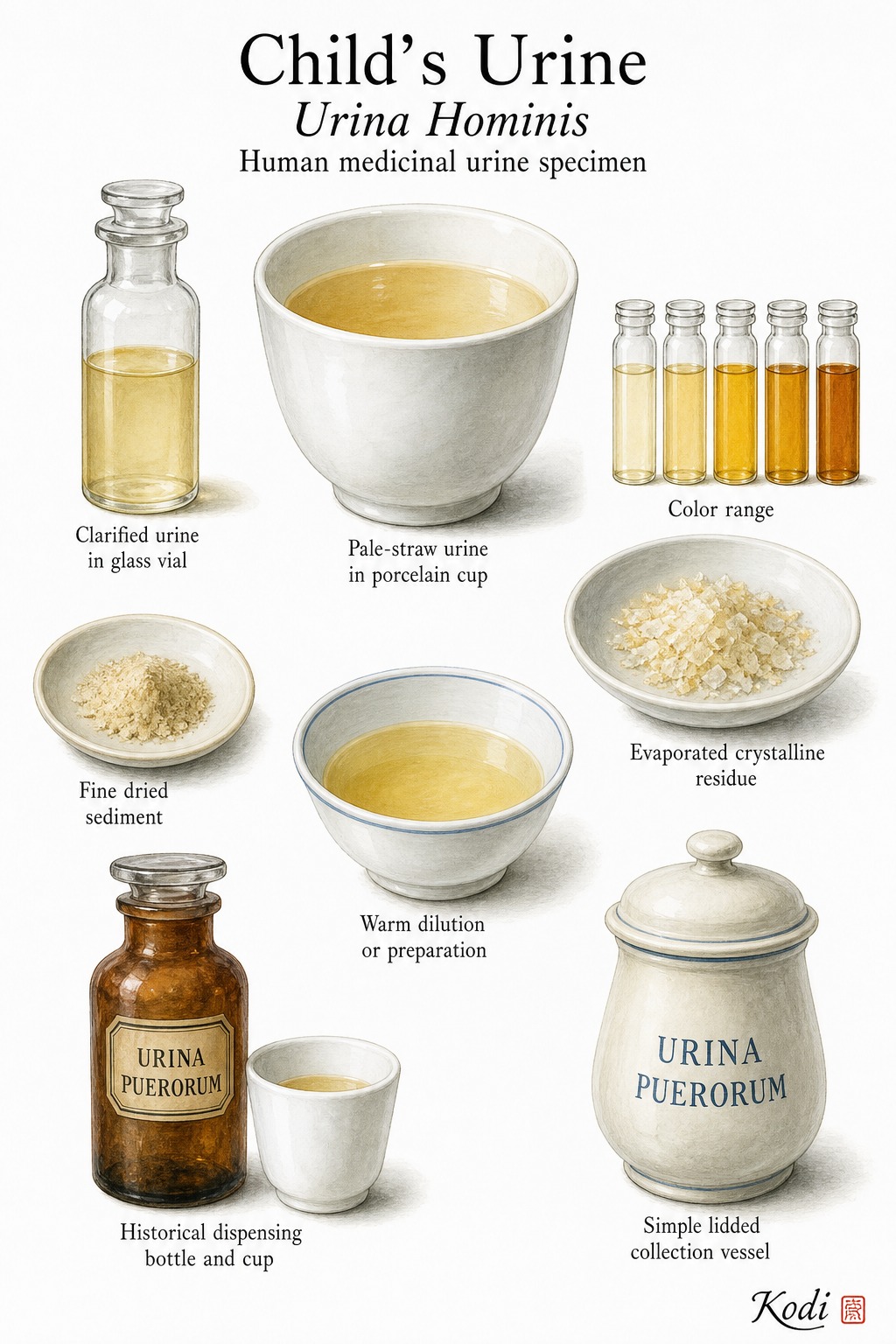
Known in TCM as Tong Bian (童便), this salty, cold herb enters the Heart, Lung, Bladder, and Kidney. Traditionally, it nourishes Yin and descends deficiency fire - Tong Bian is an old special medicinal substance used when heat signs arise from yin depletion, especially coughing or bleeding with dryness and internal heat, most often applied for traumatic injury, hemoptysis, and uterine bleeding. Modern research has identified Urea among its active constituents.
Part used: Urine
Also Known As
Latin: Urina Hominis | Pinyin: Tong Bian | Chinese: 童便
TCM Properties
- Taste
- salty
- Temperature
- cold
- Channels
- Heart, Lung, Bladder, Kidney
Traditional Use
Primary Actions
- Nourishes Yin and descends deficiency fire - Tong Bian is an old special medicinal substance used when heat signs arise from yin depletion, especially coughing or bleeding with dryness and internal heat.
- Stops bleeding while cooling the blood - classical indications include nosebleed, hemoptysis, hematemesis, and other bleeding presentations attributed to heat or consumptive irritation.
- Dispels blood stasis from trauma or postpartum retention - it appears in old records for traumatic pain, congealed blood, and postpartum faintness or pain where stasis and fluid loss coexist.
- Functions as a medicated guide or formula vehicle as much as a stand-alone substance - in older prescribing, Tong Bian often directs mineral or blood-moving medicinals downward while tempering excessive heat.
Secondary Actions
- Tong Bian is largely a historical materia medica item and is rarely used in contemporary practice except as a textual reference, because hygiene, ethics, and safer substitutes have changed clinical norms.
- Many modern formula write-ups preserve Tong Bian only as a historical preparation note and explicitly omit it from present-day dispensing.
Classic Formulas
- Hua Rui Shi San (花蕊石散) - classical emergency bleeding formula traditionally taken with warmed Tong Bian to guide the calcined minerals inward and downward while transforming stasis.
- Xiao Ding Feng Zhu (小定风珠) - older yin-fluid depletion formula in which Tong Bian appears as a minor fluid-nourishing, downward-guiding component.
- Sheng Hua Tang historical preparations (生化汤旧法) - some older postpartum methods record Tong Bian as a preparation liquid, though modern practice omits it.
Classical References
- TCM Wiki identifies Tong Bian under the broader Ren Niao / Urina Hominis tradition and gives actions of nourishing yin, lowering fire, stopping bleeding, and dissipating blood stasis.
- Me and Qi formula monographs for Hua Rui Shi San, Da Ding Feng Zhu, and Sheng Hua Tang all preserve Tong Bian as a historical vehicle or ingredient while noting that it is generally no longer used in modern practice.
- IMPORT NOTE: the XLSX stub labeled this item as 'Child's Dung,' but Tong Bian (童便) refers to child's urine, historically from healthy prepubescent boys.
Modern Research
Active Compounds
- Urea (nitrogenous metabolite) - the dominant small-molecule solute in human urine, relevant to historical interpretations of drying and cleansing effects rather than to modern herb standardization
- Uric acid and creatinine (urinary metabolites) - characteristic nitrogenous waste constituents that reflect the material's physiologic origin more than a targeted medicinal phytochemistry
- Electrolyte salts such as sodium, potassium, and chloride - major inorganic urinary fractions sometimes cited in historical external-use rationales
Safety & Interactions
Contraindications
- Any unscreened or improvised self-collection for internal use
- Known urinary-tract or systemic infection risk in the donor
- Use in immunocompromised patients or on broken tissue without medical oversight
Cautions
- The main modern concern is biohazard and contamination rather than classical thermal nature, so this should be treated as a historical medicinal substance, not a home remedy
- Contemporary practice usually replaces Tong Bian with safer formula adjustments rather than using human urine directly
- MSK page not found - drug interaction data not available from Memorial Sloan Kettering integrative medicine database
Conditions
- Traumatic Injury Traditional ★★★☆☆ JSON
- Hemoptysis Traditional ★★★☆☆ JSON
- Uterine Bleeding Traditional ★★☆☆☆ JSON
Frequently Asked Questions
What is Child's Urine used for?
Child's Urine is traditionally used to Nourishes Yin and descends deficiency fire - Tong Bian is an old special medicinal substance used when heat signs arise from yin depletion, especially coughing or bleeding with dryness and internal heat., Stops bleeding while cooling the blood - classical indications include nosebleed, hemoptysis, hematemesis, and other bleeding presentations attributed to heat or consumptive irritation., Dispels blood stasis from trauma or postpartum retention - it appears in old records for traumatic pain, congealed blood, and postpartum faintness or pain where stasis and fluid loss coexist., Functions as a medicated guide or formula vehicle as much as a stand-alone substance - in older prescribing, Tong Bian often directs mineral or blood-moving medicinals downward while tempering excessive heat..
What are other names for Child's Urine?
Child's Urine is also known as Hominis. In TCM: 童便 (Tong Bian); Urina Hominis.
Is Child's Urine safe during pregnancy?
The safety of Child's Urine during pregnancy has not been established. Consult a qualified healthcare provider before use.
What are the contraindications for Child's Urine?
Child's Urine should not be used in: Any unscreened or improvised self-collection for internal use; Known urinary-tract or systemic infection risk in the donor; Use in immunocompromised patients or on broken tissue without medical oversight. Consult a qualified practitioner before use.