Chinaroot Greenbrier Rhizome
- Chinese
- 菝葜
- Pinyin
- Ba Qia
- Latin
- Rhizoma Smilacis Chinensis
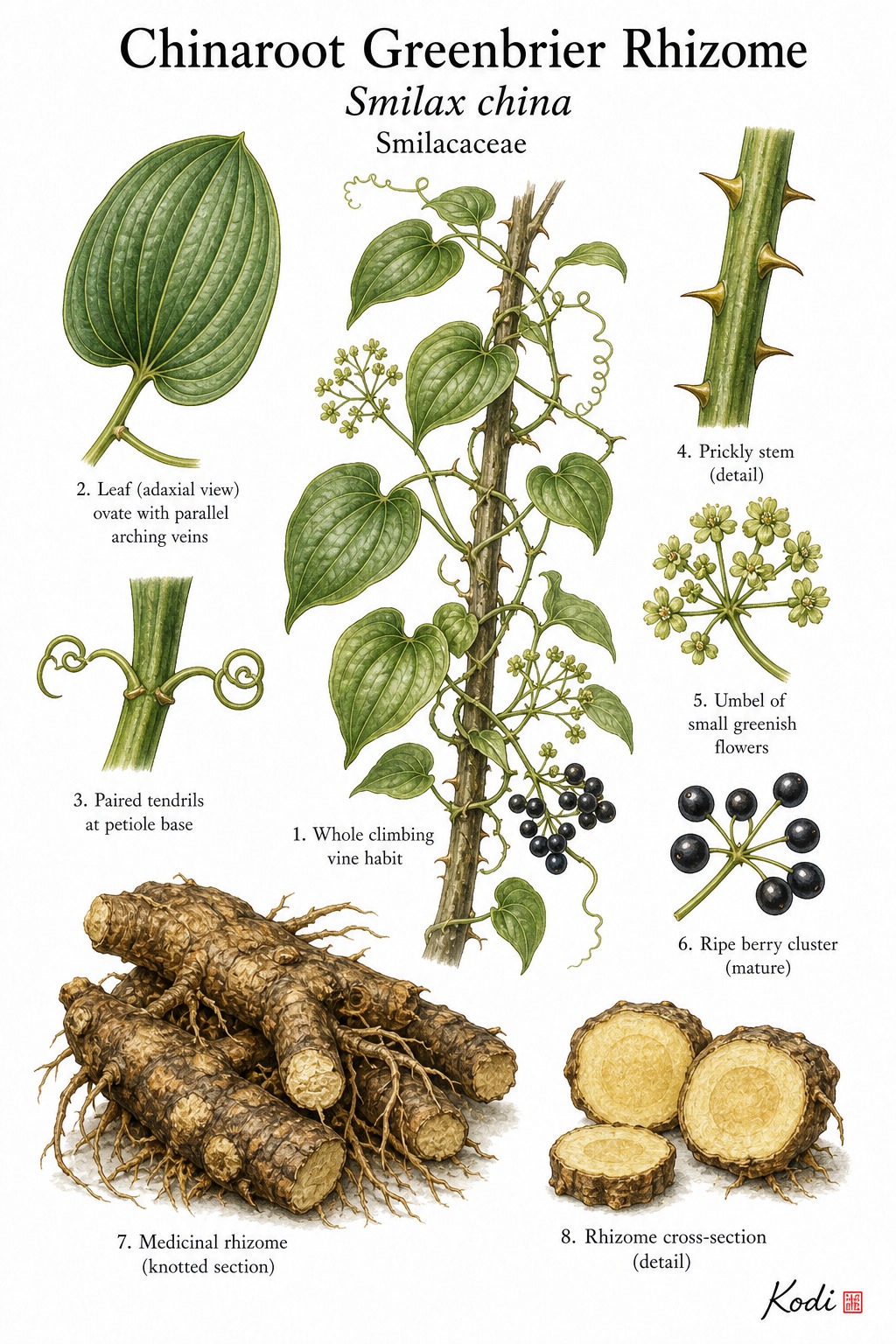
Known in TCM as Ba Qia (菝葜), this sweet and bitter, neutral herb enters the Liver and Kidney. Traditionally, it dispels wind-damp and relieves painful obstruction - Ba Qia is used for chronic joint pain, rheumatic arthralgia, low-back soreness, and heaviness or numbness in the limbs when dampness lodges in the channels, most often applied for joint pain, rheumatism, and psoriasis. Modern research has identified Furostanol among its active constituents.
Part used: Rhizome
Also Known As
Latin: Rhizoma Smilacis Chinensis | Pinyin: Ba Qia | Chinese: 菝葜
TCM Properties
- Taste
- sweet, bitter
- Temperature
- neutral
- Channels
- Liver, Kidney
Traditional Use
Primary Actions
- Dispels wind-damp and relieves painful obstruction - Ba Qia is used for chronic joint pain, rheumatic arthralgia, low-back soreness, and heaviness or numbness in the limbs when dampness lodges in the channels.
- Resolves toxic heat and reduces swelling - traditional indications extend to sores, carbuncles, damp-toxic skin eruptions, hemorrhoids, and older venereal-damp-heat presentations such as gonorrhea or syphilitic lesions.
- Promotes urination and separates turbidity - it is applied when damp-heat causes strangury, turbid urine, leukorrhea, or lingering lower-burner congestion.
- Assists in lingering dysenteric and damp-toxic digestive disorders - folk and regional use includes gastroenteritis, dysentery, and other inflammatory intestinal complaints with heat and damp accumulation.
Secondary Actions
- Ba Qia is also known regionally as Jin Gang Teng and has a stronger damp-toxic and channel-unblocking identity than a purely nutritive or tonic one.
- Fresh leaves and rhizome preparations appear in folk external practice for burns, sores, and swollen skin lesions, showing that the detoxifying aspect is not limited to internal use.
Classic Formulas
- Ba Qia Jiu (菝葜酒) - folk rhizome-in-wine preparation used for chronic rheumatic pain, channel obstruction, and lower-limb stiffness.
- Ba Qia with Tu Fu Ling and Ku Shen (菝葜配土茯苓苦参) - regional damp-toxic pairing for genital, skin, or lower-burner disorders with heat, itching, swelling, or discharge.
- Ba Qia with Bian Xu or Jin Qian Cao (菝葜配萹蓄金钱草) - used when urinary turbidity, strangury, damp-heat, and painful lower-burner obstruction occur together.
Classical References
- A recent ethnopharmacology review of Smilax china notes long Chinese use for pain, rheumatic disorders, dysentery, pelvic inflammation, burns, and damp-toxic conditions, citing early materia medica back to the Supplementary Records of Famous Physicians.
- Yin Yang House places Ba Qia among herbs that dispel wind-damp, entering the Kidney and Liver channels and emphasizing arthritic pain, diarrhea or dysentery, skin infection, gonorrhea, syphilis, hemorrhoids, and leukorrhea.
- SOURCE NOTE: some English TCM databases describe Ba Qia as sweet-sour and slightly warm, while pharmacopoeia-oriented summaries often describe it as sweet-slightly bitter and neutral; this entry follows the latter because the schema requires a single temperature value.
Modern Research
Active Compounds
- Furostanol and other steroidal saponins such as chongrenside D - major anti-inflammatory and bone-protective constituents isolated from Smilax china rhizome
- Flavonoids and epicatechin derivatives - polyphenolic compounds repeatedly linked to anti-inflammatory, antioxidant, and cytotoxic activity
- Phenylpropanoid glycosides such as smilasides - distinctive Smilax constituents investigated for antitumor potential
- Tannins and broader phenolic fractions - supportive redox-active constituents relevant to anti-inflammatory and barrier-repair research
Studied Effects
- A 2024 review summarized 134 identified constituents of Smilax china and linked the herb to anti-inflammatory, antibacterial, antidiabetic, anti-hyperuricemic, and wound-barrier effects, providing a modern overview of why Ba Qia persists in damp-toxic and rheumatic practice (PMID 37541403).
- Rhizome-derived furostanol saponins showed anti-inflammatory activity in cell testing, helping explain Ba Qia's traditional use for swollen painful damp-toxic disorders (PMID 30273696).
- Chongrenside D from Smilax china protected against inflammation-induced joint destruction by inhibiting osteoclastogenesis, giving a modern mechanistic correlate for the herb's use in painful obstruction and inflammatory bone-joint disease (PMID 39430543).
- An aqueous Smilax china extract demonstrated anti-inflammatory and anti-nociceptive activity with evidence of COX-2 suppression, supporting old uses for rheumatic pain and swelling (PMID 16387460).
PubMed References
- Smilax china L.: A review of its botany, ethnopharmacology, phytochemistry, pharmacological activities, actual and potential applications (2024)
- Anti-inflammatory furostanol saponins from the rhizomes of Smilax china L (2018)
- Chongrenside D from Smilax china L protects against inflammation-induced joint destruction via inhibiting osteoclastogenesis (2024)
- Anti-inflammatory and anti-nociceptive activities of Smilax china L. aqueous extract (2006)
Safety & Interactions
Contraindications
- Yin deficiency with heat or significant fluid depletion
- Marked deficiency patterns without dampness, toxicity, or painful obstruction
- Use based on species confusion with other Smilax rhizomes
Cautions
- Source data vary between neutral and slightly warm classification, so clinicians usually focus more on Ba Qia's damp-toxic and channel-unblocking actions than on strong temperature effects
- Smilax species are often confused in trade, so Ba Qia should be authenticated rather than assumed interchangeable with Tu Fu Ling or other sarsaparilla-like rhizomes
- MSK page not found - drug interaction data not available from Memorial Sloan Kettering integrative medicine database
Conditions
- Joint Pain Traditional ★★★☆☆ JSON
- Rheumatism Traditional ★★★☆☆ JSON
- Psoriasis Traditional ★★☆☆☆ JSON
- Syphilis Traditional ★★☆☆☆ JSON
Frequently Asked Questions
What is Chinaroot Greenbrier Rhizome used for?
Chinaroot Greenbrier Rhizome is traditionally used to Dispels wind-damp and relieves painful obstruction - Ba Qia is used for chronic joint pain, rheumatic arthralgia, low-back soreness, and heaviness or numbness in the limbs when dampness lodges in the channels., Resolves toxic heat and reduces swelling - traditional indications extend to sores, carbuncles, damp-toxic skin eruptions, hemorrhoids, and older venereal-damp-heat presentations such as gonorrhea or syphilitic lesions., Promotes urination and separates turbidity - it is applied when damp-heat causes strangury, turbid urine, leukorrhea, or lingering lower-burner congestion., Assists in lingering dysenteric and damp-toxic digestive disorders - folk and regional use includes gastroenteritis, dysentery, and other inflammatory intestinal complaints with heat and damp accumulation.. Research has investigated its effects on: A 2024 review summarized 134 identified constituents of Smilax china and linked the herb to anti-inflammatory, antibacterial, antidiabetic, anti-hyperuricemic, and wound-barrier effects, providing a modern overview of why Ba Qia persists in damp-toxic and rheumatic practice (PMID 37541403).; Rhizome-derived furostanol saponins showed anti-inflammatory activity in cell testing, helping explain Ba Qia's traditional use for swollen painful damp-toxic disorders (PMID 30273696)..
What are other names for Chinaroot Greenbrier Rhizome?
Chinaroot Greenbrier Rhizome is also known as Smilacis. In TCM: 菝葜 (Ba Qia); Rhizoma Smilacis Chinensis.
Is Chinaroot Greenbrier Rhizome safe during pregnancy?
The safety of Chinaroot Greenbrier Rhizome during pregnancy has not been established. Consult a qualified healthcare provider before use.
What are the contraindications for Chinaroot Greenbrier Rhizome?
Chinaroot Greenbrier Rhizome should not be used in: Yin deficiency with heat or significant fluid depletion; Marked deficiency patterns without dampness, toxicity, or painful obstruction; Use based on species confusion with other Smilax rhizomes. Consult a qualified practitioner before use.