Chinese Chive Seed
- Chinese
- 韭菜子
- Pinyin
- Jiu Cai Zi
- Latin
- Semen Allii Tuberosi
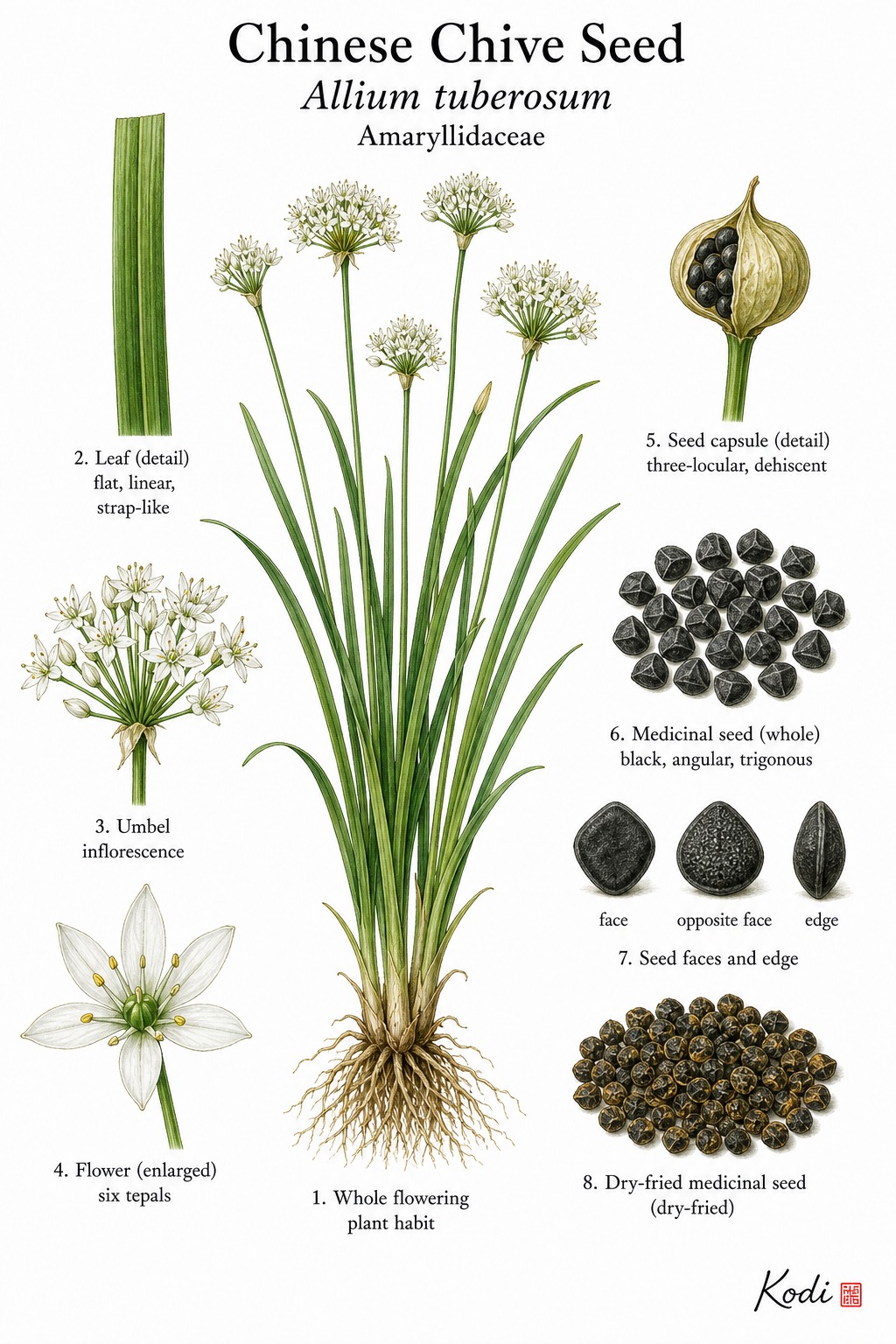
Known in TCM as Jiu Cai Zi (韭菜子), this sweet and acrid, warm herb enters the Liver and Kidney. Traditionally, it warms and tonifies Liver-Kidney Yang while securing essence - Jiu Cai Zi is chosen when weakness of the lower burner leads to impotence, reduced libido, infertility, nocturnal emission, spermatorrhea, and a cold sore low back or knees rather than an excess heat pattern, most often applied for erectile dysfunction, frequent urination, and infertility. Modern research has identified Tuberoside among its active constituents.
Part used: Seed
Also Known As
Latin: Semen Allii Tuberosi | Pinyin: Jiu Cai Zi | Chinese: 韭菜子
TCM Properties
- Taste
- sweet, acrid
- Temperature
- warm
- Channels
- Liver, Kidney
Traditional Use
Primary Actions
- Warms and tonifies Liver-Kidney Yang while securing essence - Jiu Cai Zi is chosen when weakness of the lower burner leads to impotence, reduced libido, infertility, nocturnal emission, spermatorrhea, and a cold sore low back or knees rather than an excess heat pattern.
- Secures the lower gate and helps the Bladder contain fluids - its warming-astringing combination makes it useful for frequent urination, enuresis, urinary dribbling, or clear profuse discharge when Kidney Qi and Yang are too weak to hold urine and essence.
- Assists chronic diarrhea and lower-body cold from deficiency - traditional use extends beyond sexual medicine to patterns where Spleen-Kidney deficiency cold causes dawn diarrhea, abdominal chill, or long-standing weakness with leakage symptoms.
- Supports reproductive function without being as harsh as stronger Yang tonics - compared with hotter restoratives, Jiu Cai Zi is often used as a focused seed medicine when the clinical priority is to warm, stabilize, and retain rather than aggressively rekindle collapse-level Yang deficiency.
Secondary Actions
- Later materia medica and modern teaching often mention salt-processed or dry-fried Jiu Cai Zi when the intention is to strengthen its Kidney-directing and essence-securing effect in pill or powder formulas.
- Some lineage teaching also preserves a smaller Stomach-warming role, using the seed for chronic hiccup or vomiting from middle-jiao cold when lower-burner deficiency and cold are part of the broader pattern.
Classic Formulas
- Zan Yu Dan (赞育丹) - from Jing Yue Quan Shu, a major Kidney-Yang and fertility formula in which Jiu Cai Zi assists stronger Yang tonics by adding focused essence-securing and lower-gate warming for infertility and impotence from deficiency cold.
- Jiu Zi Tang (韭子汤) - a classical small-formula pattern described in later teaching as combining Jiu Cai Zi with Long Gu and Chi Shi Zhi for seminal emission or involuntary leakage that has not responded to simple warming alone.
- Kidney-warming leakage formulas with Sang Piao Xiao or Bu Gu Zhi - common classical pairing logic for enuresis, frequent urination, or spermatorrhea when the treatment goal is to warm the Kidneys and secure what is leaking.
Classical References
- TCM Wiki records Jiu Cai Zi as sweet, acrid, and warm, entering the Liver and Kidney channels, with the core actions of tonifying the Liver and Kidney, warming the waist and knees, tonifying Yang, and securing essence.
- Me and Qi expands the classical logic by emphasizing that Jiu Cai Zi is especially suited to leakage disorders because it both warms Kidney Yang and strengthens the containing function of the lower gate for urine, semen, and discharge.
- American Dragon preserves an older secondary indication for Stomach cold with vomiting or stubborn hiccup and also notes the stronger astringing character of the dry-fried preparation, showing how processing shifts the herb toward securing and warming.
Modern Research
Active Compounds
- Tuberoside and related tuberoside-series steroidal saponins - characteristic seed saponins repeatedly isolated from Allium tuberosum and linked to reproductive and endocrine interest
- Allituberoside-class steroidal glycosides - newer named glycosides from the seeds that were studied for their ability to promote testosterone production in Leydig-cell models
- Nicotianoside C and related steroidal glycosides - seed constituents identified in phytochemical isolation work that broaden the non-food medicinal profile of the seed
- Adenosine and nucleoside fractions - small polar constituents isolated from the seed that may contribute to broader metabolic and tissue-response effects
- Linoleic-acid-rich seed oil with palmitic and other fatty acids - the nutritional lipid fraction that distinguishes the seed chemically from the more familiar leafy vegetable
Studied Effects
- A rat behavioral study found that n-butanol extract of Allium tuberosum seeds significantly improved multiple sexual-behavior parameters, providing one of the clearest modern experimental correlates for the traditional use of Jiu Cai Zi in impotence and seminal weakness (PMID 19429330).
- A later in vitro and in vivo study reported corpus-cavernosum smooth-muscle relaxation together with improved mating-behavior measures in male rats, strengthening the modern pharmacologic rationale for its use in erectile dysfunction and reduced sexual function (PMID 29191197).
- A 2017 Food Research International study found antidiabetic and hepatoprotective effects from Allium tuberosum extract, including lower fasting glucose and inflammatory mediators plus improved antioxidant markers in animal models, suggesting that the seed's modern activity profile extends beyond reproduction (PMID 29196001).
- A 2020 phytochemical study isolated 27 steroidal glycosides from the seeds and reported that several promoted testosterone production in rat Leydig cells, directly linking seed chemistry to the classic Yang-tonifying and fertility-supportive reputation of Jiu Cai Zi (PMID 33266475).
PubMed References
- Aphrodisiac properties of Allium tuberosum seeds extract (2009)
- In vitro and in vivo aphrodisiac properties of the seed extract from Allium tuberosum on corpus cavernosum smooth muscle relaxation and sexual behavior parameters in male Wistar rats (2017)
- Allium tuberosum: Antidiabetic and hepatoprotective activities (2017)
- Steroidal Glycosides from Allium tuberosum Seeds and Their Roles in Promoting Testosterone Production of Rat Leydig Cells (2020)
Safety & Interactions
Contraindications
- Yin deficiency with flaring fire or obvious internal heat signs
- Damp-Heat or burning urinary disorders rather than cold deficiency
- Active toxic sores or inflammatory skin eruptions that worsen with warming substances
Cautions
- Although Chinese chive is a food plant, the seed is used medicinally as a warming astringent and excessive dosing can aggravate heat signs, mouth dryness, or gastric irritation in sensitive patients
- Traditional sources caution breastfeeding women who are trying to maintain milk supply because leek-family medicines are sometimes regarded as reducing lactation
- Use during pregnancy should be practitioner-directed rather than casual because the herb is warming and not typically chosen for the average pregnant presentation
- MSK page not found - drug interaction data not available from Memorial Sloan Kettering integrative medicine database
Conditions
- Erectile Dysfunction Traditional ★★★★☆ JSON
- Frequent Urination Traditional ★★★☆☆ JSON
- Infertility Traditional ★★★☆☆ JSON
- Kidney Yang Deficiency Traditional ★★★★☆ JSON
- Low Back Pain Traditional ★★☆☆☆ JSON
Frequently Asked Questions
What is Chinese Chive Seed used for?
Chinese Chive Seed is traditionally used to Warms and tonifies Liver-Kidney Yang while securing essence - Jiu Cai Zi is chosen when weakness of the lower burner leads to impotence, reduced libido, infertility, nocturnal emission, spermatorrhea, and a cold sore low back or knees rather than an excess heat pattern., Secures the lower gate and helps the Bladder contain fluids - its warming-astringing combination makes it useful for frequent urination, enuresis, urinary dribbling, or clear profuse discharge when Kidney Qi and Yang are too weak to hold urine and essence., Assists chronic diarrhea and lower-body cold from deficiency - traditional use extends beyond sexual medicine to patterns where Spleen-Kidney deficiency cold causes dawn diarrhea, abdominal chill, or long-standing weakness with leakage symptoms., Supports reproductive function without being as harsh as stronger Yang tonics - compared with hotter restoratives, Jiu Cai Zi is often used as a focused seed medicine when the clinical priority is to warm, stabilize, and retain rather than aggressively rekindle collapse-level Yang deficiency.. Research has investigated its effects on: A rat behavioral study found that n-butanol extract of Allium tuberosum seeds significantly improved multiple sexual-behavior parameters, providing one of the clearest modern experimental correlates for the traditional use of Jiu Cai Zi in impotence and seminal weakness (PMID 19429330).; A later in vitro and in vivo study reported corpus-cavernosum smooth-muscle relaxation together with improved mating-behavior measures in male rats, strengthening the modern pharmacologic rationale for its use in erectile dysfunction and reduced sexual function (PMID 29191197)..
What are other names for Chinese Chive Seed?
Chinese Chive Seed is also known as Allium. In TCM: 韭菜子 (Jiu Cai Zi); Semen Allii Tuberosi.
Is Chinese Chive Seed safe during pregnancy?
The safety of Chinese Chive Seed during pregnancy has not been established. Consult a qualified healthcare provider before use.
What are the contraindications for Chinese Chive Seed?
Chinese Chive Seed should not be used in: Yin deficiency with flaring fire or obvious internal heat signs; Damp-Heat or burning urinary disorders rather than cold deficiency; Active toxic sores or inflammatory skin eruptions that worsen with warming substances. Consult a qualified practitioner before use.