Chinese Lizardtail Herb
- Chinese
- 三白草
- Pinyin
- San Bai Cao
- Latin
- Saururi Herba
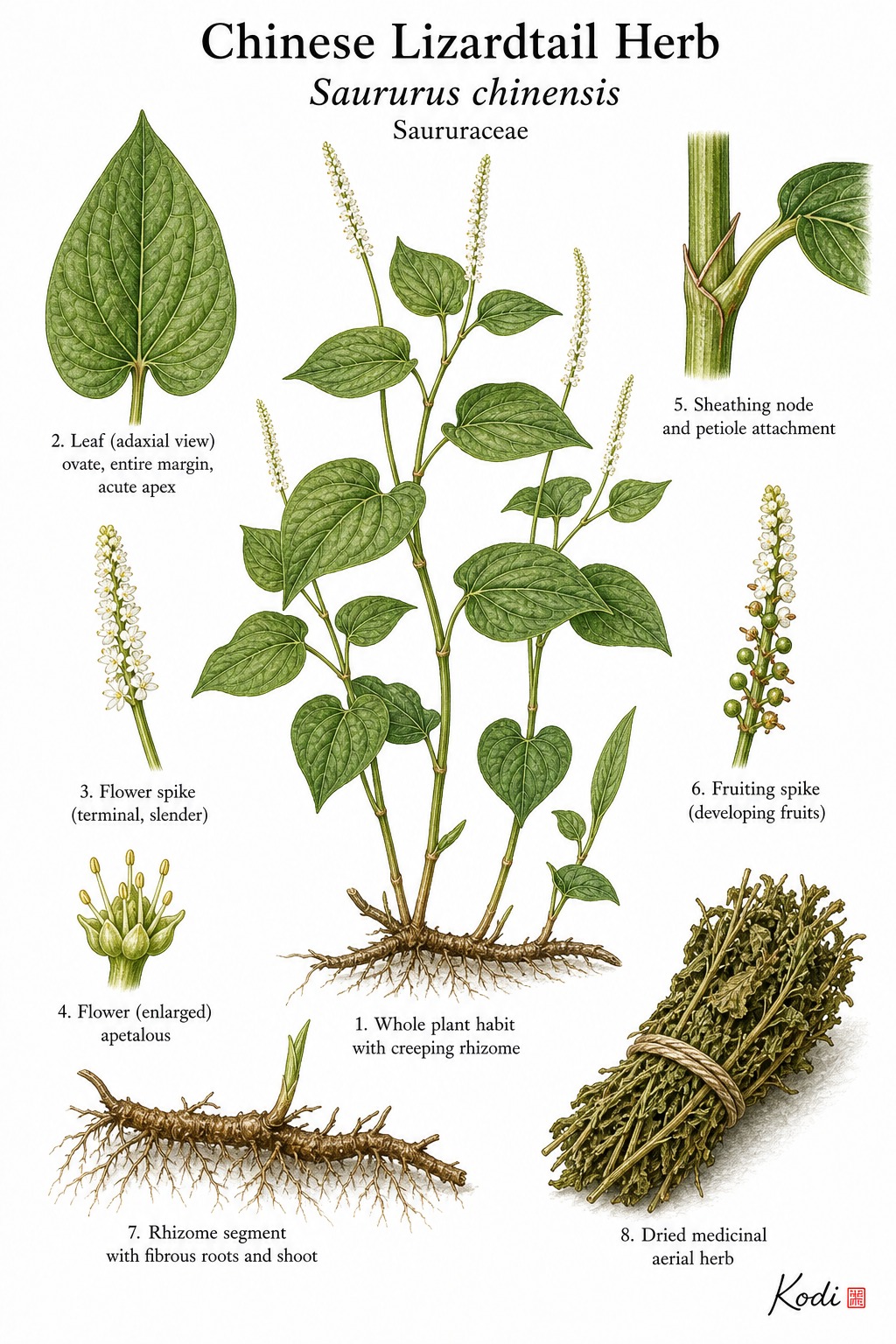
Known in TCM as San Bai Cao (三白草), this sweet and acrid, cold herb enters the Spleen, Bladder, and Large Intestine. Traditionally, it promotes urination and drains dampness for swelling and difficult urination - San Bai Cao is a damp-clearing herb used when edema, puffy limbs, scanty urine, turbid urine, or lower-body fluid retention arise from damp-heat or water stagnation rather than pure deficiency cold, most often applied for edema, jaundice, and eczema. Modern research has identified Sauchinone among its active constituents.
Part used: Whole herb
Also Known As
Latin: Saururi Herba | Pinyin: San Bai Cao | Chinese: 三白草
TCM Properties
- Taste
- sweet, acrid
- Temperature
- cold
- Channels
- Spleen, Bladder, Large Intestine
Traditional Use
Primary Actions
- Promotes urination and drains dampness for swelling and difficult urination - San Bai Cao is a damp-clearing herb used when edema, puffy limbs, scanty urine, turbid urine, or lower-body fluid retention arise from damp-heat or water stagnation rather than pure deficiency cold.
- Clears heat and resolves toxicity from the skin and flesh - traditional use includes infected sores, carbuncles, furuncles, weeping eczema, and other damp-toxic lesions in which the herb is taken internally or applied externally as a wash or poultice.
- Clears damp-heat from the lower burner - classical and folk indications include leukorrhea, urinary tract irritation, and pelvic damp-heat patterns where heat, discharge, swelling, and obstructed urination occur together.
- Reduces jaundice and damp-heat obstruction affecting the Liver and biliary pathways - regional practice uses San Bai Cao when yellowing, dark urine, edema, and inflammatory damp-heat signs cluster together.
Secondary Actions
- Because San Bai Cao is both draining and detoxifying, it often bridges internal damp-heat patterns and external skin disease better than herbs that only clear heat or only induce urination.
- Older folk and regional practice sometimes extends the herb to urinary gravel and stone-type problems, consistent with later experimental work on stone-component solubility.
Classic Formulas
- San Bai Cao with Yin Chen Hao and Che Qian Cao - a common damp-heat and jaundice combination used when edema, dark scanty urine, and yellow discoloration point to combined water retention and biliary damp-heat.
- San Bai Cao with Jin Yin Hua and Pu Gong Ying - toxin-clearing pairings used for carbuncles, furunculosis, breast-area swelling, or hot suppurative lesions that need both internal heat clearing and external detoxification.
- San Bai Cao wash with Ku Shen or Huang Bai - external application logic for damp-toxic eczema, itching, and weeping lesions where the herb's damp-draining and anti-inflammatory actions are used topically.
Classical References
- The modern Chinese Pharmacopoeia, summarized in a Planta Medica review, records Saururi herba as the dried aerial part of Saururus chinensis and lists edema, dysuria, infected suppurative skin, and eczema as core indications.
- A broad PubMed review of the genus Saururus summarizes long-standing traditional uses of Saururus chinensis for edema, beriberi, jaundice, leucorrhea, urinary tract infections, hepatitis, and tumors, showing that San Bai Cao has long been treated as a damp-heat and toxicity herb rather than a narrow single-indication medicine.
- IMPORT NOTE: the XLSX import called this entry 'rhizome or herb', but current pharmacopoeial usage standardizes San Bai Cao as Saururi Herba, the aerial part; folk and regional practice can include rhizome or whole-plant use, which likely explains the original import wording.
Modern Research
Active Compounds
- Sauchinone (lignan) - one of the best-studied signature constituents and a modern quality marker associated with anti-inflammatory and hepatoprotective activity
- Manassantin A and manassantin B (dineolignans) - major bioactive lignans repeatedly linked to anti-inflammatory, metabolic, and signaling-pathway effects
- Saucerneol-series lignans such as saucerneol B and F - related lignans contributing to the herb's broader anti-inflammatory and anti-allergic research profile
- Quercetin, hyperoside, quercitrin, and related flavonoids - abundant flavonoid constituents relevant to antioxidant and tissue-protective effects
- Caffeoylquinic acid and quercetin-glucuronide-type phenolics - polar constituents identified in modern profiling work on Saururi herba extracts
Studied Effects
- Ethanol extract of Saururus chinensis showed anti-inflammatory, anti-angiogenic, and anti-nociceptive effects in cell and mouse models, including suppression of nitric oxide, iNOS, and COX-2, supporting the traditional use of San Bai Cao for swollen painful inflammatory conditions (PMID 18790036).
- A later study on the aerial parts found anti-inflammatory activity in murine macrophages through heme-oxygenase-1 induction, giving a more specific mechanistic explanation for the herb's damp-toxic and swelling-relieving profile (PMID 26553125).
- A 2025 randomized, double-blind, placebo-controlled multicenter trial reported that standardized Saururus chinensis extract significantly improved allergic-rhinitis symptom scores and reduced dust-mite-specific IgE without major adverse effects, offering unusually modern human evidence for this herb family (PMID 40468211).
- Manassantin B isolated from Saururus chinensis attenuated adipogenesis and lipogenesis through AMPK-dependent mechanisms, illustrating that the herb's lignans now attract interest well beyond classic damp-heat indications (PMID 33904622).
PubMed References
- Anti-inflammatory, anti-angiogenic and anti-nociceptive activities of Saururus chinensis extract (2008)
- Anti-inflammatory effects of Saururus chinensis aerial parts in murine macrophages via induction of heme oxygenase-1 (2016)
- Efficacy and Safety of Saururus chinensis Extract (LHF618) for Treating Allergic Rhinitis: A Randomized, Double-Blind, Placebo-Controlled, Multicenter Clinical Study (2025)
- Manassantin B attenuates obesity by inhibiting adipogenesis and lipogenesis in an AMPK dependent manner (2021)
Safety & Interactions
Contraindications
- Edema from deficiency without damp-heat excess
- Chronic Spleen and Stomach deficiency cold with loose stool
- Patients who are easily depleted by cold draining herbs
Cautions
- San Bai Cao is distinctly cold and draining, so prolonged or excessive use may weaken digestion or aggravate loose stools in deficiency-prone patients
- Source identity should be checked carefully because the import wording blurred herb and rhizome usage, while modern pharmacopoeial material is the aerial part
- Topical use for infected or weeping skin lesions still requires standard wound-care judgment and should not substitute for modern treatment of progressive infection
- MSK page not found - drug interaction data not available from Memorial Sloan Kettering integrative medicine database
Conditions
- Edema Traditional ★★★★☆ JSON
- Jaundice Traditional ★★★☆☆ JSON
- Eczema Traditional ★★★☆☆ JSON
- Urinary Tract Infection Traditional ★★★☆☆ JSON
- Furunculosis Traditional ★★★☆☆ JSON
Frequently Asked Questions
What is Chinese Lizardtail Herb used for?
Chinese Lizardtail Herb is traditionally used to Promotes urination and drains dampness for swelling and difficult urination - San Bai Cao is a damp-clearing herb used when edema, puffy limbs, scanty urine, turbid urine, or lower-body fluid retention arise from damp-heat or water stagnation rather than pure deficiency cold., Clears heat and resolves toxicity from the skin and flesh - traditional use includes infected sores, carbuncles, furuncles, weeping eczema, and other damp-toxic lesions in which the herb is taken internally or applied externally as a wash or poultice., Clears damp-heat from the lower burner - classical and folk indications include leukorrhea, urinary tract irritation, and pelvic damp-heat patterns where heat, discharge, swelling, and obstructed urination occur together., Reduces jaundice and damp-heat obstruction affecting the Liver and biliary pathways - regional practice uses San Bai Cao when yellowing, dark urine, edema, and inflammatory damp-heat signs cluster together.. Research has investigated its effects on: Ethanol extract of Saururus chinensis showed anti-inflammatory, anti-angiogenic, and anti-nociceptive effects in cell and mouse models, including suppression of nitric oxide, iNOS, and COX-2, supporting the traditional use of San Bai Cao for swollen painful inflammatory conditions (PMID 18790036).; A later study on the aerial parts found anti-inflammatory activity in murine macrophages through heme-oxygenase-1 induction, giving a more specific mechanistic explanation for the herb's damp-toxic and swelling-relieving profile (PMID 26553125)..
What are other names for Chinese Lizardtail Herb?
Chinese Lizardtail Herb is also known as Saururi. In TCM: 三白草 (San Bai Cao); Saururi Herba.
Is Chinese Lizardtail Herb safe during pregnancy?
The safety of Chinese Lizardtail Herb during pregnancy has not been established. Consult a qualified healthcare provider before use.
What are the contraindications for Chinese Lizardtail Herb?
Chinese Lizardtail Herb should not be used in: Edema from deficiency without damp-heat excess; Chronic Spleen and Stomach deficiency cold with loose stool; Patients who are easily depleted by cold draining herbs. Consult a qualified practitioner before use.