Chinese Tamarisk Twig
- Chinese
- 西河柳
- Pinyin
- Xi He Liu
- Latin
- Cacumen Tamaricis
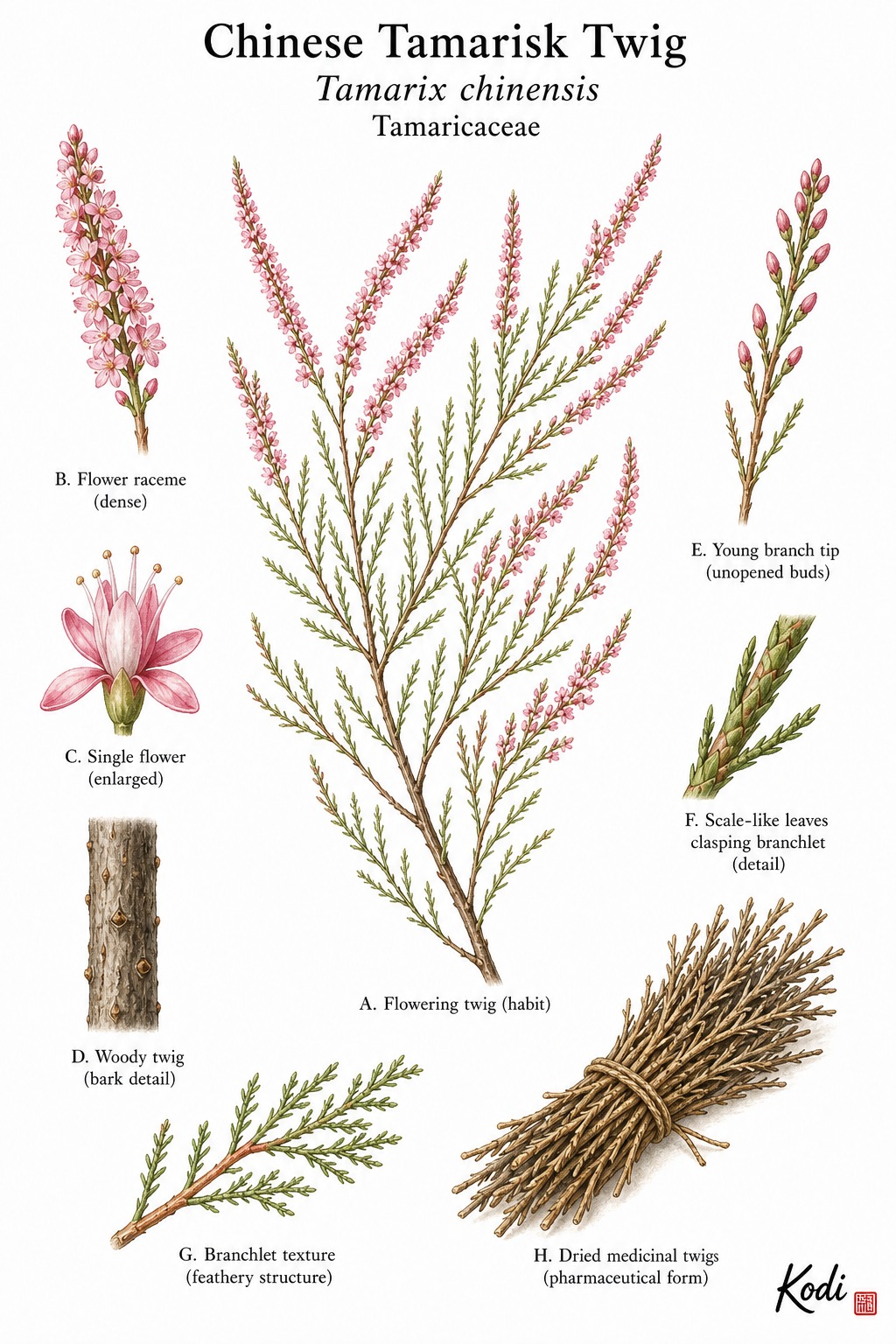
Known in TCM as Xi He Liu (西河柳), this sweet and acrid, neutral herb enters the Lung, Stomach, and Heart. Traditionally, it releases the exterior and dispels wind - Xi He Liu is used for early-stage exterior wind presentations, especially when light sweating and venting are needed without harsh dispersal, most often applied for common cold, urticaria, and rheumatoid arthritis. Modern research has identified Kaempferol among its active constituents.
Part used: Leafy tip
Also Known As
Latin: Cacumen Tamaricis | Pinyin: Xi He Liu | Chinese: 西河柳
TCM Properties
- Taste
- sweet, acrid
- Temperature
- neutral
- Channels
- Lung, Stomach, Heart
Traditional Use
Primary Actions
- Releases the exterior and dispels wind - Xi He Liu is used for early-stage exterior wind presentations, especially when light sweating and venting are needed without harsh dispersal.
- Promotes measles eruption - the twig has a classic role when measles or other rash illnesses do not vent smoothly to the exterior and heat remains constrained beneath the surface.
- Resolves toxicity and relieves itching - internal or external use is described for pruritic skin conditions, damp-toxic irritation, and toxic swellings with prominent itching.
- Unblocks channels in wind-damp pain - some regional sources also note use for rheumatic aching and painful obstruction, especially when the exterior and superficial collaterals are involved.
Secondary Actions
- Xi He Liu is gentler than stronger sweating herbs and is often selected when the therapeutic goal is to guide a pathogen or rash outward rather than to strongly scatter cold or heat.
- Because one of its best-known uses is for measles eruption, older sources discuss it mainly in staged pediatric or febrile-disease contexts rather than as an all-purpose common-cold herb.
Classic Formulas
- Xi He Liu with Niu Bang Zi, Chan Tui, and Bo He - eruption-promoting pairing logic for incomplete measles expression or wind-heat rash that remains trapped under the surface.
- Zhu Ye Liu Bang Tang - traditional formula logic in which Xi He Liu helps vent the exterior and guide rash outward while accompanying herbs clear heat and throat toxicity.
- External Xi He Liu wash with Ku Shen or Bai Xian Pi - folk and regional approach for itchy skin, superficial toxic lesions, or damp-wind irritation.
Classical References
- TCM Wiki describes Xi He Liu as sweet, acrid, and neutral, entering the Lung, Stomach, and Heart channels, with actions of inducing diaphoresis and promoting measles eruption.
- American Dragon adds traditional indications such as common cold, rheumatic arthralgia, and pruritic eruptions, illustrating the twig's overlap between exterior release and superficial detoxifying use.
- Later herb summaries repeatedly emphasize that Xi He Liu is best known when rash illness is not venting properly, which keeps its clinical identity distinct from stronger diaphoresis herbs.
Modern Research
Active Compounds
- Kaempferol and methylated kaempferol derivatives - major flavonoids repeatedly isolated from Tamarix chinensis twigs and leaves
- Ferulic acid and related phenolic acids - antioxidant phenolics relevant to anti-inflammatory interpretation
- Matairesinol and other lignans - additional secondary metabolites identified in branch and leaf material
- Flavonoid-rich polysaccharides - macromolecular fractions investigated for immunologic and antioxidant activity
- Tamarix polyphenol complexes - broad constituent group highlighted in recent reviews of anti-inflammatory and antiviral potential
Studied Effects
- A recent review summarized antioxidant, anti-inflammatory, antibacterial, antiviral, hepatoprotective, and immunomodulatory findings across Tamarix chinensis extracts, while noting that clinical evidence remains limited (PMID 38750332).
- Phytochemical investigation of Tamarix chinensis branches isolated multiple flavonoids and lignans including kaempferol derivatives and matairesinol, helping define the plant's modern chemical profile (PMID 25090705).
- Tamarix chinensis Lour polysaccharides alleviated H1N1-influenza-induced lung injury in mice by modulating complement and inflammatory pathways, providing a mechanistic correlate for traditional exterior and respiratory uses (PMID 38135232).
- Branch extract improved markers of alcoholic liver injury in experimental models, suggesting broader anti-inflammatory and organ-protective potential beyond its classical superficial indications (PMID 32256017).
PubMed References
- Tamarix chinensis Lour.: Botanical characteristics, traditional uses, phytochemistry, and pharmacological activities (2024)
- Chemical constituents from the branches of Tamarix chinensis (2014)
- Tamarix chinensis Lour polysaccharides attenuate H1N1 influenza virus-induced acute lung injury via complement inhibition (2024)
- Protective effect of Tamarix chinensis branch extract against ethanol-induced liver injury (2020)
Safety & Interactions
Contraindications
- Exterior deficiency with spontaneous sweating
- Rash illness that has already fully erupted
- Very dry patients who do not tolerate sweating methods well
Cautions
- Because Xi He Liu is primarily a light exterior-venting herb, it is usually less useful once a rash has already vented or when deep interior heat predominates
- Most modern evidence for Tamarix chinensis remains preclinical and should not be interpreted as proof for self-treatment of influenza, liver disease, or autoimmune disease
- Regional practice and source texts vary somewhat on whether itching and rheumatic indications are emphasized internally, externally, or both
- MSK page not found - drug interaction data not available from Memorial Sloan Kettering integrative medicine database
Conditions
- Common Cold Traditional ★★★☆☆ JSON
- Urticaria Traditional ★★☆☆☆ JSON
- Rheumatoid Arthritis Traditional ★★☆☆☆ JSON
Frequently Asked Questions
What is Chinese Tamarisk Twig used for?
Chinese Tamarisk Twig is traditionally used to Releases the exterior and dispels wind - Xi He Liu is used for early-stage exterior wind presentations, especially when light sweating and venting are needed without harsh dispersal., Promotes measles eruption - the twig has a classic role when measles or other rash illnesses do not vent smoothly to the exterior and heat remains constrained beneath the surface., Resolves toxicity and relieves itching - internal or external use is described for pruritic skin conditions, damp-toxic irritation, and toxic swellings with prominent itching., Unblocks channels in wind-damp pain - some regional sources also note use for rheumatic aching and painful obstruction, especially when the exterior and superficial collaterals are involved.. Research has investigated its effects on: A recent review summarized antioxidant, anti-inflammatory, antibacterial, antiviral, hepatoprotective, and immunomodulatory findings across Tamarix chinensis extracts, while noting that clinical evidence remains limited (PMID 38750332).; Phytochemical investigation of Tamarix chinensis branches isolated multiple flavonoids and lignans including kaempferol derivatives and matairesinol, helping define the plant's modern chemical profile (PMID 25090705)..
What are other names for Chinese Tamarisk Twig?
Chinese Tamarisk Twig is also known as Tamaricis. In TCM: 西河柳 (Xi He Liu); Cacumen Tamaricis.
Is Chinese Tamarisk Twig safe during pregnancy?
The safety of Chinese Tamarisk Twig during pregnancy has not been established. Consult a qualified healthcare provider before use.
What are the contraindications for Chinese Tamarisk Twig?
Chinese Tamarisk Twig should not be used in: Exterior deficiency with spontaneous sweating; Rash illness that has already fully erupted; Very dry patients who do not tolerate sweating methods well. Consult a qualified practitioner before use.