Chinese Waxgourd Peel
- Chinese
- 冬瓜皮
- Pinyin
- Dong Gua Pi
- Latin
- Exocarpium Benincasae
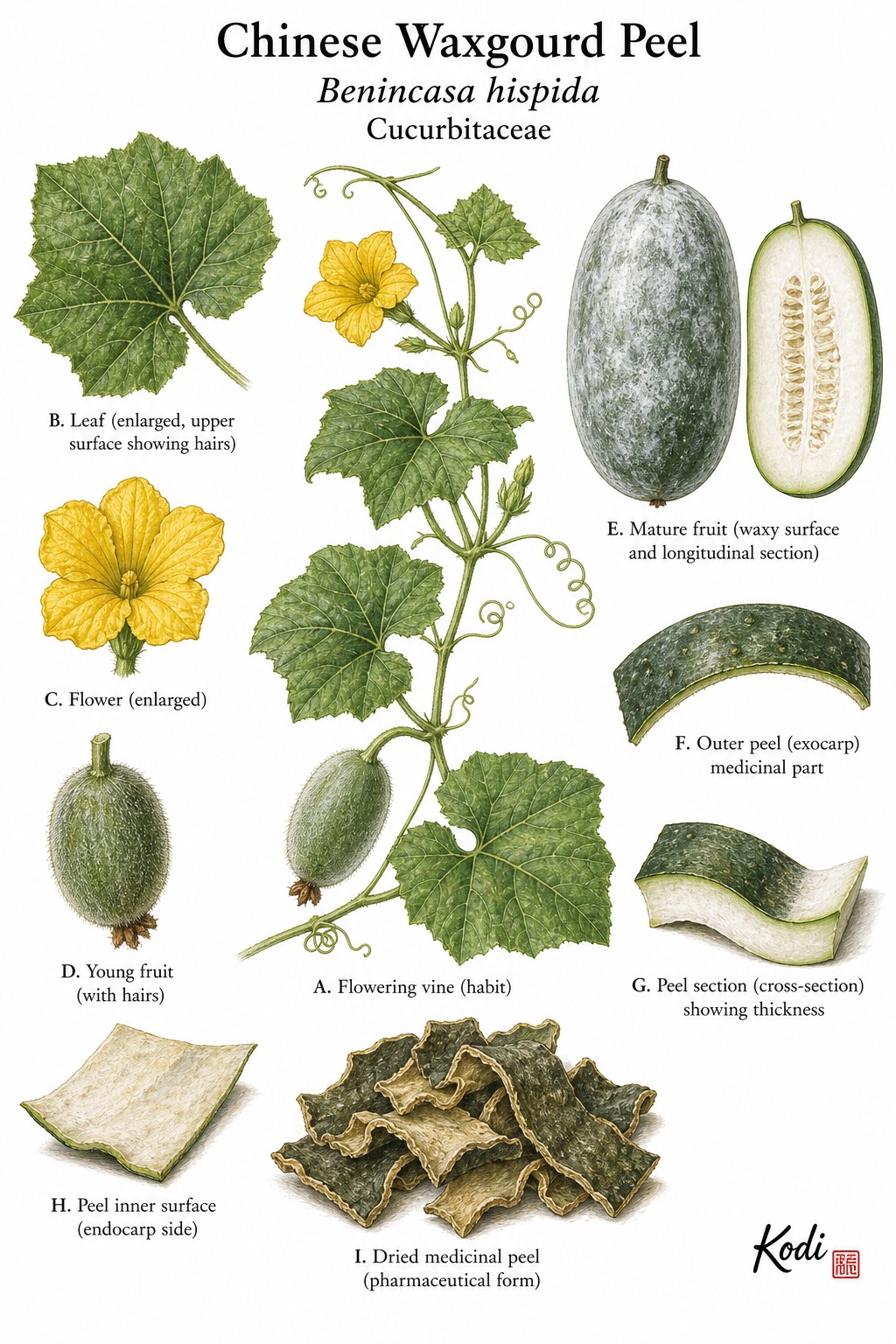
Known in TCM as Dong Gua Pi (冬瓜皮), this sweet, cool herb enters the Lung and Small Intestine. Traditionally, it promotes urination and reduces edema - Dong Gua Pi is a gentle diuretic peel used for swelling, water retention, puffy limbs, and damp accumulation when stronger draining herbs would be excessive, most often applied for edema. Modern research has identified Phenolic-rich among its active constituents.
Part used: Outer peel
Also Known As
Latin: Exocarpium Benincasae | Pinyin: Dong Gua Pi | Chinese: 冬瓜皮
TCM Properties
- Taste
- sweet
- Temperature
- cool
- Channels
- Lung, Small Intestine
Traditional Use
Primary Actions
- Promotes urination and reduces edema - Dong Gua Pi is a gentle diuretic peel used for swelling, water retention, puffy limbs, and damp accumulation when stronger draining herbs would be excessive.
- Clears summer-heat and relieves vexation - traditional use includes hot-weather thirst, heaviness, irritability, and damp summer discomfort, especially when fluid metabolism is sluggish.
- Lightly transforms dampness without damaging Qi - compared with harsher draining herbs, the peel is food-like and mild, making it suitable for edema in weaker constitutions.
- Supports the Lung's fluid pathways - some sources also place it in mild phlegm-fluid and upper-body water-retention presentations because its cooling, light, and descending nature helps water move downward.
Secondary Actions
- Dong Gua Pi is best understood as the lighter, more dispersing companion to Dong Gua Ren, with the peel emphasizing edema and damp-fluid movement while the seed emphasizes phlegm and intestinal drainage.
- Because it is mild and food-like, it often appears in kitchen-style decoctions and congee approaches for puffiness and summer-heat rather than only in formal high-intensity formulas.
Classic Formulas
- Dong Gua Pi with Fu Ling Pi and Da Fu Pi - classic edema-pairing logic when the goal is to promote urination gently and move superficial water swelling downward.
- Dong Gua Pi with Yi Yi Ren and Chi Xiao Dou - dampness and swelling strategy for puffy limbs, heaviness, and sluggish fluid metabolism.
- Dong Gua Pi summer-heat decoction - food-medicine use in warm weather for thirst, swelling, and irritability with internal dampness.
Classical References
- TCM Wiki describes Dong Gua Pi as sweet and cool, entering the Lung and Small Intestine channels, with actions of promoting urination and relieving edema.
- American Dragon and related materia-medica summaries emphasize its value when edema is mild to moderate and the patient is too weak or too heat-affected for stronger draining methods.
- Traditional comparison with winter-melon seed highlights that the peel is the gentler fluid-moving part of the plant and is especially associated with swelling and summer-heat.
Modern Research
Active Compounds
- Phenolic-rich peel extract - a broad antioxidant fraction highlighted in peel-focused pharmacology studies
- Flavonoids and related polyphenols - likely contributors to antioxidant and anti-inflammatory activity
- Triterpenoid and cucurbit-type constituents - broader Benincasa phytochemicals relevant to metabolic and anti-inflammatory interpretation
- Peel-associated polysaccharides - macromolecular fractions that may contribute to hydration and antioxidant effects
- Organic acids and small polar metabolites - components contributing to the fruit peel's mild food-medicine profile
Studied Effects
- A 2021 review of Benincasa hispida summarized antioxidant, anti-inflammatory, diuretic, gastroprotective, and metabolic effects across the plant while noting that evidence quality is still largely preclinical (PMID 34521541).
- Winter-melon peel extract was used as a green reducing agent for selenium nanoparticles that demonstrated notable antioxidant and antidiabetic potential in experimental work, showing that the peel itself has measurable bioactivity beyond the flesh (PMID 37752300).
- A 2024 study of Benincasa hispida peel reported antioxidant and anti-skin-aging effects in experimental systems, further supporting that the peel is chemically active rather than a nutritionally inert byproduct (PMID 37835208).
- Most direct modern studies still evaluate the broader plant or peel extract rather than the classical decoction use of Dong Gua Pi specifically.
PubMed References
- Benincasa hispida: A review of ethnobotany, phytochemistry, pharmacology, and nutritional value (2021)
- Green synthesis of selenium nanoparticles using Benincasa hispida peel extract and evaluation of antioxidant and antidiabetic activity (2023)
- Antioxidant and anti-skin-aging effects of Benincasa hispida peel extract (2024)
Safety & Interactions
Contraindications
- Cold edema or swelling due to Yang collapse
- Excessive urination, dehydration, or fluid depletion
- Marked Spleen-Kidney deficiency cold without damp accumulation
Cautions
- Dong Gua Pi is mild, but it still promotes fluid loss and may not suit already-depleted patients with dryness, nocturia, or weak urinary control
- Most modern evidence is plant-wide or peel-extract-based rather than direct clinical evidence for classical decoction use
- Because it is food-like and gentle, it is sometimes underestimated; persistent edema should still be medically evaluated rather than self-treated indefinitely
- MSK page not found - drug interaction data not available from Memorial Sloan Kettering integrative medicine database
Conditions
Frequently Asked Questions
What is Chinese Waxgourd Peel used for?
Chinese Waxgourd Peel is traditionally used to Promotes urination and reduces edema - Dong Gua Pi is a gentle diuretic peel used for swelling, water retention, puffy limbs, and damp accumulation when stronger draining herbs would be excessive., Clears summer-heat and relieves vexation - traditional use includes hot-weather thirst, heaviness, irritability, and damp summer discomfort, especially when fluid metabolism is sluggish., Lightly transforms dampness without damaging Qi - compared with harsher draining herbs, the peel is food-like and mild, making it suitable for edema in weaker constitutions., Supports the Lung's fluid pathways - some sources also place it in mild phlegm-fluid and upper-body water-retention presentations because its cooling, light, and descending nature helps water move downward.. Research has investigated its effects on: A 2021 review of Benincasa hispida summarized antioxidant, anti-inflammatory, diuretic, gastroprotective, and metabolic effects across the plant while noting that evidence quality is still largely preclinical (PMID 34521541).; Winter-melon peel extract was used as a green reducing agent for selenium nanoparticles that demonstrated notable antioxidant and antidiabetic potential in experimental work, showing that the peel itself has measurable bioactivity beyond the flesh (PMID 37752300)..
What are other names for Chinese Waxgourd Peel?
Chinese Waxgourd Peel is also known as Benincasa. In TCM: 冬瓜皮 (Dong Gua Pi); Exocarpium Benincasae.
Is Chinese Waxgourd Peel safe during pregnancy?
The safety of Chinese Waxgourd Peel during pregnancy has not been established. Consult a qualified healthcare provider before use.
What are the contraindications for Chinese Waxgourd Peel?
Chinese Waxgourd Peel should not be used in: Cold edema or swelling due to Yang collapse; Excessive urination, dehydration, or fluid depletion; Marked Spleen-Kidney deficiency cold without damp accumulation. Consult a qualified practitioner before use.