Chinese White Olive
- Chinese
- 青果
- Pinyin
- Qing Guo
- Latin
- Fructus Canarii
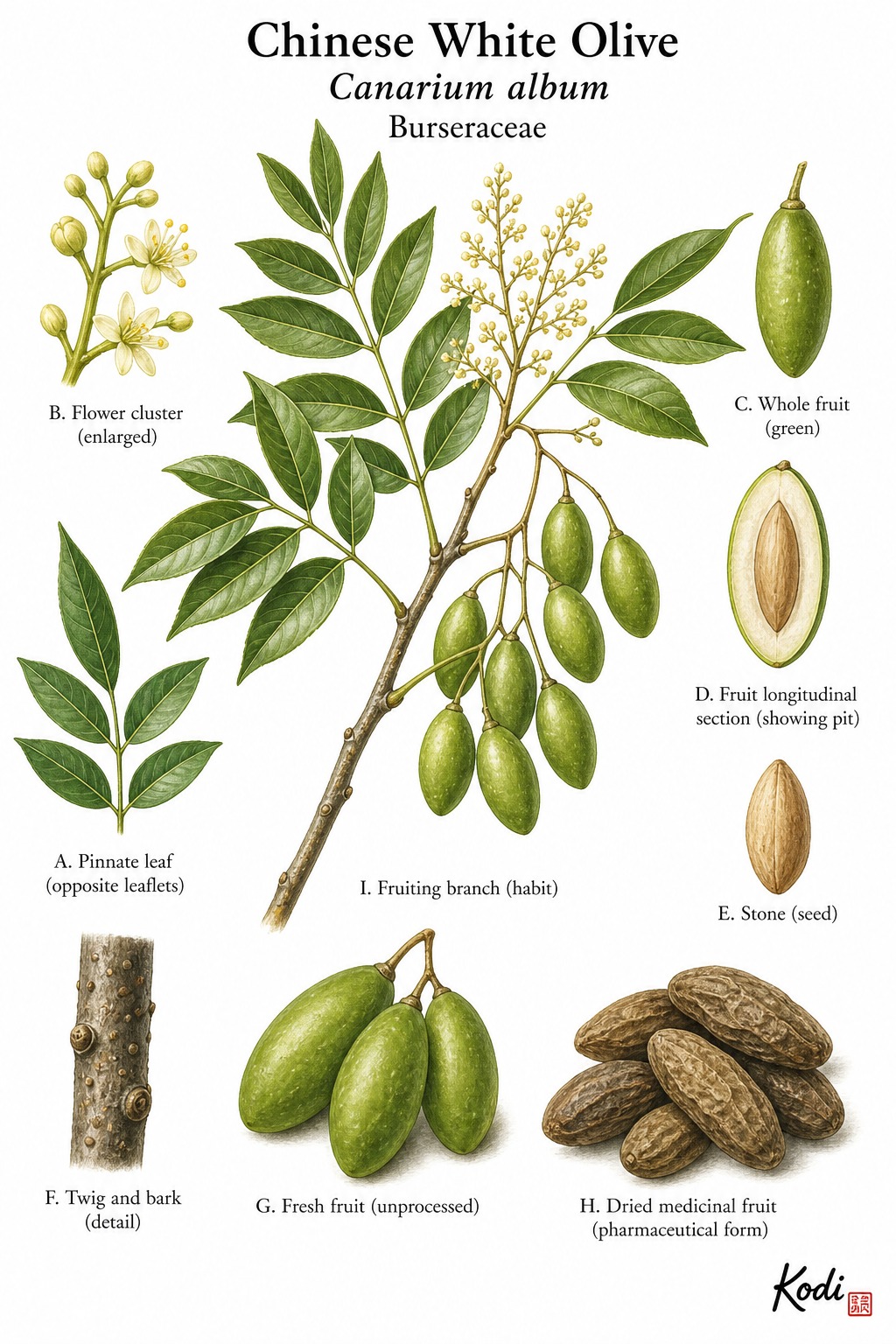
Known in TCM as Qing Guo (青果), this sweet and sour, neutral herb enters the Lung and Stomach. Traditionally, it clears the Lung and relieves sore throat - Qing Guo is used for dry or swollen throat, hoarseness, thirst, and irritative cough when heat and dryness affect the upper burner, most often applied for sore throat, cough, and diarrhea. Modern research has identified Hydrolysable among its active constituents.
Part used: Fruit
Also Known As
Latin: Fructus Canarii | Pinyin: Qing Guo | Chinese: 青果
TCM Properties
- Taste
- sweet, sour
- Temperature
- neutral
- Channels
- Lung, Stomach
Traditional Use
Primary Actions
- Clears the Lung and relieves sore throat - Qing Guo is used for dry or swollen throat, hoarseness, thirst, and irritative cough when heat and dryness affect the upper burner.
- Generates fluids and quenches thirst - it is a classic fruit-medicine for dry mouth, thirst, warm-weather irritation, and fluid depletion after heat, smoke exposure, or prolonged talking.
- Resolves toxicity from food and drink - traditional use includes fish, alcohol, and food-toxin discomforts, reflecting its long reputation as a soothing detoxifying fruit.
- Soothes the Stomach and intestines - some source traditions extend its use to diarrhea, dysentery, and cough-related blood-tinged sputum when dryness and heat damage fluids.
Secondary Actions
- Qing Guo is also widely known in food and regional medicine as Gan Lan or Chinese olive, so classical medicinal naming and everyday naming often overlap.
- The fruit is valued partly because it can clear and moisten at the same time, making it gentler than many strongly bitter sore-throat herbs.
Classic Formulas
- Qing Guo with Pang Da Hai and Xuan Shen - common sore-throat and voice-use pairing logic for dryness, hoarseness, and painful swallowing.
- Qing Guo with Lu Gen and Mai Men Dong - fluid-generating strategy for dry throat, thirst, and irritability after heat or prolonged vocal strain.
- Salted or preserved Qing Guo preparations - long-standing food-medicine approach for cough, dry throat, and digestive discomfort after rich foods or alcohol.
Classical References
- TCM Wiki describes Qing Guo as sweet, sour, and neutral, entering the Lung and Stomach channels, with actions of clearing Lung heat, relieving sore throat, generating fluids, and resolving toxicity.
- American Dragon likewise emphasizes sore throat, cough, thirst, fish and alcohol toxicity, and certain dysenteric or intestinal irritation patterns.
- Traditional food-medicine usage helps explain why the same fruit may be referred to medicinally as Qing Guo while still being popularly called Gan Lan or Chinese olive.
Modern Research
Active Compounds
- Hydrolysable tannins including corilagin and related galloyl compounds - major polyphenols relevant to anti-inflammatory and antimicrobial activity
- Biflavonoids and flavonoid glycosides - antioxidant constituents contributing to broad free-radical-scavenging activity
- Phenolic acids such as protocatechuic-acid-related compounds - small phenolics linked with anti-inflammatory effects
- Triterpenoids - fruit constituents investigated for hepatoprotective and metabolic activity
- Polysaccharides and other water-soluble fractions - components likely relevant to the fruit's traditional soothing and fluid-supportive character
Studied Effects
- A 2023 review of Canarium album summarized antioxidant, anti-inflammatory, antimicrobial, antiviral, hepatoprotective, and metabolic effects, positioning Qing Guo as a chemically rich food-medicine fruit with expanding pharmacology data (PMID 38094884).
- Compounds from Canarium album showed anti-inflammatory and antioxidant activity in modern pharmacology studies, supporting the fruit's traditional use for irritated throat and toxic-heat-type discomforts (PMID 31561441).
- Canarium album extracts activated AMPK-related pathways and improved glucose utilization in experimental systems, illustrating a metabolic research direction beyond the fruit's classical throat uses (PMID 32333610).
- Natural products from Canarium album have also demonstrated antiviral and anti-Helicobacter pylori activity in preclinical work, though these findings should not be confused with proven clinical efficacy.
PubMed References
Safety & Interactions
Contraindications
- Early exterior cold stage when venting is still needed
- Pronounced dampness or phlegm-cold without dryness or heat
- Severe digestive stagnation from overeating cold fruit
Cautions
- Qing Guo is generally gentle, but preserved preparations can vary widely in salt, sugar, and processing additives
- The fruit's astringent and moistening balance is best suited to dry, irritated throat patterns rather than thick cold-phlegm conditions
- Most modern pharmacology is preclinical and should not be treated as proof for antiviral, metabolic, or gastric-disease self-treatment
- MSK page not found - drug interaction data not available from Memorial Sloan Kettering integrative medicine database
Conditions
Frequently Asked Questions
What is Chinese White Olive used for?
Chinese White Olive is traditionally used to Clears the Lung and relieves sore throat - Qing Guo is used for dry or swollen throat, hoarseness, thirst, and irritative cough when heat and dryness affect the upper burner., Generates fluids and quenches thirst - it is a classic fruit-medicine for dry mouth, thirst, warm-weather irritation, and fluid depletion after heat, smoke exposure, or prolonged talking., Resolves toxicity from food and drink - traditional use includes fish, alcohol, and food-toxin discomforts, reflecting its long reputation as a soothing detoxifying fruit., Soothes the Stomach and intestines - some source traditions extend its use to diarrhea, dysentery, and cough-related blood-tinged sputum when dryness and heat damage fluids.. Research has investigated its effects on: A 2023 review of Canarium album summarized antioxidant, anti-inflammatory, antimicrobial, antiviral, hepatoprotective, and metabolic effects, positioning Qing Guo as a chemically rich food-medicine fruit with expanding pharmacology data (PMID 38094884).; Compounds from Canarium album showed anti-inflammatory and antioxidant activity in modern pharmacology studies, supporting the fruit's traditional use for irritated throat and toxic-heat-type discomforts (PMID 31561441)..
What are other names for Chinese White Olive?
Chinese White Olive is also known as Canarium. In TCM: 青果 (Qing Guo); Fructus Canarii.
Is Chinese White Olive safe during pregnancy?
The safety of Chinese White Olive during pregnancy has not been established. Consult a qualified healthcare provider before use.
What are the contraindications for Chinese White Olive?
Chinese White Olive should not be used in: Early exterior cold stage when venting is still needed; Pronounced dampness or phlegm-cold without dryness or heat; Severe digestive stagnation from overeating cold fruit. Consult a qualified practitioner before use.