Citric Acid
- Chinese
- 柠檬酸
- Pinyin
- Ning Meng Suan
- Latin
- Acidum Citricum
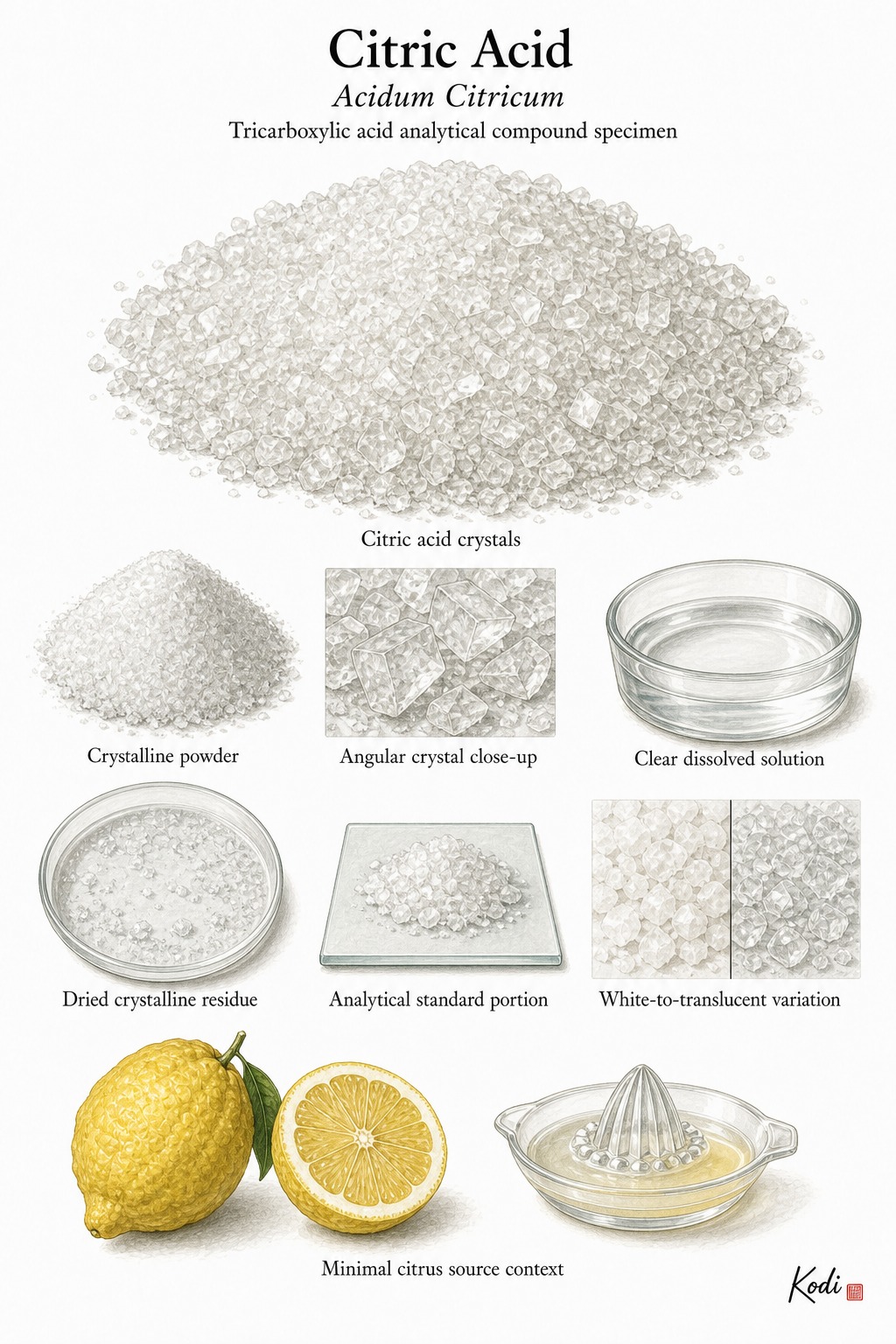
Known in TCM as Ning Meng Suan (柠檬酸). Traditionally, it import-variant compound record rather than a classical standalone herb - citric acid is a naturally occurring organic acid widely present in citrus fruits and fermentation systems, not a canonical decoction herb in traditional materia medica. Modern research has identified Citric among its active constituents.
Part used: Acid
Also Known As
Latin: Acidum Citricum | Pinyin: Ning Meng Suan | Chinese: 柠檬酸
Traditional Use
Primary Actions
- Import-variant compound record rather than a classical standalone herb - citric acid is a naturally occurring organic acid widely present in citrus fruits and fermentation systems, not a canonical decoction herb in traditional materia medica.
- Contextualizes sour, acidifying, and chelating functions - in practice, citric acid appears more often as a food, pharmaceutical, excipient, or analytical ingredient than as an independently prescribed traditional medicinal.
- Bridges citrus-based traditional materials and modern chemistry - its main role in this library is to explain how a recognizable sour organic acid intersects with preservation, formulation, mucosal irritation, and broader biomedical research.
- Functions as a modern additive and quality-control compound - the record is retained for catalog completeness and import fidelity rather than to imply a classical single-herb prescribing tradition.
Secondary Actions
- Readers should not mistake citric acid for Xiang Yuan, Fo Shou, lemon peel, or other true citrus materia medica records whose therapeutic identity depends on the whole medicinal material.
- This file is best read as a compound or excipient note, not as a direct substitute for pattern-based citrus herb treatment in TCM.
Classic Formulas
- No standalone classical formulas - citric acid is cataloged here as an imported compound-level record rather than as a recognized traditional prescription ingredient.
Classical References
- IMPORT NOTE: The source dataset imported this record as the isolated compound citric acid with the Latin Acidum Citricum and pinyin Ning Meng Suan. This is not a canonical standalone Chinese materia-medica item.
- Citric acid is better understood as a widely distributed chemical constituent of foods and medicinal plants, and as a modern acidulant, preservative, chelator, or formulation aid.
- This record therefore complements the library's true citrus-herb entries rather than replacing them.
Modern Research
Active Compounds
- Citric acid (2-hydroxypropane-1,2,3-tricarboxylic acid)
- Citrate anion
- Three carboxyl groups responsible for acidity and metal chelation
- Hydroxyl-bearing tricarboxylate backbone central to buffering and formulation behavior
Studied Effects
- A 2024 review described citric acid as a nexus between cellular metabolism, biomaterial design, chelation chemistry, and regenerative-engineering applications, illustrating how widely the molecule now functions outside classical herbalism (PMID 38801111).
- Experimental work reported that citric acid improved intestinal-barrier markers and beneficial microbiota patterns in mice, suggesting biologic effects that extend beyond simple acidification (PMID 38279237).
- Another study found that exogenous citric acid could confer broad antibiotic tolerance in bacteria by altering metabolism and oxidative-stress handling, an important reminder that even familiar food acids can have complex microbiologic effects (PMID 37240435).
- Dental-material research continues to use citric acid as a model erosive challenge, reinforcing that concentrated or repeated exposure can damage hard tissues and is not physiologically neutral (PMID 37569934).
PubMed References
- Citric Acid: A Nexus Between Cellular Mechanisms and Biomaterial Innovations (2024)
- Citric Acid Promotes Immune Function by Modulating the Intestinal Barrier (2024)
- Citric Acid Confers Broad Antibiotic Tolerance through Alteration of Bacterial Metabolism and Oxidative Stress (2023)
- Inhibition of Citric Acid-Induced Dentin Erosion by an Acidulated Phosphate Sodium Monofluorophosphate Solution (2023)
Safety & Interactions
Cautions
- Concentrated citric acid can irritate oral, esophageal, gastric, or cutaneous surfaces despite its familiarity as a food acid.
- Repeated acidic exposure can contribute to dental erosion and should not be treated as harmless in concentrated powders, rinses, or supplements.
- The molecule's broad use in food and medicine does not mean isolated high-dose use reproduces the effects of whole citrus foods or herbs.
Frequently Asked Questions
What is Citric Acid used for?
Citric Acid is traditionally used to Import-variant compound record rather than a classical standalone herb - citric acid is a naturally occurring organic acid widely present in citrus fruits and fermentation systems, not a canonical decoction herb in traditional materia medica., Contextualizes sour, acidifying, and chelating functions - in practice, citric acid appears more often as a food, pharmaceutical, excipient, or analytical ingredient than as an independently prescribed traditional medicinal., Bridges citrus-based traditional materials and modern chemistry - its main role in this library is to explain how a recognizable sour organic acid intersects with preservation, formulation, mucosal irritation, and broader biomedical research., Functions as a modern additive and quality-control compound - the record is retained for catalog completeness and import fidelity rather than to imply a classical single-herb prescribing tradition.. Research has investigated its effects on: A 2024 review described citric acid as a nexus between cellular metabolism, biomaterial design, chelation chemistry, and regenerative-engineering applications, illustrating how widely the molecule now functions outside classical herbalism (PMID 38801111).; Experimental work reported that citric acid improved intestinal-barrier markers and beneficial microbiota patterns in mice, suggesting biologic effects that extend beyond simple acidification (PMID 38279237)..
What are other names for Citric Acid?
Citric Acid is also known as Citricum. In TCM: 柠檬酸 (Ning Meng Suan); Acidum Citricum.
Is Citric Acid safe during pregnancy?
The safety of Citric Acid during pregnancy has not been established. Consult a qualified healthcare provider before use.