Clove
- Chinese
- 丁香
- Pinyin
- Ding Xiang
- Latin
- Flos Caryophylli
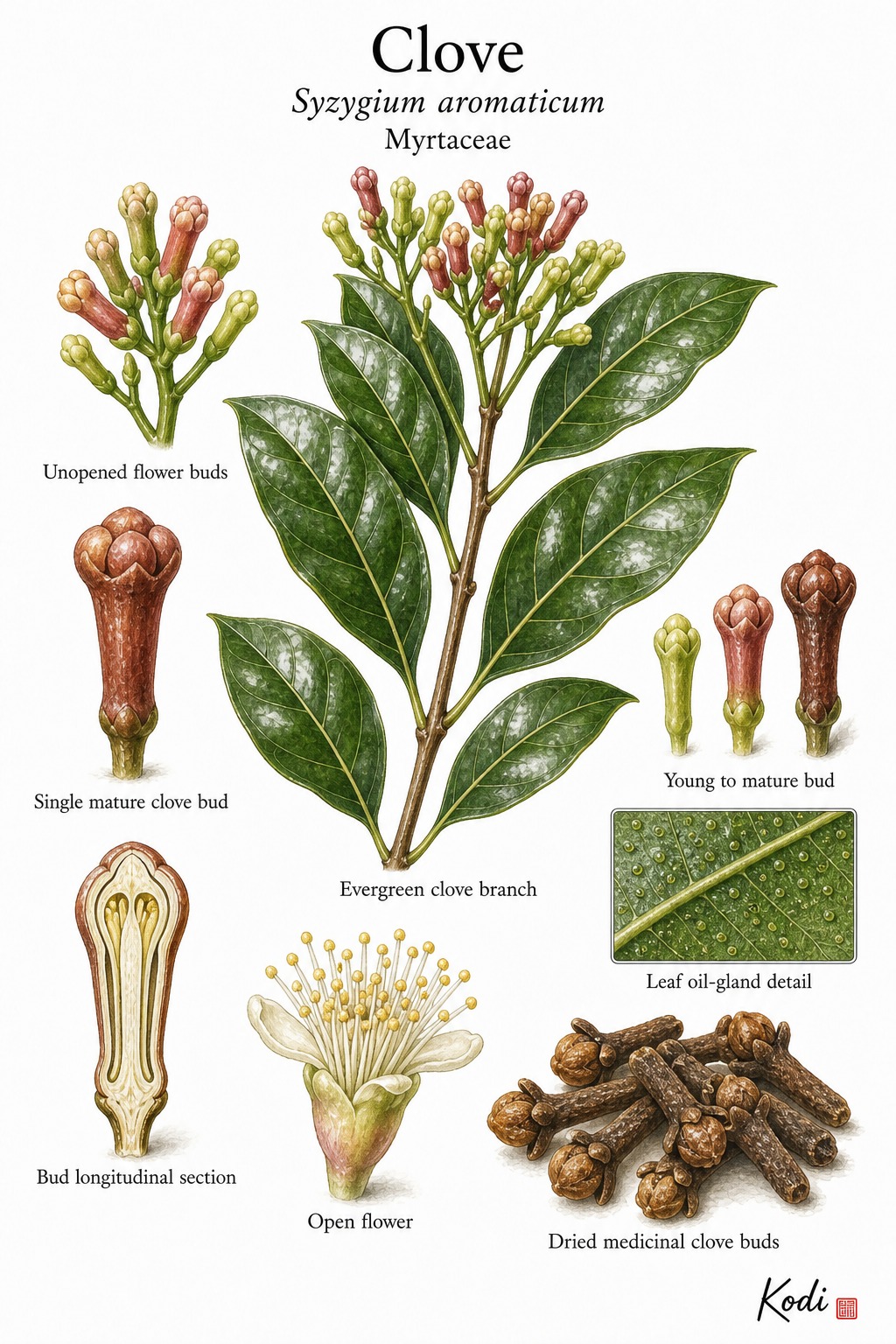
Known in TCM as Ding Xiang (丁香), this acrid, warm herb enters the Kidney, Spleen, and Stomach. Traditionally, it warms the middle burner and dispels interior cold - Ding Xiang is used for cold in the Spleen and Stomach causing abdominal pain, poor appetite, loose stool, and a preference for warmth, most often applied for nausea, abdominal pain, and diarrhea. Modern research has identified Eugenol among its active constituents.
Part used: Flower
Also Known As
Latin: Flos Caryophylli | Pinyin: Ding Xiang | Chinese: 丁香
TCM Properties
- Taste
- acrid
- Temperature
- warm
- Channels
- Kidney, Spleen, Stomach
Traditional Use
Primary Actions
- Warms the middle burner and dispels interior cold - Ding Xiang is used for cold in the Spleen and Stomach causing abdominal pain, poor appetite, loose stool, and a preference for warmth.
- Directs rebellious Stomach Qi downward - it is a classic herb for hiccup, retching, nausea, and vomiting when the underlying pattern is deficiency-cold rather than heat or food stagnation.
- Warms the Kidneys and assists Yang - traditional use extends to impotence, lower-abdominal cold pain, and cold weakness when Mingmen fire is insufficient.
Secondary Actions
- Ding Xiang is strongly aromatic and penetrating despite its small size, so it is often used in low dose as a guiding warming herb rather than as a bulk tonic.
- Compared with Mu Ding Xiang, the flower bud is regarded as the sharper, more immediately descending form for cold-type rebellious Qi.
Classic Formulas
- Ding Xiang Shi Di Tang - classic formula for hiccup from Stomach deficiency-cold in which Ding Xiang helps redirect rebellious Qi downward.
- Ding Xiang with Ban Xia and Sheng Jiang - common warming antiemetic strategy for nausea and vomiting from cold obstructing the middle burner.
- Ding Xiang with Rou Gui or Fu Zi - Kidney-Yang-supportive pairing logic when cold lower-abdominal pain or impotence is part of the presentation.
Classical References
- American Dragon and TCM Wiki describe Ding Xiang as acrid and warm, entering the Spleen, Stomach, and Kidney, with core actions of warming the middle, directing rebellious Qi downward, and warming Kidney Yang.
- Traditional sources repeatedly anchor the herb in hiccup and vomiting from deficiency-cold rather than in broad antiemetic use for every nausea pattern.
- Later formula traditions also preserve its role in cold lower-jiao and Kidney-Yang weakness patterns, which explains its secondary use in impotence and cold pain.
Modern Research
Active Compounds
- Eugenol - the dominant phenolic constituent most associated with clove's analgesic, antimicrobial, and anti-inflammatory effects
- Eugenyl acetate - a major aromatic constituent that supports fragrance and bioactivity
- Beta-caryophyllene - a sesquiterpene discussed in anti-inflammatory and analgesic research
- Tannins and flavonoids - supporting nonvolatile constituents found in whole clove bud preparations
Studied Effects
- A 2020 review summarized the broad pharmacology of Syzygium aromaticum, including antimicrobial, anti-inflammatory, antioxidant, antispasmodic, and analgesic effects, with eugenol identified as the main bioactive compound (PMID 32019140).
- An experimental study found that ethanol extract of clove flower bud had significant anti-nociceptive and anti-inflammatory effects in rodent models, which fits well with the herb's traditional use for cold pain and discomfort (PMID 20161939).
- Another study reported that aqueous clove extract inhibited neutrophil oxidative activity and protected mice from LPS-induced lung inflammation, offering a mechanistic anti-inflammatory bridge beyond its classical warming profile (PMID 30707845).
- Eugenol-focused reviews continue to support antioxidant and anti-inflammatory activity, although concentrated constituent use should not be confused with whole-herb decoction practice (PMID 39598416).
PubMed References
- Syzygium aromaticum L. (Myrtaceae): Traditional Uses, Bioactive Chemical Constituents, Pharmacological and Toxicological Activities (2020)
- Anti-nociceptive and anti-inflammatory activities of ethanol extract of Syzygium aromaticum flower bud in Wistar rats and mice (2010)
- Syzygium aromaticum aqueous extract inhibits human neutrophils myeloperoxidase and protects mice from LPS-induced lung inflammation (2019)
- Anti-Inflammatory and Antioxidant Activities of Eugenol: An Update (2024)
Safety & Interactions
Contraindications
- Yin deficiency with heat signs
- Stomach heat or hot-pattern vomiting rather than deficiency-cold rebellion
Cautions
- The whole herb is gentler than the essential oil, but concentrated clove preparations can still irritate mucosa and aggravate reflux or heat signs.
- Later sources advise caution in pregnancy, especially with larger doses or concentrated preparations.
- Most modern evidence centers on eugenol-rich extracts and essential oil rather than on traditional decoction use.
Drug Interactions
- Anticoagulants or antiplatelet drugs - eugenol-rich preparations may increase bleeding tendency, especially at concentrated doses
Conditions
Frequently Asked Questions
What is Clove used for?
Clove is traditionally used to Warms the middle burner and dispels interior cold - Ding Xiang is used for cold in the Spleen and Stomach causing abdominal pain, poor appetite, loose stool, and a preference for warmth., Directs rebellious Stomach Qi downward - it is a classic herb for hiccup, retching, nausea, and vomiting when the underlying pattern is deficiency-cold rather than heat or food stagnation., Warms the Kidneys and assists Yang - traditional use extends to impotence, lower-abdominal cold pain, and cold weakness when Mingmen fire is insufficient.. Research has investigated its effects on: A 2020 review summarized the broad pharmacology of Syzygium aromaticum, including antimicrobial, anti-inflammatory, antioxidant, antispasmodic, and analgesic effects, with eugenol identified as the main bioactive compound (PMID 32019140).; An experimental study found that ethanol extract of clove flower bud had significant anti-nociceptive and anti-inflammatory effects in rodent models, which fits well with the herb's traditional use for cold pain and discomfort (PMID 20161939)..
What are other names for Clove?
Clove is also known as Caryophylli. In TCM: 丁香 (Ding Xiang); Flos Caryophylli.
Is Clove safe during pregnancy?
The safety of Clove during pregnancy has not been established. Consult a qualified healthcare provider before use.
What are the contraindications for Clove?
Clove should not be used in: Yin deficiency with heat signs; Stomach heat or hot-pattern vomiting rather than deficiency-cold rebellion. Consult a qualified practitioner before use.
Does Clove interact with any medications?
Clove may interact with: Anticoagulants or antiplatelet drugs - eugenol-rich preparations may increase bleeding tendency, especially at concentrated doses. Always inform your healthcare provider of any herbal supplements you are taking.