Cluster Mallow Fruit
- Chinese
- 冬葵果
- Pinyin
- Dong Kui Guo
- Latin
- Fructus Malvae
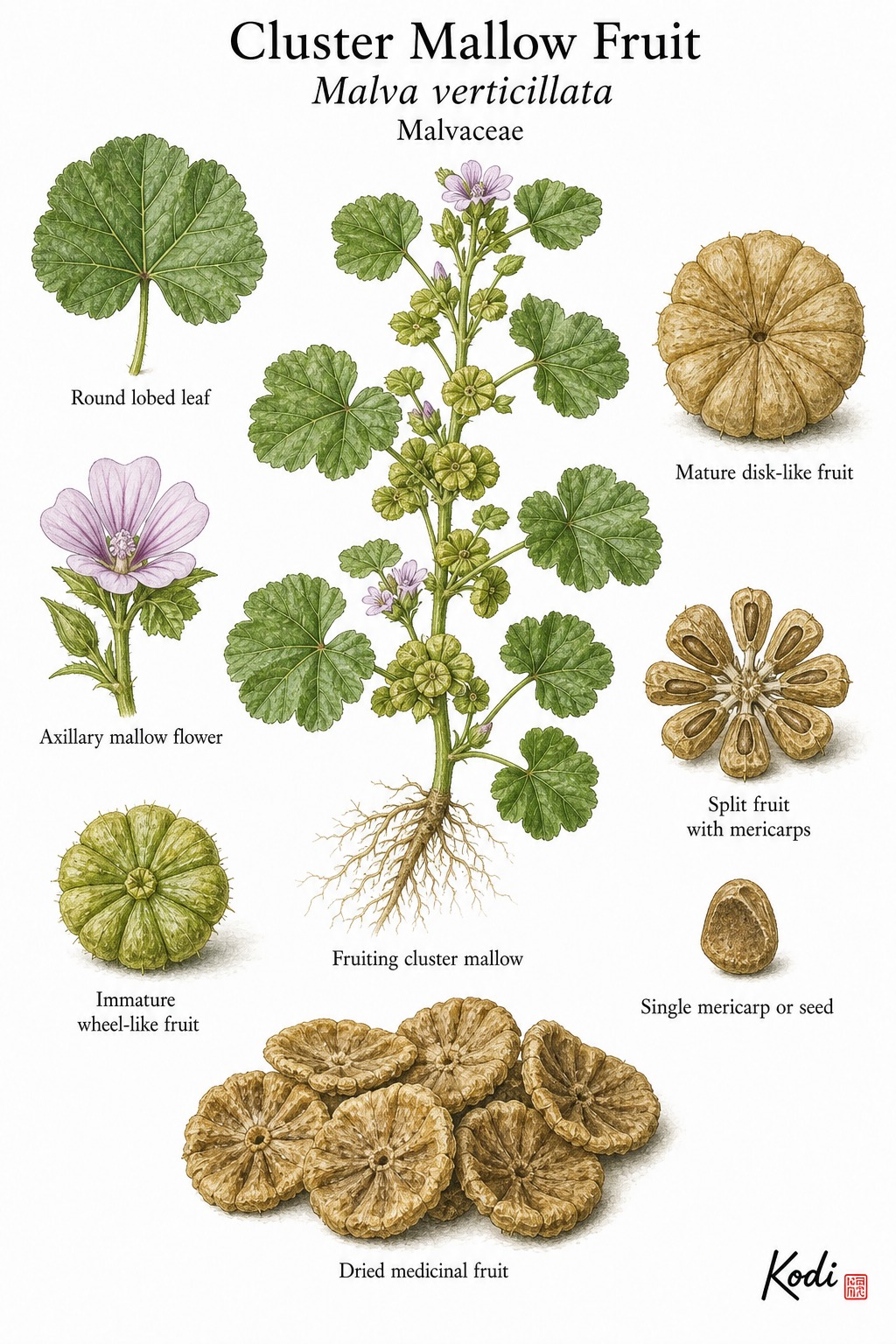
Known in TCM as Dong Kui Guo (冬葵果), this sweet, cold herb enters the Bladder, Large Intestine, and Small Intestine. Traditionally, it promotes urination and unblocks painful urinary difficulty - Dong Kui Guo is used for damp-heat or heat-type urinary obstruction, dribbling, dark scanty urine, and edema related to water-pathway constraint, most often applied for edema, constipation, and urinary tract infection. Modern research has identified Mucilage-rich among its active constituents.
Part used: Fruit
Also Known As
Latin: Fructus Malvae | Pinyin: Dong Kui Guo | Chinese: 冬葵果
TCM Properties
- Taste
- sweet
- Temperature
- cold
- Channels
- Bladder, Large Intestine, Small Intestine
Traditional Use
Primary Actions
- Promotes urination and unblocks painful urinary difficulty - Dong Kui Guo is used for damp-heat or heat-type urinary obstruction, dribbling, dark scanty urine, and edema related to water-pathway constraint.
- Moistens the Intestines and facilitates stool - the slippery sweet-cold fruit is also used for constipation when dryness and heat combine with poor fluid movement.
- Promotes lactation and opens constrained flow - traditional use extends to insufficient breast milk when body fluids are not moving freely.
Secondary Actions
- Dong Kui Guo overlaps heavily with Dong Kui Zi traditions, and some materia-medica lineages discuss the fruit and seed together rather than sharply separating them.
- Its combination of urinary-draining and bowel-moistening action makes it useful when heat and fluid stagnation affect more than one lower-burner pathway.
Classic Formulas
- Dong Kui Guo with Mu Tong and Hua Shi - lower-burner heat and difficult urination pairing logic.
- Dong Kui Guo with Huo Ma Ren - constipation strategy when dryness and poor fluid movement coexist.
- Dong Kui Guo with Tong Cao - classical lactation-opening logic when milk is scant and channels are constrained.
Classical References
- American Dragon's Dong Kui Zi entry notes that the Malvae fruit/seed lineage is sweet and cold and is used to clear heat, promote urination, reduce edema, lubricate the bowels, and support lactation.
- Modern TCM references often use Dong Kui Zi and Dong Kui Guo in overlapping ways, so this record preserves the fruit-name import while keeping the core traditional profile conservative.
- The herb belongs more to the draining-lubricating category than to harsh purgation; its movement is slippery and fluid rather than forceful.
Modern Research
Active Compounds
- Mucilage-rich polysaccharides - likely contributors to bowel-lubricating and soothing effects
- Fatty acids and seed oil fractions - traditional fruit or seed constituents with metabolic relevance
- Flavonoids and phenolic compounds - supporting antioxidant and anti-inflammatory constituents
- Additional oligosaccharide and glycoside fractions - part of the broader Fructus Malvae phytochemical profile
Studied Effects
- A 2022 review of Fructus Malvae summarized diuretic, antidiabetic, antioxidant, antitumor, and other pharmacologic findings, reinforcing that the fruit has a broader modern research profile than its modest classical fame might suggest (PMID 36080446).
- Human clinical evidence directly on Dong Kui Guo remains limited, but its mucilage-rich Malva lineage has been investigated for bowel support, which is consistent with the herb's traditional stool-lubricating use.
- Most modern research still focuses on pharmacology and composition rather than on large clinical trials, so traditional lower-burner and constipation use remains the main interpretive anchor.
PubMed References
Safety & Interactions
Contraindications
- Deficiency-cold urinary difficulty without heat or dryness
- Loose stools from Spleen deficiency
Cautions
- Because the fruit is cold and slippery, it can worsen diarrhea or weak digestion in patients who are already cold and loose.
- Traditional texts differ on how strongly to warn in pregnancy, but because the herb promotes downward and outward fluid movement, pregnancy use should be practitioner-directed.
- Modern clinical evidence is still limited compared with the breadth of traditional indications.
Conditions
- Edema Traditional ★★★☆☆ JSON
- Constipation Traditional ★★★☆☆ JSON
- Urinary Tract Infection Traditional ★★☆☆☆ JSON
Frequently Asked Questions
What is Cluster Mallow Fruit used for?
Cluster Mallow Fruit is traditionally used to Promotes urination and unblocks painful urinary difficulty - Dong Kui Guo is used for damp-heat or heat-type urinary obstruction, dribbling, dark scanty urine, and edema related to water-pathway constraint., Moistens the Intestines and facilitates stool - the slippery sweet-cold fruit is also used for constipation when dryness and heat combine with poor fluid movement., Promotes lactation and opens constrained flow - traditional use extends to insufficient breast milk when body fluids are not moving freely.. Research has investigated its effects on: A 2022 review of Fructus Malvae summarized diuretic, antidiabetic, antioxidant, antitumor, and other pharmacologic findings, reinforcing that the fruit has a broader modern research profile than its modest classical fame might suggest (PMID 36080446).; Human clinical evidence directly on Dong Kui Guo remains limited, but its mucilage-rich Malva lineage has been investigated for bowel support, which is consistent with the herb's traditional stool-lubricating use..
What are other names for Cluster Mallow Fruit?
Cluster Mallow Fruit is also known as Malva. In TCM: 冬葵果 (Dong Kui Guo); Fructus Malvae.
Is Cluster Mallow Fruit safe during pregnancy?
The safety of Cluster Mallow Fruit during pregnancy has not been established. Consult a qualified healthcare provider before use.
What are the contraindications for Cluster Mallow Fruit?
Cluster Mallow Fruit should not be used in: Deficiency-cold urinary difficulty without heat or dryness; Loose stools from Spleen deficiency. Consult a qualified practitioner before use.