Lindera Root
- Chinese
- 乌药
- Pinyin
- Wu Yao
- Latin
- Radix Linderae
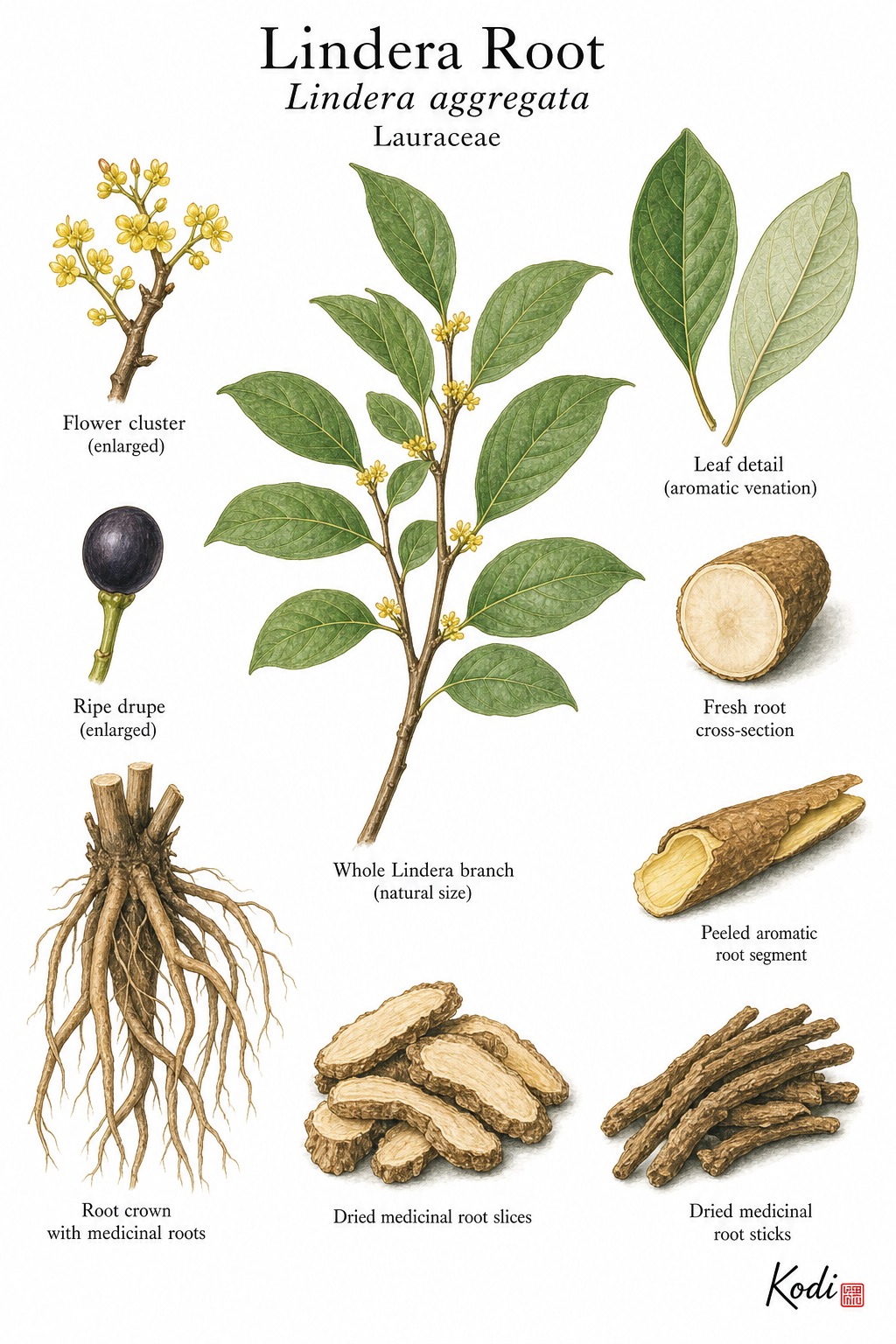
Known in TCM as Wu Yao (乌药), this acrid, warm herb enters the Bladder, Kidney, Lung, and Spleen. Traditionally, it promotes Qi movement and alleviates pain - Wu Yao is a classic warming Qi regulator for abdominal pain, distention, cold stagnation, and constrained movement in the chest, epigastrium, or lower abdomen, most often applied for abdominal pain, dysmenorrhea, and frequent urination. Modern research has identified Isoquinoline among its active constituents.
Part used: Root
Also Known As
Latin: Radix Linderae | Pinyin: Wu Yao | Chinese: 乌药
TCM Properties
- Taste
- acrid
- Temperature
- warm
- Channels
- Bladder, Kidney, Lung, Spleen
Traditional Use
Primary Actions
- Promotes Qi movement and alleviates pain - Wu Yao is a classic warming Qi regulator for abdominal pain, distention, cold stagnation, and constrained movement in the chest, epigastrium, or lower abdomen.
- Warms the Kidneys and disperses cold - its traditional lower-jiao use includes cold hernia-type pain, lower-abdominal constriction, and weakness from Kidney cold.
- Reduces frequent urination - when Kidney and Bladder cold cause frequent, clear urination, Wu Yao helps restore containment and warmth.
Secondary Actions
- Wu Yao is unusual because it moves Qi strongly without being especially drying or upward-scattering, which makes it versatile across upper, middle, and lower-jiao cold stagnation patterns.
- Its lower-abdominal and urinary uses are why it appears in both pain formulas and formulas for cold-deficiency urination.
Classic Formulas
- Tian Tai Wu Yao San - one of the defining formulas for cold hernia and lower-abdominal cold stagnation.
- Shao Fu Zhu Yu Tang - lower-abdominal blood-cold pain formula logic in which Wu Yao helps move cold-constrained Qi and ease pain.
- Suo Quan Wan - classic formula for frequent urination and loss of control from Kidney and Bladder deficiency-cold.
Classical References
- American Dragon and TCM Wiki describe Wu Yao as acrid and warm, entering the Lung, Spleen, Kidney, and Bladder, with actions of promoting Qi, dispersing cold, alleviating pain, and reducing frequent urination.
- Traditional formula usage makes clear that Wu Yao's center of gravity is the lower abdomen and urinary system even though it can also regulate middle-burner cold stagnation.
- The herb's history in Tian Tai Wu Yao San and Suo Quan Wan anchors both its pain-relieving and urine-controlling functions.
Modern Research
Active Compounds
- Isoquinoline alkaloids such as norisoboldine and related compounds - major bioactive constituents discussed in modern Wu Yao research
- Sesquiterpenes and lactones including linderane and isolinderalactone-type compounds - important components in Lindera aggregata chemistry
- Flavonoids and phenolic constituents - supporting antioxidant and anti-inflammatory molecules
- Volatile aromatic fractions - contributors to the herb's traditional Qi-moving character
Studied Effects
- A 2023 critical review of Lindera aggregata summarized traditional use, phytochemistry, pharmacology, processing, and quality control, reinforcing the herb's long-standing association with promoting Qi, relieving pain, warming the Kidneys, and dispersing cold (PMID 37499843).
- Chemical and pharmacologic work has identified anti-inflammatory principles from Lindera aggregata, supporting a modern mechanism bridge for some pain-relieving uses (PMID 32359855).
- A transcriptome-metabolome study paired with animal testing found analgesic activity in different parts of Lindera aggregata, offering direct support for the herb's pain-oriented traditional reputation (PMID 33288181).
- Recent work on an alkaloids-enriched fraction also explored metabolic and diabetes-related intestinal effects, showing how Wu Yao research is broadening beyond classical Qi-pain indications (PMID 41135272).
PubMed References
- Traditional uses, phytochemistry, pharmacology, processing methods and quality control of Lindera aggregata (Sims) Kosterm: A critical review (2023)
- Anti-inflammatory principles from Lindera aggregata (2020)
- Integrated analysis of the transcriptome, metabolome and analgesic effect provide insight into potential applications of different parts of Lindera aggregata (2020)
- Radix Linderae Alkaloids-enriched fraction improves reactive oxygen species-related metabolic disorders in diabetes through modulating intestinal homeostasis (2025)
Safety & Interactions
Contraindications
- Yin deficiency with heat signs
- Damp-heat painful urinary patterns that need cooling rather than warming dispersal
Cautions
- Warm aromatic Qi-movers can aggravate dryness or heat if used outside a true cold-stagnation pattern.
- Frequent urination may reflect diabetes, infection, prostate disease, or neurologic causes, so the herb should not replace evaluation when symptoms are persistent or progressive.
- Most modern research remains preclinical despite the herb's long traditional history.
Conditions
- Abdominal Pain Traditional ★★★★☆ JSON
- Dysmenorrhea Traditional ★★★☆☆ JSON
- Frequent Urination Traditional ★★★☆☆ JSON
- Impotence Traditional ★★☆☆☆ JSON
Frequently Asked Questions
What is Lindera Root used for?
Lindera Root is traditionally used to Promotes Qi movement and alleviates pain - Wu Yao is a classic warming Qi regulator for abdominal pain, distention, cold stagnation, and constrained movement in the chest, epigastrium, or lower abdomen., Warms the Kidneys and disperses cold - its traditional lower-jiao use includes cold hernia-type pain, lower-abdominal constriction, and weakness from Kidney cold., Reduces frequent urination - when Kidney and Bladder cold cause frequent, clear urination, Wu Yao helps restore containment and warmth.. Research has investigated its effects on: A 2023 critical review of Lindera aggregata summarized traditional use, phytochemistry, pharmacology, processing, and quality control, reinforcing the herb's long-standing association with promoting Qi, relieving pain, warming the Kidneys, and dispersing cold (PMID 37499843).; Chemical and pharmacologic work has identified anti-inflammatory principles from Lindera aggregata, supporting a modern mechanism bridge for some pain-relieving uses (PMID 32359855)..
What are other names for Lindera Root?
Lindera Root is also known as Lindera. In TCM: 乌药 (Wu Yao); Radix Linderae.
Is Lindera Root safe during pregnancy?
The safety of Lindera Root during pregnancy has not been established. Consult a qualified healthcare provider before use.
What are the contraindications for Lindera Root?
Lindera Root should not be used in: Yin deficiency with heat signs; Damp-heat painful urinary patterns that need cooling rather than warming dispersal. Consult a qualified practitioner before use.