Cnidium Fruit
- Chinese
- 蛇床子
- Pinyin
- She Chuang Zi
- Latin
- Fructus Cnidii
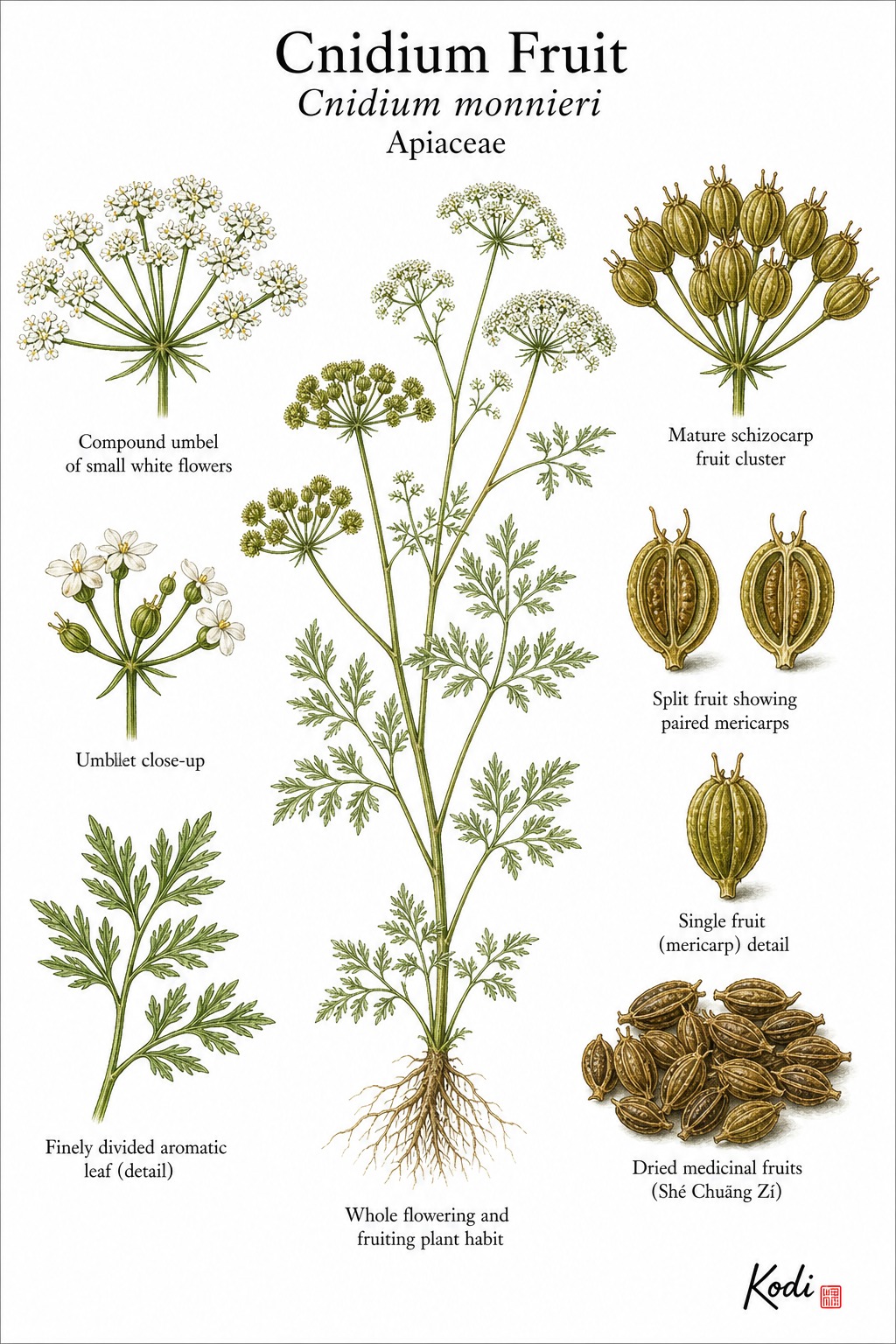
Known in TCM as She Chuang Zi (蛇床子), this acrid and bitter, warm herb enters the Kidney. Traditionally, it dries dampness, kills parasites, and stops itching - She Chuang Zi is best known for external washes, powders, or ointments used for genital itching, eczema, scabies, ringworm, and other damp, itchy skin eruptions, most often applied for eczema, fungal infection, and leukorrhea. Modern research has identified Osthole among its active constituents.
Part used: Fruit
Also Known As
Latin: Fructus Cnidii | Pinyin: She Chuang Zi | Chinese: 蛇床子
TCM Properties
- Taste
- acrid, bitter
- Temperature
- warm
- Channels
- Kidney
Traditional Use
Primary Actions
- Dries dampness, kills parasites, and stops itching - She Chuang Zi is best known for external washes, powders, or ointments used for genital itching, eczema, scabies, ringworm, and other damp, itchy skin eruptions.
- Warms the Kidney and strengthens Yang - internally it is used for impotence, cold infertility, reduced libido, and cold lower-burner weakness when deficiency and chill predominate rather than heat.
- Dispels cold and dries dampness in the lower burner - a small internal dose can help cold-damp leukorrhea, vulvar itching, or chronic discharge with a pale, cold presentation.
- Dispels wind-damp and eases cold painful obstruction - later materia medica extends its use to low-back pain and fixed Bi pain when cold-damp obstruction and Kidney deficiency overlap.
Secondary Actions
- Because of its strong topical reputation, She Chuang Zi is commonly prepared as a wash, soak, powder, or ointment rather than used only in decoction.
- The herb is warm, drying, and slightly toxic, so it is chosen for cold-damp patterns much more often than for hot, red, or Yin-deficient itching disorders.
Classic Formulas
- She Chuang Zi San - external powder or wash classically used for damp itching, genital irritation, scabies, and weeping skin lesions in which the herb's parasite-killing and antipruritic actions are central.
- She Chuang Zi with Ku Shen and Bai Xian Pi - common external combination for vulvar itching, eczema, or fungal-type damp lesions that need both drying and itch relief.
- She Chuang Zi with Tu Si Zi and Yin Yang Huo - internal Kidney-Yang strategy for impotence, infertility, and cold lower-burner weakness rather than purely dermatologic use.
- She Chuang Zi with Du Huo or Wei Ling Xian - channel-warming pairing for cold-damp low-back pain or fixed Bi pain with lower-body weakness.
Classical References
- Shen Nong Ben Cao Jing records She Chuang Zi among early medicinals for damp itching and lower-burner disorders, establishing its long-standing reputation as a genital and skin herb.
- Later materia medica such as Ben Cao Gang Mu emphasizes both external antipruritic use and internal warming use for impotence, cold uterus, and leukorrhea.
- Modern teaching texts still classify She Chuang Zi primarily among external-application herbs even though its internal Kidney-warming role remains clinically important in cold-damp presentations.
Modern Research
Active Compounds
- Osthole (osthol) - the dominant prenylated coumarin and the best-studied marker compound for antipruritic and bone-focused research
- Imperatorin - a furanocoumarin repeatedly identified in Cnidii Fructus phytochemical reviews and linked to anti-inflammatory interest
- Bergapten and xanthotoxin - characteristic furanocoumarins that help define the herb's pharmacologic and safety profile
- Isopimpinellin and related coumarins - secondary constituents that broaden the total-coumarin fraction studied in modern extracts
Studied Effects
- Ethyl acetate extract of Fructus cnidii attenuated DNFB-induced atopic-dermatitis-like itching, reduced mast-cell infiltration, lowered IgE, and decreased itch-related cytokines including IL-17, IL-31, IL-33, and TSLP in mice (PMID 32454868).
- Osthole reduced histamine-, HTMT-, and VUF8430-induced scratching and inhibited histamine-responsive dorsal-root-ganglion signaling by modulating TRPV1 activity, supporting the herb's traditional antipruritic use (PMID 27160770).
- A 2024 review concluded that Cnidii Fructus compounds such as osthole, bergapten, imperatorin, and xanthotoxin show notable antiosteoporotic potential through OPG/RANKL/RANK, Wnt/beta-catenin, and BMP/Smad pathways (PMID 38507853).
PubMed References
- Antipruritic Effect of Ethyl Acetate Extract from Fructus cnidii in Mice with 2,4-Dinitrofluorobenzene-Induced Atopic Dermatitis (2020)
- Osthole inhibits histamine-dependent itch via modulating TRPV1 activity (2016)
- Cnidii Fructus: A traditional Chinese medicine herb and source of antiosteoporotic drugs (2024)
Safety & Interactions
Contraindications
- Damp-heat itching disorders with pronounced redness, burning, or yellow discharge
- Kidney Yin deficiency with empty heat
- Marked internal heat or fluid depletion
Cautions
- She Chuang Zi is classically described as slightly toxic, so high oral doses or prolonged unsupervised use can cause oral numbness, dryness, or gastrointestinal upset.
- Topical use on excoriated mucosa or very sensitive skin may sting or irritate; discontinue if burning clearly worsens after application.
- The herb is strongly warming and drying, so it is usually combined with other agents rather than used alone for long courses.
- MSK page not found - drug interaction data not available from Memorial Sloan Kettering integrative medicine database
Conditions
- Eczema Traditional ★★★★☆ JSON
- Fungal Infection Traditional ★★★★☆ JSON
- Leukorrhea Traditional ★★★☆☆ JSON
- Impotence Traditional ★★★☆☆ JSON
Frequently Asked Questions
What is Cnidium Fruit used for?
Cnidium Fruit is traditionally used to Dries dampness, kills parasites, and stops itching - She Chuang Zi is best known for external washes, powders, or ointments used for genital itching, eczema, scabies, ringworm, and other damp, itchy skin eruptions., Warms the Kidney and strengthens Yang - internally it is used for impotence, cold infertility, reduced libido, and cold lower-burner weakness when deficiency and chill predominate rather than heat., Dispels cold and dries dampness in the lower burner - a small internal dose can help cold-damp leukorrhea, vulvar itching, or chronic discharge with a pale, cold presentation., Dispels wind-damp and eases cold painful obstruction - later materia medica extends its use to low-back pain and fixed Bi pain when cold-damp obstruction and Kidney deficiency overlap.. Research has investigated its effects on: Ethyl acetate extract of Fructus cnidii attenuated DNFB-induced atopic-dermatitis-like itching, reduced mast-cell infiltration, lowered IgE, and decreased itch-related cytokines including IL-17, IL-31, IL-33, and TSLP in mice (PMID 32454868).; Osthole reduced histamine-, HTMT-, and VUF8430-induced scratching and inhibited histamine-responsive dorsal-root-ganglion signaling by modulating TRPV1 activity, supporting the herb's traditional antipruritic use (PMID 27160770)..
What are other names for Cnidium Fruit?
Cnidium Fruit is also known as Cnidium. In TCM: 蛇床子 (She Chuang Zi); Fructus Cnidii.
Is Cnidium Fruit safe during pregnancy?
The safety of Cnidium Fruit during pregnancy has not been established. Consult a qualified healthcare provider before use.
What are the contraindications for Cnidium Fruit?
Cnidium Fruit should not be used in: Damp-heat itching disorders with pronounced redness, burning, or yellow discharge; Kidney Yin deficiency with empty heat; Marked internal heat or fluid depletion. Consult a qualified practitioner before use.