Chinese Yam Rhizome
- Chinese
- 山药
- Pinyin
- Shan Yao
- Latin
- Rhizoma Dioscoreae
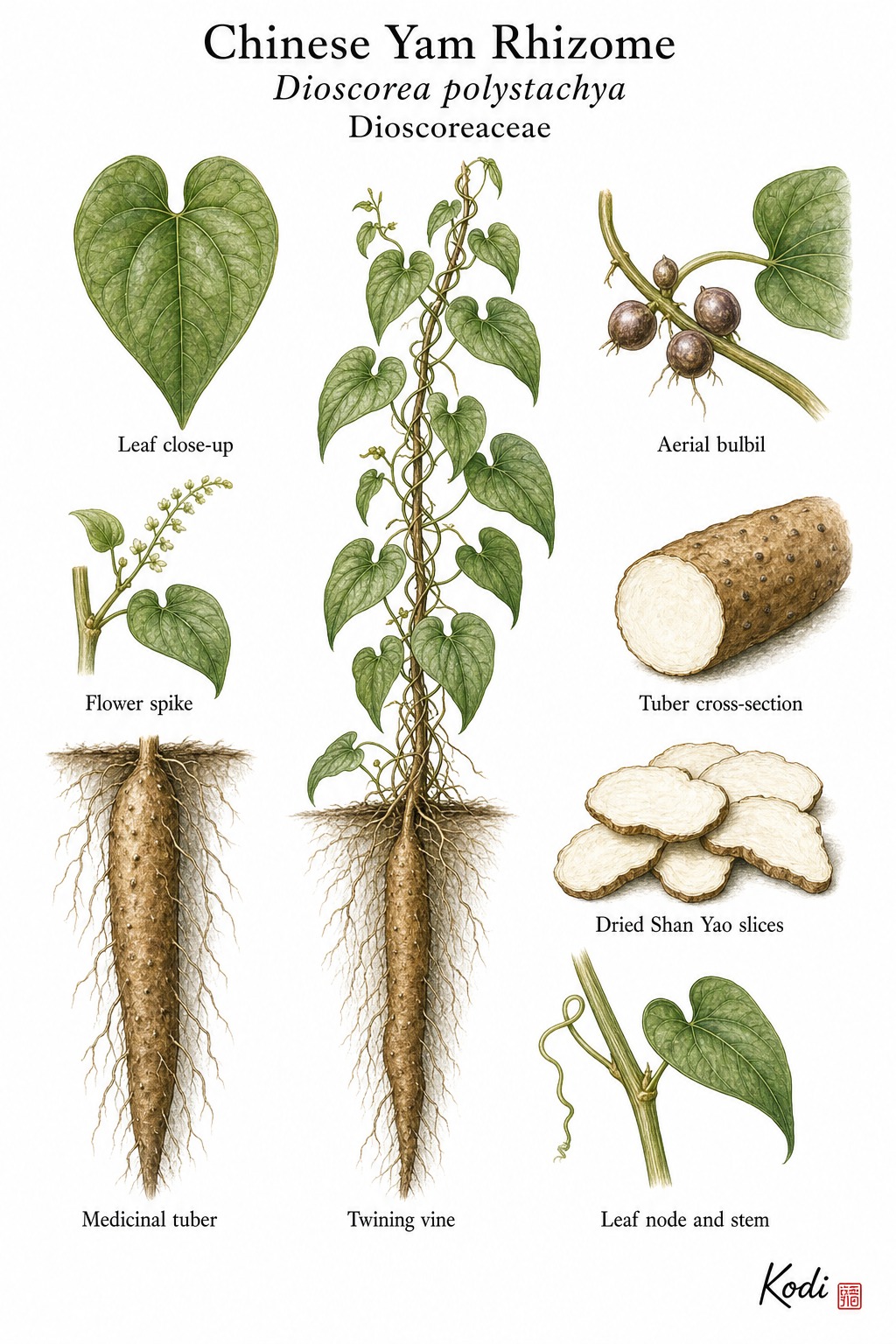
Known in TCM as Shan Yao (山药), this sweet, neutral herb enters the Spleen, Lung, and Kidney. Traditionally, it tonifies the Spleen and supports digestion - Shan Yao is a classic food-like tonic for poor appetite, fatigue, loose stools, chronic diarrhea, and recovery after long digestive weakness, most often applied for diarrhea, poor appetite, and digestive weakness. Modern research has identified Chinese among its active constituents.
Part used: Rhizome
Also Known As
Latin: Rhizoma Dioscoreae | Pinyin: Shan Yao | Chinese: 山药
TCM Properties
- Taste
- sweet
- Temperature
- neutral
- Channels
- Spleen, Lung, Kidney
Traditional Use
Primary Actions
- Tonifies the Spleen and supports digestion - Shan Yao is a classic food-like tonic for poor appetite, fatigue, loose stools, chronic diarrhea, and recovery after long digestive weakness.
- Nourishes Lung Qi and Lung Yin - it helps chronic cough, mild dyspnea, or wasting-thirst patterns when dryness and deficiency are present but a gentle, noncloying tonic is preferred.
- Benefits the Kidneys and secures essence - classically used for frequent urination, spermatorrhea, leucorrhea, and weakness of the lower burner associated with Spleen-Kidney deficiency.
Secondary Actions
- Shan Yao is valued because it supplements both Qi and Yin without being overly greasy, making it one of the easier long-term tonic herbs to integrate into food or mild formulas.
- The fresh and dried forms are both used, but the dried medicinal rhizome is especially associated with securing leakage while also rebuilding deficient middle-burner function.
Classic Formulas
- Shen Ling Bai Zhu San - strengthens the Spleen and stops chronic diarrhea while preserving fluids.
- Liu Wei Di Huang Wan - Shan Yao anchors the middle and helps secure essence while the formula nourishes Kidney and Liver Yin.
- Jin Suo Gu Jing Wan - used in essence-leakage patterns where Shan Yao supports Kidney astringency and gentle tonification.
- Shen Qi Wan - supports Kidney deficiency with urinary weakness while helping the formula remain balanced and digestible.
Classical References
- Classical herb texts consistently place Shan Yao among upper-grade tonic substances that strengthen the Spleen, benefit the Lungs, and secure the Kidneys without harshness.
- Traditional physicians prize it as a dual food and medicine because it can rebuild chronic deficiency while also helping contain leakage such as diarrhea, seminal loss, and excessive urination.
- Its long use in both medicinal decoctions and congee-like food therapy explains why Shan Yao is often considered one of the gentlest foundational tonics in Chinese medicine.
Modern Research
Active Compounds
- Chinese yam polysaccharides - the main research focus for gut, metabolic, and immune effects
- Phenolic compounds - antioxidant and cyclooxygenase-related constituents identified from Dioscorea opposita
- Mucilage and resistant starch fractions - food-medicine components relevant to intestinal barrier and fermentation effects
- Allantoin and related small molecules - supportive constituents linked with tissue-repair and nutritive profiles in the broader Shan Yao literature
Studied Effects
- A 2025 systematic review found accumulating evidence that Dioscoreae Rhizoma benefits gastrointestinal function through anti-inflammatory, antioxidant, microbiota-modulating, and mucosal-protective mechanisms, although stronger human trials are still needed (PMID 41010469).
- Chinese yam polysaccharides showed enhanced intestinal anti-inflammatory activity after gut microbial fermentation, supporting the traditional use of Shan Yao for chronic digestive weakness and diarrhea-prone states (PMID 36152553).
- Chinese yam polysaccharides from Dioscorea opposita improved glucose and lipid markers in a type 2 diabetic mouse model, reinforcing modern interest in Shan Yao as a medicinal food for metabolic support (PMID 41344459).
PubMed References
- The Effect of Dioscoreae Rhizoma on Gastrointestinal Function: A Systematic Review (2025)
- Gut microbial fermentation promotes the intestinal anti-inflammatory activity of Chinese yam polysaccharides (2023)
- Effects of Chinese yam and its peel polysaccharides on blood glucose and lipids in type 2 diabetic mice (2025)
Safety & Interactions
Contraindications
- Patterns dominated by food stagnation or thick damp obstruction without deficiency
- Acute external excess where tonifying therapy would trap the pathogen
Cautions
- Shan Yao is generally gentle, but very sticky tonic formulas containing it can worsen fullness if pronounced food stagnation is not addressed first.
- People with marked bloating from damp accumulation may tolerate smaller doses better than large tonic doses.
- MSK page not found - drug interaction data not available from Memorial Sloan Kettering integrative medicine database
Conditions
- Diarrhea Traditional ★★★★☆ JSON
- Poor Appetite Traditional ★★★★☆ JSON
- Digestive Weakness Traditional ★★★★☆ JSON
- Dry Cough Traditional ★★☆☆☆ JSON
- Frequent Urination Traditional ★★☆☆☆ JSON
- Leucorrhea Traditional ★★☆☆☆ JSON
Frequently Asked Questions
What is Chinese Yam Rhizome used for?
Chinese Yam Rhizome is traditionally used to Tonifies the Spleen and supports digestion - Shan Yao is a classic food-like tonic for poor appetite, fatigue, loose stools, chronic diarrhea, and recovery after long digestive weakness., Nourishes Lung Qi and Lung Yin - it helps chronic cough, mild dyspnea, or wasting-thirst patterns when dryness and deficiency are present but a gentle, noncloying tonic is preferred., Benefits the Kidneys and secures essence - classically used for frequent urination, spermatorrhea, leucorrhea, and weakness of the lower burner associated with Spleen-Kidney deficiency.. Research has investigated its effects on: A 2025 systematic review found accumulating evidence that Dioscoreae Rhizoma benefits gastrointestinal function through anti-inflammatory, antioxidant, microbiota-modulating, and mucosal-protective mechanisms, although stronger human trials are still needed (PMID 41010469).; Chinese yam polysaccharides showed enhanced intestinal anti-inflammatory activity after gut microbial fermentation, supporting the traditional use of Shan Yao for chronic digestive weakness and diarrhea-prone states (PMID 36152553)..
What are other names for Chinese Yam Rhizome?
Chinese Yam Rhizome is also known as Dioscorea. In TCM: 山药 (Shan Yao); Rhizoma Dioscoreae.
Is Chinese Yam Rhizome safe during pregnancy?
The safety of Chinese Yam Rhizome during pregnancy has not been established. Consult a qualified healthcare provider before use.
What are the contraindications for Chinese Yam Rhizome?
Chinese Yam Rhizome should not be used in: Patterns dominated by food stagnation or thick damp obstruction without deficiency; Acute external excess where tonifying therapy would trap the pathogen. Consult a qualified practitioner before use.