Coriander Herb
- Chinese
- 胡荽
- Pinyin
- Hu Sui
- Latin
- Herba Coriandri Sativi
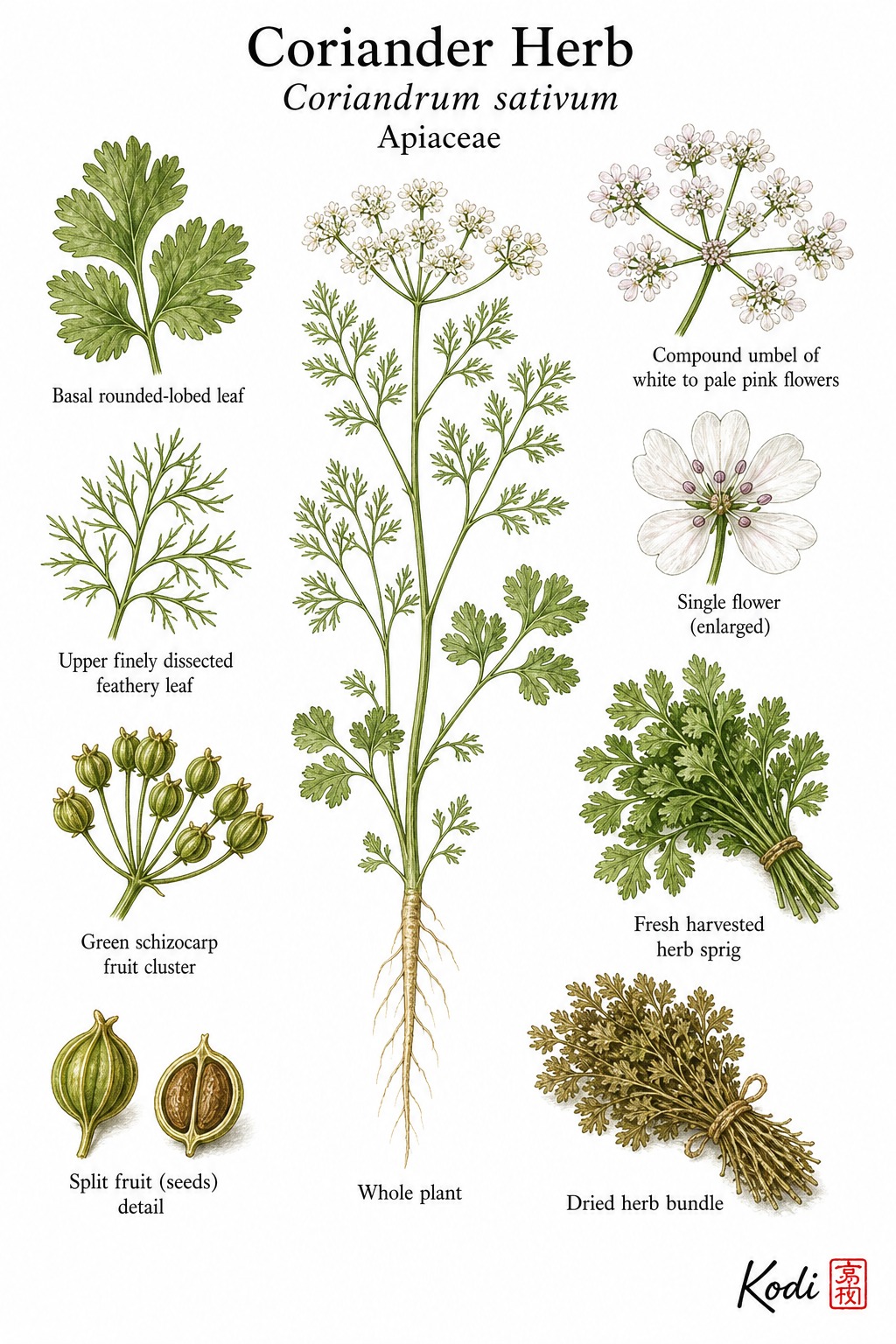
Known in TCM as Hu Sui (胡荽), this acrid, warm herb enters the Lung and Spleen. Traditionally, it releases the exterior and promotes eruption - Hu Sui is classically used when measles or similar rashes are slow to surface and mild warm dispersal is needed to bring the pathogen outward, most often applied for poor appetite, indigestion, and wind cold. Modern research has identified Linalool among its active constituents.
Part used: Whole herb
Also Known As
Latin: Herba Coriandri Sativi | Pinyin: Hu Sui | Chinese: 胡荽
TCM Properties
- Taste
- acrid
- Temperature
- warm
- Channels
- Lung, Spleen
Traditional Use
Primary Actions
- Releases the exterior and promotes eruption - Hu Sui is classically used when measles or similar rashes are slow to surface and mild warm dispersal is needed to bring the pathogen outward.
- Promotes digestion and directs Qi downward - the fresh herb is used for poor appetite, food stagnation, nausea, and mild abdominal fullness, especially when aromatic movement is needed without heavy treatment.
- Assists early wind-cold release - because it is warm and pungent, coriander is sometimes used in the very early stages of simple exterior cold with chills and poor appetite.
Secondary Actions
- Hu Sui is both a culinary plant and a medicine, so fresh dosage and food-style administration are common in traditional practice.
- Its dispersing action is relatively gentle, which is why it is favored for children or convalescent patients when one wants to vent and move without using stronger acrid medicinals.
Classical References
- Traditional herb summaries describe Hu Sui as acrid and warm, entering the Lung and Spleen to promote sweating, vent rashes, and aid sluggish digestion.
- Historical food-therapy sources treat coriander as a bridge between kitchen and clinic, especially for eruption disorders and mild cold-digestive overlap patterns.
- The old caution against using it once eruptions are already complete remains important because a dispersing herb is unnecessary after the surface stage has already resolved.
Modern Research
Active Compounds
- Linalool - the major volatile constituent associated with aromatic, antimicrobial, and calming effects
- Other terpenes including gamma-terpinene and camphor-type volatiles - supportive fragrance-bearing compounds
- Flavonoids and polyphenols - antioxidant and anti-inflammatory fractions
- Essential oil fractions from leaves and seeds - the best studied modern coriander extracts
Studied Effects
- A 2023 review summarized coriander essential oil chemistry and described broad antimicrobial, antioxidant, and anti-inflammatory activity, supporting why the plant remains interesting as both food and medicine (PMID 36677754).
- A 2022 systematic review of preclinical studies found that Coriandrum sativum favorably modulates inflammatory mediators such as TNF-alpha, IL-1beta, and IL-6 across experimental models (PMID 35554788).
- Coriandrum sativum essential oil showed antifungal activity against Candida species and altered fungal molecular targets, offering a modern rationale for some traditional external and antimicrobial uses (PMID 24901768).
PubMed References
- Essential Oil from Coriandrum sativum: A review on Its Phytochemistry and Biological Activity (2023)
- Systematic review of preclinical studies about effects of Coriandrum sativum L. on inflammatory mediators (2022)
- Coriandrum sativum L. (Coriander) essential oil: antifungal activity and mode of action on Candida spp., and molecular targets affected in human whole-genome expression (2014)
Safety & Interactions
Contraindications
- Adequately erupted rashes or measles that have already fully surfaced
- Profuse sweating from deficiency
Cautions
- Although common as food, medicinal use aims at mild dispersal; excessive use may be too scattering for people who are already sweating or depleted.
- Very sensitive individuals may react to fresh coriander or concentrated essential-oil products more strongly than to culinary amounts.
- MSK page not found - drug interaction data not available from Memorial Sloan Kettering integrative medicine database
Conditions
- Poor Appetite Traditional ★★★☆☆ JSON
- Indigestion Traditional ★★★☆☆ JSON
- Wind Cold Traditional ★★☆☆☆ JSON
Frequently Asked Questions
What is Coriander Herb used for?
Coriander Herb is traditionally used to Releases the exterior and promotes eruption - Hu Sui is classically used when measles or similar rashes are slow to surface and mild warm dispersal is needed to bring the pathogen outward., Promotes digestion and directs Qi downward - the fresh herb is used for poor appetite, food stagnation, nausea, and mild abdominal fullness, especially when aromatic movement is needed without heavy treatment., Assists early wind-cold release - because it is warm and pungent, coriander is sometimes used in the very early stages of simple exterior cold with chills and poor appetite.. Research has investigated its effects on: A 2023 review summarized coriander essential oil chemistry and described broad antimicrobial, antioxidant, and anti-inflammatory activity, supporting why the plant remains interesting as both food and medicine (PMID 36677754).; A 2022 systematic review of preclinical studies found that Coriandrum sativum favorably modulates inflammatory mediators such as TNF-alpha, IL-1beta, and IL-6 across experimental models (PMID 35554788)..
What are other names for Coriander Herb?
Coriander Herb is also known as Coriandri. In TCM: 胡荽 (Hu Sui); Herba Coriandri Sativi.
Is Coriander Herb safe during pregnancy?
The safety of Coriander Herb during pregnancy has not been established. Consult a qualified healthcare provider before use.
What are the contraindications for Coriander Herb?
Coriander Herb should not be used in: Adequately erupted rashes or measles that have already fully surfaced; Profuse sweating from deficiency. Consult a qualified practitioner before use.