Crab
- Chinese
- 蟃蟹
- Pinyin
- Pang Xie
- Latin
- Caro Eriocheiris
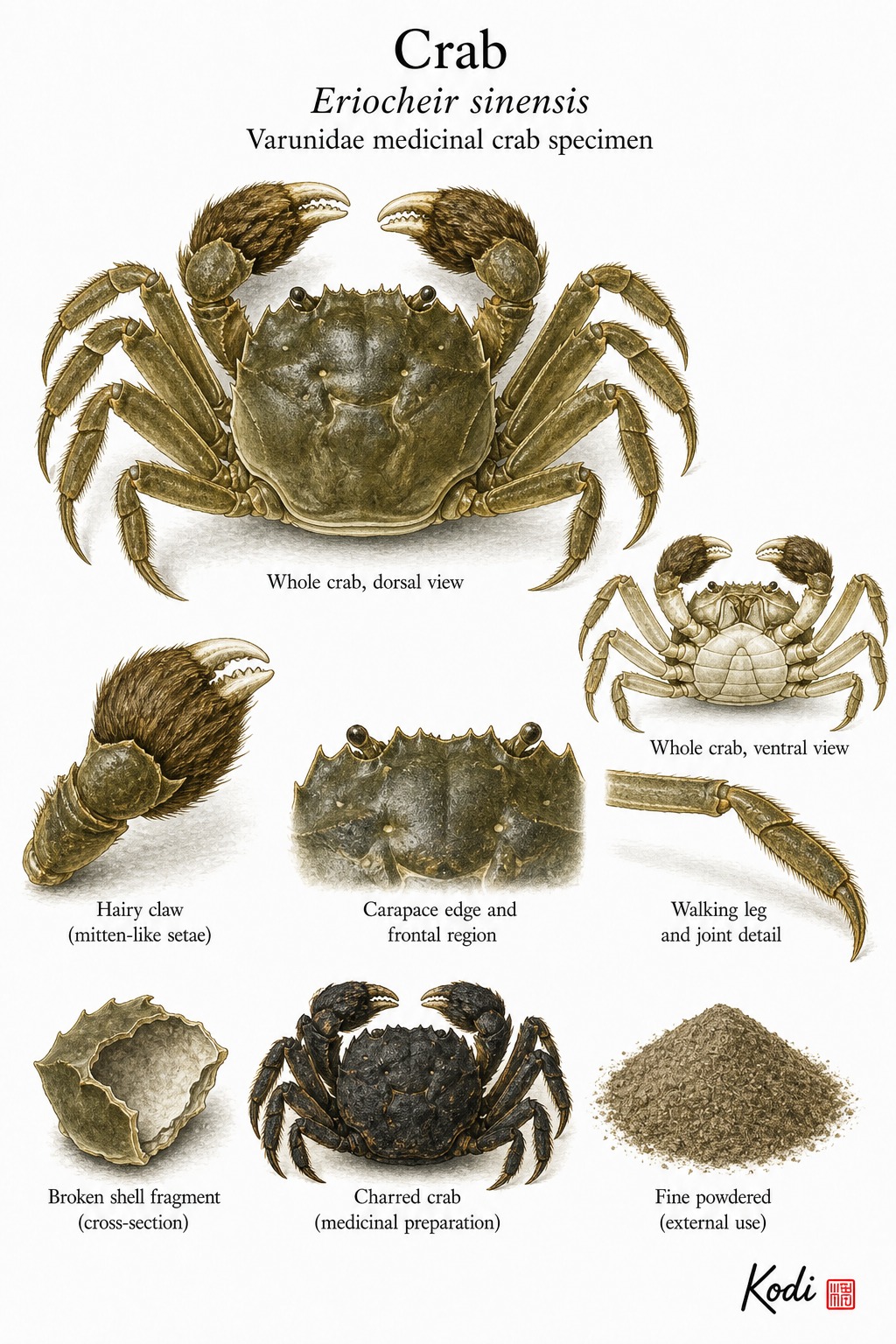
Known in TCM as Pang Xie (蟃蟹), this salty, cold herb enters the Liver and Stomach. Traditionally, it clears Heat and resolves toxicity - Pang Xie is classically used for toxic skin presentations such as scabies, irritant dermatitis, and inflamed external lesions, most often applied for scabies, skin burns, and traumatic injury. Modern research has identified Chitin among its active constituents.
Part used: Flesh
Also Known As
Latin: Caro Eriocheiris | Pinyin: Pang Xie | Chinese: 蟃蟹
TCM Properties
- Taste
- salty
- Temperature
- cold
- Channels
- Liver, Stomach
Traditional Use
Primary Actions
- Clears Heat and resolves toxicity - Pang Xie is classically used for toxic skin presentations such as scabies, irritant dermatitis, and inflamed external lesions.
- Dissipates Blood stasis and reduces swelling - older use includes traumatic injury and localized swelling where a cold, salty animal drug is chosen to break stagnant accumulation.
- Assists treatment of scalds and external burns - the crab is typically charred, powdered, or applied externally rather than used as an everyday internal medicinal food.
Secondary Actions
- This is a niche external-use medicinal and should not be confused with ordinary dietary crab consumption.
- The herb's clinical identity is tied more to charcoal, powder, and topical handling than to routine decoction use.
Classical References
- Traditional herb references describe Pang Xie as salty and cold, entering the Liver and Stomach to clear heat, dispel stasis, reduce swelling, and resolve toxin.
- The standard indications of scabies, scalds, traumatic injury, and dermatitis show that Pang Xie belongs to the practical external-medicine side of Chinese materia medica.
- Traditional administration methods emphasize charring, powdering, pills, or topical application rather than everyday food use.
Modern Research
Active Compounds
- Chitin and chitosan from crab shell - the best studied crab-derived biomaterial fractions
- Calcium carbonate from shell matrix - a mineral component relevant to powders and wound biomaterials
- Astaxanthin and other carotenoids - antioxidant pigments associated with crustacean shell material
- Shell proteins and peptides - structural and bioactive fractions used in regenerative-material research
Studied Effects
- A blue-crab chitosan and protein hydrogel enriched with carotenoids showed notable wound-healing effects in vivo, offering a modern analogue for Pang Xie's traditional external role in injured and inflamed tissue (PMID 32487393).
- A review of chitosan-based functional materials described strong hemostatic, anti-inflammatory, and granulation-promoting effects in skin wound repair, which helps explain why crab-derived materials remain relevant to external healing applications (PMID 33681176).
- A 2025 study on blue-crab biogenic carbonates showed that even aged crustacean shell material retained structural calcium carbonate and embedded astaxanthin, reinforcing the biomedical interest of crab-derived external materials rather than directly validating broad internal use of Pang Xie (PMID 41303966).
PubMed References
- A novel blue crab chitosan/protein composite hydrogel enriched with carotenoids endowed with distinguished wound healing capability: In vitro characterization and in vivo assessment (2020)
- Chitosan-Based Functional Materials for Skin Wound Repair: Mechanisms and Applications (2021)
- Aged Biogenic Carbonates from Crustacean Waste: Structural and Functional Evaluation of Calibrated Fine Powders and Their Conversion into Phosphate Minerals (2025)
Safety & Interactions
Contraindications
- Deficiency-cold patterns
- Wandering arthritis and hemiplegia in the traditional caution framework
- Known shellfish allergy
Cautions
- Crab-derived external materials may irritate highly sensitive skin, especially in people with shellfish allergy.
- The traditional medicinal use of Pang Xie is specialized and should not be generalized from ordinary dietary crab consumption.
- MSK page not found - drug interaction data not available from Memorial Sloan Kettering integrative medicine database
Conditions
- Scabies Traditional ★★★★☆ JSON
- Skin Burns Traditional ★★★☆☆ JSON
- Traumatic Injury Traditional ★★★☆☆ JSON
- Eczema Traditional ★★☆☆☆ JSON
Frequently Asked Questions
What is Crab used for?
Crab is traditionally used to Clears Heat and resolves toxicity - Pang Xie is classically used for toxic skin presentations such as scabies, irritant dermatitis, and inflamed external lesions., Dissipates Blood stasis and reduces swelling - older use includes traumatic injury and localized swelling where a cold, salty animal drug is chosen to break stagnant accumulation., Assists treatment of scalds and external burns - the crab is typically charred, powdered, or applied externally rather than used as an everyday internal medicinal food.. Research has investigated its effects on: A blue-crab chitosan and protein hydrogel enriched with carotenoids showed notable wound-healing effects in vivo, offering a modern analogue for Pang Xie's traditional external role in injured and inflamed tissue (PMID 32487393).; A review of chitosan-based functional materials described strong hemostatic, anti-inflammatory, and granulation-promoting effects in skin wound repair, which helps explain why crab-derived materials remain relevant to external healing applications (PMID 33681176)..
What are other names for Crab?
Crab is also known as Eriocheiris. In TCM: 蟃蟹 (Pang Xie); Caro Eriocheiris.
Is Crab safe during pregnancy?
The safety of Crab during pregnancy has not been established. Consult a qualified healthcare provider before use.
What are the contraindications for Crab?
Crab should not be used in: Deficiency-cold patterns; Wandering arthritis and hemiplegia in the traditional caution framework; Known shellfish allergy. Consult a qualified practitioner before use.