Crystal Sugar
- Chinese
- 冰糖
- Pinyin
- Bing Tang
- Latin
- Saccharum Crystallidum
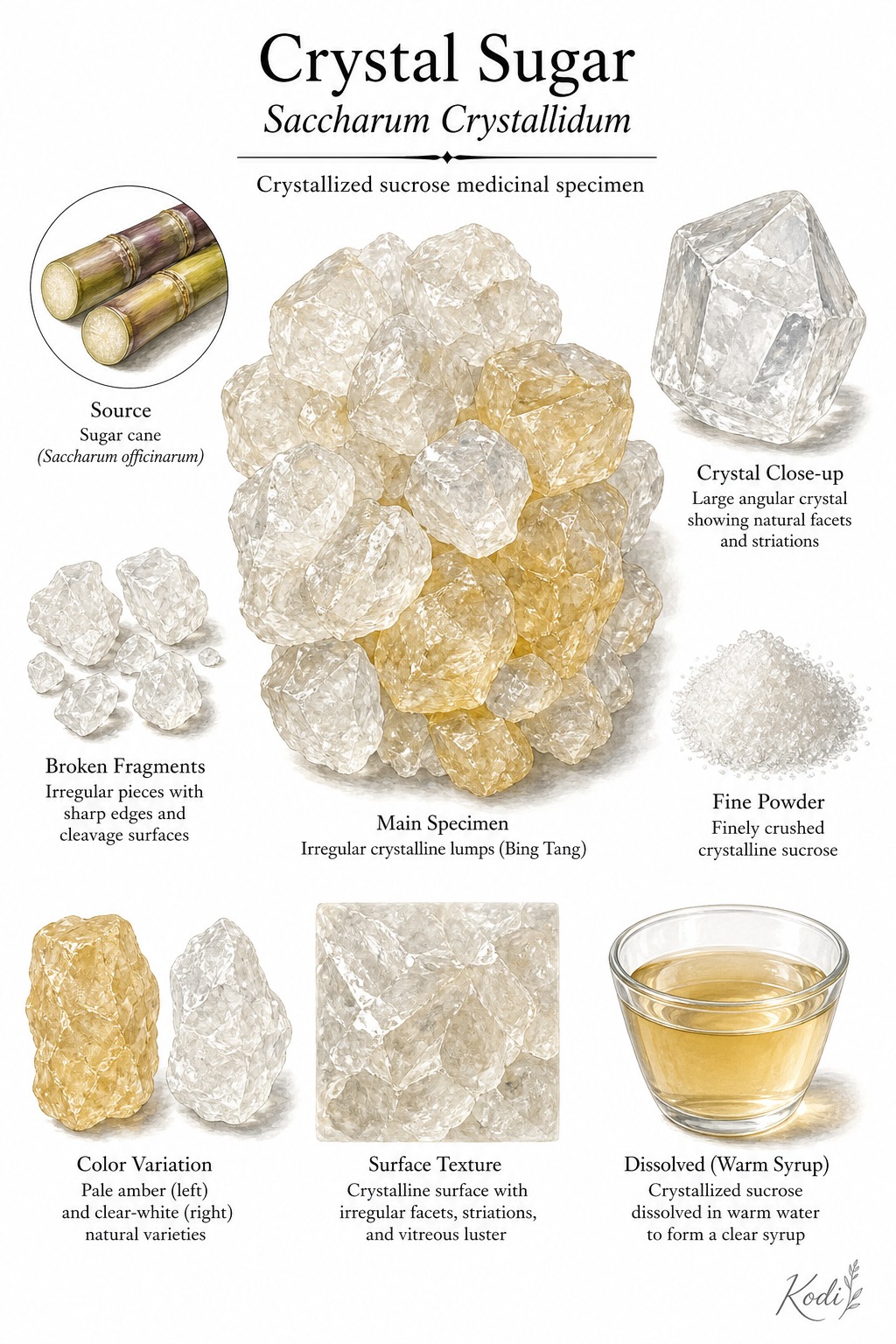
Known in TCM as Bing Tang (冰糖), this sweet, neutral herb enters the Lung and Spleen. Traditionally, it moistens the Lung and relieves dryness-type cough - Bing Tang is a gentle food-medicine ingredient used when Lung dryness causes an irritated throat, dry cough, or scanty blood-streaked sputum, most often applied for dry cough, cough, and digestive weakness. Modern research has identified Sucrose among its active constituents.
Part used: Sugar
Also Known As
Latin: Saccharum Crystallidum | Pinyin: Bing Tang | Chinese: 冰糖
TCM Properties
- Taste
- sweet
- Temperature
- neutral
- Channels
- Lung, Spleen
Traditional Use
Primary Actions
- Moistens the Lung and relieves dryness-type cough - Bing Tang is a gentle food-medicine ingredient used when Lung dryness causes an irritated throat, dry cough, or scanty blood-streaked sputum.
- Strengthens the Spleen and harmonizes the Stomach - traditional dietetic use includes mild Spleen-Stomach Qi weakness, poor appetite, and recovery from depletion when a soft, nourishing sweet is appropriate.
- Soothes the throat and moderates harsh herbs - rock sugar is often added to stewed or decocted remedies to soften irritation and make dry-cough formulas easier to take.
Secondary Actions
- Bing Tang belongs more to medicinal food therapy than to forceful crude-herb treatment, so it is usually combined with foods or demulcent herbs rather than used alone as a major intervention.
- Its neutral, moistening quality makes it gentler than warming brown sugar for respiratory dryness, but it remains a concentrated sweet and should still be used thoughtfully.
Classic Formulas
- Bing Tang stewed with pear - the classic household pairing for dry cough, throat irritation, and mild heat-dryness affecting the Lung.
- Chuan Bei Mu stewed with pear and Bing Tang - a traditional food-therapy preparation for lingering dry cough with sticky scant phlegm or throat discomfort.
- Bing Tang with Bai He or Sha Shen in sweet soups - a dietetic approach to moistening dryness and supporting gentle recovery.
Classical References
- Traditional references describe Bing Tang as sweet and neutral, entering the Lung and Spleen to moisten the Lung, relieve cough, and support the middle burner.
- Unlike stronger medicinal sugars such as Hong Tang, Bing Tang is valued for being relatively neutral and soothing rather than warming or Blood-moving.
- Its role in cough preparations is often supportive and harmonizing, which is why it appears so frequently in medicinal stews and convalescent recipes.
Modern Research
Active Compounds
- Sucrose - the dominant carbohydrate and principal sweetening constituent
- Trace minerals - minor residual constituents that vary with source and processing
- Water-soluble crystallized sugar matrix - the processed form that makes Bing Tang useful as a food-therapy carrier rather than as a phytochemical-rich herb
Studied Effects
- Modern literature on Bing Tang itself is limited because it is primarily a processed sugar rather than a phytochemically distinctive medicinal herb.
- Its present-day relevance is mainly as a soothing food-therapy ingredient and delivery vehicle in traditional respiratory preparations rather than as a stand-alone evidence-based treatment.
- From a modern safety perspective, the main concern is glycemic load and overuse in patients with metabolic disease, not hidden herb-drug pharmacology.
Safety & Interactions
Contraindications
- Poorly controlled diabetes
- Pronounced damp-phlegm accumulation with heavy digestion
Cautions
- Bing Tang is gentle in traditional use but still delivers a substantial sugar load, so repeated medicinal use may be inappropriate for patients with hyperglycemia or metabolic syndrome.
- It is best understood as a supportive food-medicine ingredient and should not replace treatment for persistent cough, hemoptysis, or serious digestive disease.
- MSK page not found - drug interaction data not available from Memorial Sloan Kettering integrative medicine database
Conditions
- Dry Cough Traditional ★★★☆☆ JSON
- Cough Traditional ★★☆☆☆ JSON
- Digestive Weakness Traditional ★★☆☆☆ JSON
- Poor Appetite Traditional ★☆☆☆☆ JSON
Frequently Asked Questions
What is Crystal Sugar used for?
Crystal Sugar is traditionally used to Moistens the Lung and relieves dryness-type cough - Bing Tang is a gentle food-medicine ingredient used when Lung dryness causes an irritated throat, dry cough, or scanty blood-streaked sputum., Strengthens the Spleen and harmonizes the Stomach - traditional dietetic use includes mild Spleen-Stomach Qi weakness, poor appetite, and recovery from depletion when a soft, nourishing sweet is appropriate., Soothes the throat and moderates harsh herbs - rock sugar is often added to stewed or decocted remedies to soften irritation and make dry-cough formulas easier to take.. Research has investigated its effects on: Modern literature on Bing Tang itself is limited because it is primarily a processed sugar rather than a phytochemically distinctive medicinal herb.; Its present-day relevance is mainly as a soothing food-therapy ingredient and delivery vehicle in traditional respiratory preparations rather than as a stand-alone evidence-based treatment..
What are other names for Crystal Sugar?
Crystal Sugar is also known as Crystallidum. In TCM: 冰糖 (Bing Tang); Saccharum Crystallidum.
Is Crystal Sugar safe during pregnancy?
The safety of Crystal Sugar during pregnancy has not been established. Consult a qualified healthcare provider before use.
What are the contraindications for Crystal Sugar?
Crystal Sugar should not be used in: Poorly controlled diabetes; Pronounced damp-phlegm accumulation with heavy digestion. Consult a qualified practitioner before use.