Cynanchum Root
- Chinese
- 白前
- Pinyin
- Bai Qian
- Latin
- Rhizoma Cynanchi Stauntonii
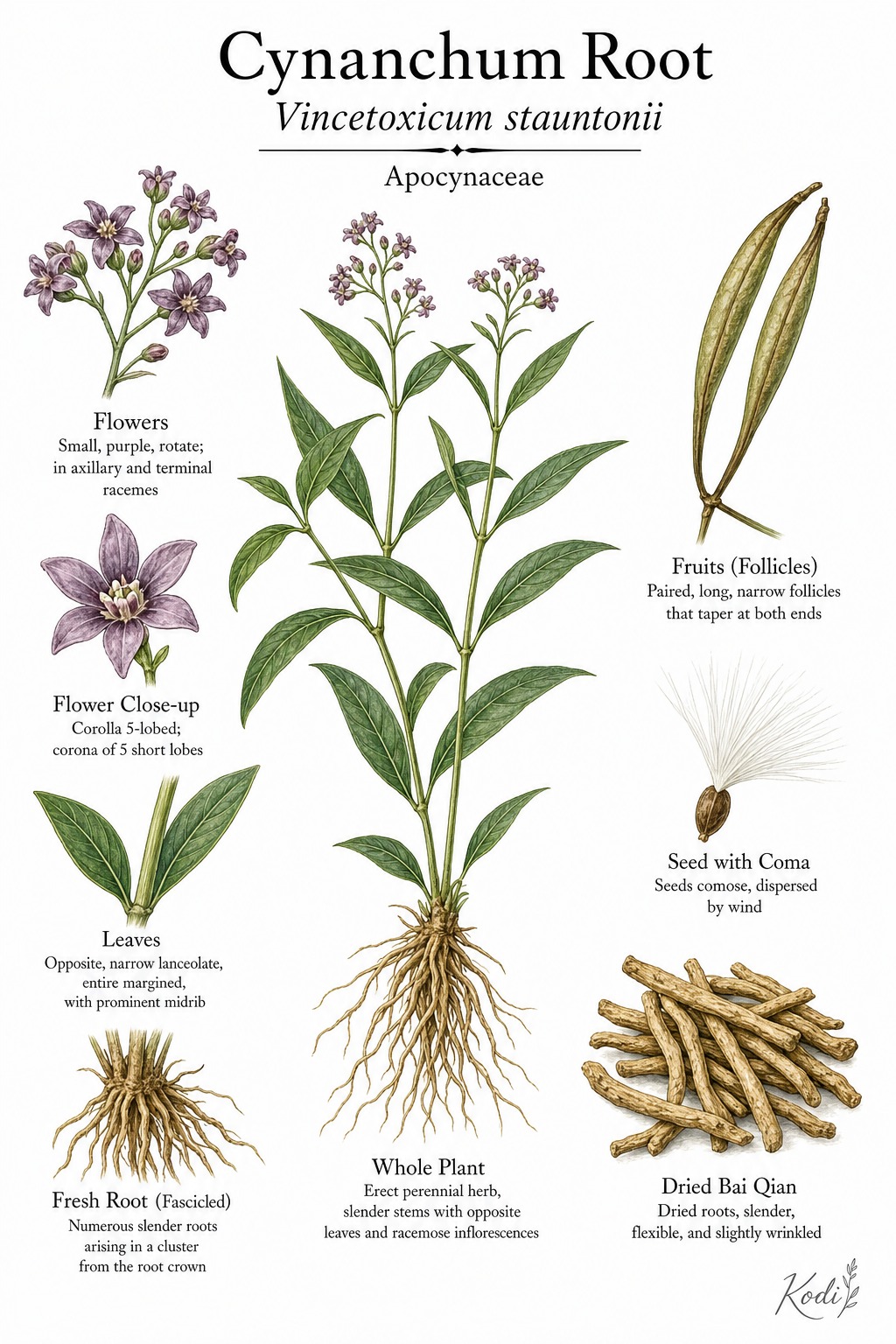
Known in TCM as Bai Qian (白前), this acrid and bitter, slightly warm herb enters the Lung. Traditionally, it directs Lung Qi downward and transforms phlegm - Bai Qian is a core herb for cough, dyspnea, chest fullness, and noisy phlegm when the Lung fails to descend, most often applied for cough, productive cough, and bronchitis. Modern research has identified Steroidal among its active constituents.
Part used: Rhizome
Also Known As
Latin: Rhizoma Cynanchi Stauntonii | Pinyin: Bai Qian | Chinese: 白前
TCM Properties
- Taste
- acrid, bitter
- Temperature
- slightly warm
- Channels
- Lung
Traditional Use
Primary Actions
- Directs Lung Qi downward and transforms phlegm - Bai Qian is a core herb for cough, dyspnea, chest fullness, and noisy phlegm when the Lung fails to descend.
- Relieves cough in both cold-phlegm and mixed obstruction patterns - its action is broad enough to appear in formulas for new or chronic cough, especially when phlegm is prominent.
- Opens the chest and eases labored breathing - by restoring the descending function of Lung Qi, it helps reduce a sense of blockage in the chest and difficulty exhaling.
Secondary Actions
- Bai Qian is valued because it is neither extremely drying nor extremely cold, making it more flexible than harsher phlegm-transforming herbs.
- Honey-processed Bai Qian is considered milder and is often chosen when lingering dry cough or deficiency complicates the phlegm pattern.
Classic Formulas
- Zhi Sou San - Bai Qian works with Jing Jie and Jie Geng to stop lingering cough after an exterior pathogen has not fully resolved.
- Bai Qian Wan - a traditional pairing with Lung-draining herbs such as Sang Bai Pi and Ting Li Zi for cough and dyspnea with heat or retained phlegm.
- Bai Qian with Su Zi, Ban Xia, and Bai Jie Zi - a common cold-phlegm strategy for chest fullness, cough, and difficult expectoration.
Classical References
- Traditional sources describe Bai Qian as acrid, bitter, and slightly warm, entering the Lung to descend Qi, transform phlegm, stop cough, and relieve dyspnea.
- The herb is repeatedly praised for handling cough with profuse phlegm regardless of whether the presentation leans somewhat cold or somewhat warm, as long as phlegm obstruction is central.
- Older cautions note that Bai Qian can irritate the Stomach and should be used carefully in patients with weak digestion or a tendency to bleeding.
Modern Research
Active Compounds
- Steroidal glycosides such as cynatratoside B - airway-active constituents investigated in root extracts
- Stauntosides and related C21 steroidal glycosides - major chemical markers of Cynanchum stauntonii
- Glaucogenin-type steroids - additional characteristic constituents of the root
Studied Effects
- A bioassay-guided study isolated cynatratoside B from Cynanchum stauntonii and demonstrated potent airway smooth-muscle relaxation, providing a strong modern rationale for Bai Qian's traditional antitussive role (PMID 24761833).
- Phytochemical work on the roots identified multiple anti-inflammatory secopregnane-type steroidal glycosides, supporting the idea that Bai Qian is more than a simple expectorant (PMID 28284564).
- Chemical studies continue to identify new steroidal glycosides in the root, showing that Bai Qian has a distinctive medicinal chemistry that is still being mapped (PMID 23127820).
PubMed References
Safety & Interactions
Contraindications
- Chronic cough from severe Lung deficiency without phlegm obstruction
- Active gastritis or a strong tendency to gastric irritation
- Marked bleeding tendency
Cautions
- Traditional sources caution that Bai Qian can stimulate the gastric mucosa, so patients with sensitive digestion may not tolerate it well.
- The herb is best suited to cough with obstructive phlegm rather than purely dry, depleted, or collapsing Lung patterns.
- MSK page not found - drug interaction data not available from Memorial Sloan Kettering integrative medicine database
Conditions
- Cough Traditional ★★★★☆ JSON
- Productive Cough Traditional ★★★★☆ JSON
- Bronchitis Traditional ★★★☆☆ JSON
- Wheezing Traditional ★★★☆☆ JSON
- Phlegm Accumulation Traditional ★★★☆☆ JSON
Frequently Asked Questions
What is Cynanchum Root used for?
Cynanchum Root is traditionally used to Directs Lung Qi downward and transforms phlegm - Bai Qian is a core herb for cough, dyspnea, chest fullness, and noisy phlegm when the Lung fails to descend., Relieves cough in both cold-phlegm and mixed obstruction patterns - its action is broad enough to appear in formulas for new or chronic cough, especially when phlegm is prominent., Opens the chest and eases labored breathing - by restoring the descending function of Lung Qi, it helps reduce a sense of blockage in the chest and difficulty exhaling.. Research has investigated its effects on: A bioassay-guided study isolated cynatratoside B from Cynanchum stauntonii and demonstrated potent airway smooth-muscle relaxation, providing a strong modern rationale for Bai Qian's traditional antitussive role (PMID 24761833).; Phytochemical work on the roots identified multiple anti-inflammatory secopregnane-type steroidal glycosides, supporting the idea that Bai Qian is more than a simple expectorant (PMID 28284564)..
What are other names for Cynanchum Root?
Cynanchum Root is also known as Cynanchi. In TCM: 白前 (Bai Qian); Rhizoma Cynanchi Stauntonii.
Is Cynanchum Root safe during pregnancy?
The safety of Cynanchum Root during pregnancy has not been established. Consult a qualified healthcare provider before use.
What are the contraindications for Cynanchum Root?
Cynanchum Root should not be used in: Chronic cough from severe Lung deficiency without phlegm obstruction; Active gastritis or a strong tendency to gastric irritation; Marked bleeding tendency. Consult a qualified practitioner before use.