Dahurian Rhododendron Leaf
- Chinese
- 满山红
- Pinyin
- Man Shan Hong
- Latin
- Folium Rhododendri Daurici
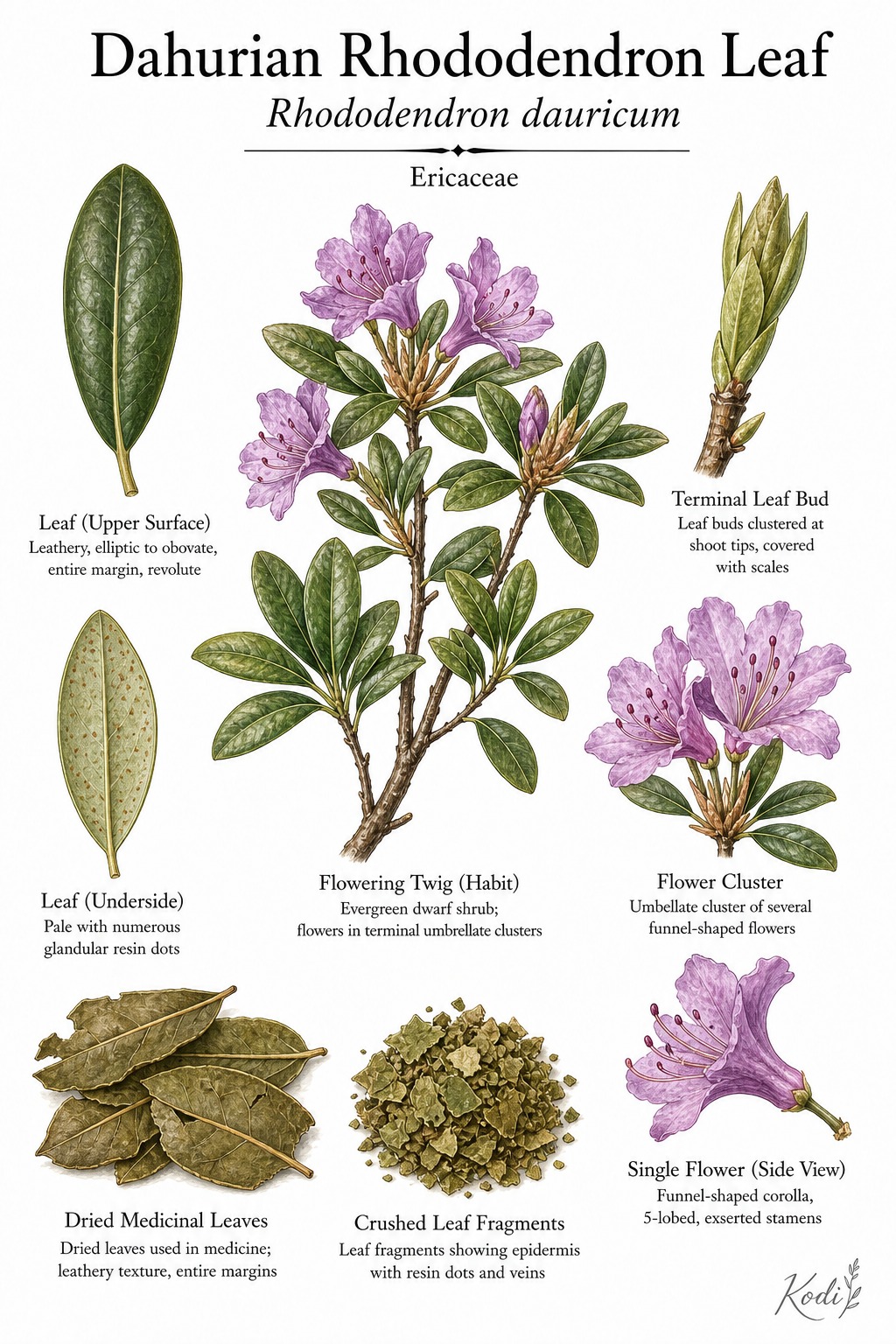
Known in TCM as Man Shan Hong (满山红), this acrid and bitter, cold herb enters the Lung and Spleen. Traditionally, it relieves cough and transforms phlegm - Man Shan Hong is classically used for cough, dyspnea, and chest oppression with copious phlegm, most often applied for productive cough, bronchitis, and phlegm accumulation. Modern research has identified Farrerol among its active constituents.
Part used: Leaf
Also Known As
Latin: Folium Rhododendri Daurici | Pinyin: Man Shan Hong | Chinese: 满山红
TCM Properties
- Taste
- acrid, bitter
- Temperature
- cold
- Channels
- Lung, Spleen
Traditional Use
Primary Actions
- Relieves cough and transforms phlegm - Man Shan Hong is classically used for cough, dyspnea, and chest oppression with copious phlegm.
- Benefits acute and chronic bronchitic patterns - regional use in northeastern China especially emphasizes productive cough and recurrent bronchial irritation.
- Clears phlegm-heat and eases labored breathing - its bitter, acrid, cooling profile makes it more suitable for obstructive phlegm and heat than for dry deficient cough.
Secondary Actions
- Man Shan Hong is a regional respiratory herb rather than a universally used textbook staple, but within its home tradition it has a strong reputation for bronchitic cough.
- The leaf record should be distinguished from Man Shan Hong You, the distilled oil preparation derived from the same plant but used as a more concentrated product.
Classic Formulas
- Man Shan Hong decoction for productive cough - traditional leaf use for phlegm-heavy cough and dyspnea.
- Man Shan Hong with Xing Ren and Jie Geng - a regional antitussive pairing to open the Lung and facilitate expectoration.
- Man Shan Hong with Chen Pi and Ban Xia - a practical phlegm-transforming combination when chest fullness and sticky sputum predominate.
Classical References
- Traditional references describe Man Shan Hong as acrid, bitter, and cold, entering the Lung and Spleen to stop cough and eliminate phlegm.
- Its core indication is cough and dyspnea with excessive phlegm rather than dry throat or yin-deficient cough.
- Northeastern folk and pharmacopoeial usage expanded the herb's reputation to acute and chronic bronchitic conditions, which remains central to modern Chinese use.
Modern Research
Active Compounds
- Farrerol - a major flavanone associated with respiratory and anti-inflammatory studies of Rhododendron dauricum
- Quercetin and other flavonoids - prominent bioactive polyphenols identified in the leaves
- Gallic acid and scopoletin - quantitated leaf constituents in analytical studies
- Daurichromenic-acid-related meroterpenoids - distinctive Rhododendron dauricum constituents of pharmacologic interest
Studied Effects
- A 2023 comprehensive review summarized the traditional use, phytochemistry, pharmacology, toxicology, and quality control of Rhododendron dauricum leaves and confirmed their long-standing role in cough, asthma, and bronchitis traditions (PMID 36584919).
- An analytical study identified and quantified multiple flavonoids, phenolic acids, and coumarins in Rhododendron dauricum leaves, providing a strong chemical basis for the herb's respiratory reputation (PMID 26154189).
- Newer isolation work continues to find anti-inflammatory meroterpenoids from Rhododendron dauricum, supporting ongoing pharmacologic interest in the leaf beyond folk respiratory use (PMID 40669545).
PubMed References
- Traditional uses, phytochemistry, pharmacology, toxicology, and quality control of Rhododendron dauricum L. leaves: A comprehensive review (2023)
- Systematic characterization and simultaneous quantification of the multiple components of Rhododendron dauricum based on high-performance liquid chromatography with quadrupole time-of-flight tandem mass spectrometry (2015)
- Grifolin derivatives from Rhododendron dauricum L. and their anti-inflammatory effects (2025)
Safety & Interactions
Contraindications
- Dry cough from yin deficiency without phlegm
- Known sensitivity to Rhododendron species
Cautions
- Rhododendron species have a real toxicology literature, so medicinal leaf material should come from standardized sources rather than ornamental look-alikes.
- Man Shan Hong is best suited to phlegm-obstructive cough and bronchitic patterns and may be inappropriate for depleted, dry, or nonproductive cough.
- MSK page not found - drug interaction data not available from Memorial Sloan Kettering integrative medicine database
Conditions
- Productive Cough Traditional ★★★★☆ JSON
- Bronchitis Research ★★★★☆ JSON
- Phlegm Accumulation Traditional ★★★☆☆ JSON
- Wheezing Traditional ★★☆☆☆ JSON
Frequently Asked Questions
What is Dahurian Rhododendron Leaf used for?
Dahurian Rhododendron Leaf is traditionally used to Relieves cough and transforms phlegm - Man Shan Hong is classically used for cough, dyspnea, and chest oppression with copious phlegm., Benefits acute and chronic bronchitic patterns - regional use in northeastern China especially emphasizes productive cough and recurrent bronchial irritation., Clears phlegm-heat and eases labored breathing - its bitter, acrid, cooling profile makes it more suitable for obstructive phlegm and heat than for dry deficient cough.. Research has investigated its effects on: A 2023 comprehensive review summarized the traditional use, phytochemistry, pharmacology, toxicology, and quality control of Rhododendron dauricum leaves and confirmed their long-standing role in cough, asthma, and bronchitis traditions (PMID 36584919).; An analytical study identified and quantified multiple flavonoids, phenolic acids, and coumarins in Rhododendron dauricum leaves, providing a strong chemical basis for the herb's respiratory reputation (PMID 26154189)..
What are other names for Dahurian Rhododendron Leaf?
Dahurian Rhododendron Leaf is also known as Rhododendri. In TCM: 满山红 (Man Shan Hong); Folium Rhododendri Daurici.
Is Dahurian Rhododendron Leaf safe during pregnancy?
The safety of Dahurian Rhododendron Leaf during pregnancy has not been established. Consult a qualified healthcare provider before use.
What are the contraindications for Dahurian Rhododendron Leaf?
Dahurian Rhododendron Leaf should not be used in: Dry cough from yin deficiency without phlegm; Known sensitivity to Rhododendron species. Consult a qualified practitioner before use.