Deer Horn
- Chinese
- 鹿角
- Pinyin
- Lu Jiao
- Latin
- Cornu Cervi
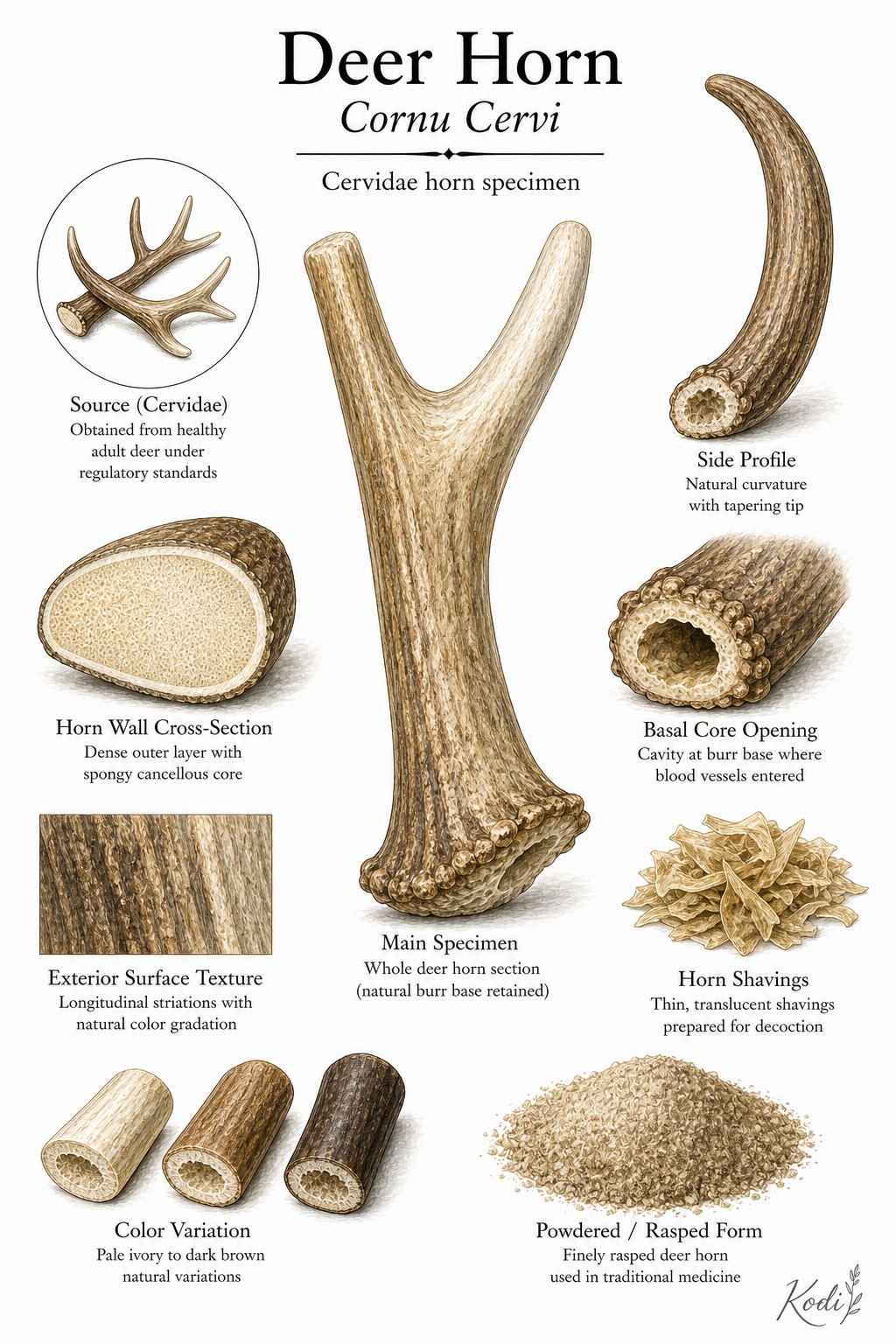
Known in TCM as Lu Jiao (鹿角), this salty, warm herb enters the Liver and Kidney. Traditionally, it warms the Kidney and supports Yang at a rougher, more moving level than velvet antler - Lu Jiao is used for weak low back and knees, lower-body cold, and chronic deficiency when warming support is needed without the expense of Lu Rong, most often applied for low back pain, joint pain, and kidney yang deficiency. Modern research has identified Collagen-rich among its active constituents.
Part used: Horn
Also Known As
Latin: Cornu Cervi | Pinyin: Lu Jiao | Chinese: 鹿角
TCM Properties
- Taste
- salty
- Temperature
- warm
- Channels
- Liver, Kidney
Traditional Use
Primary Actions
- Warms the Kidney and supports Yang at a rougher, more moving level than velvet antler - Lu Jiao is used for weak low back and knees, lower-body cold, and chronic deficiency when warming support is needed without the expense of Lu Rong.
- Invigorates blood and reduces swelling - traditional indications include sores, boils, fixed pain, and stubborn swellings where deficiency and blood stasis overlap.
- Strengthens sinews and bones in long-standing debility - later use often places Lu Jiao in formulas for soreness, weakness, and impaired recovery after chronic depletion.
Secondary Actions
- Traditional comparison commonly places Lu Jiao below Lu Rong in strength but above purely food-like deer products, with a somewhat more blood-moving and less luxuriantly tonic character.
- Because it is dense and mineral-rich, Lu Jiao is often processed or powdered before use rather than treated as a quick-acting decoction herb.
Classic Formulas
- Guilu Erxian Jiao pairing logic - deer products and turtle-shell products are combined to support deep constitutional weakness involving jing, blood, and bone.
- Lu Jiao with Du Zhong, Niu Xi, and Shu Di Huang - common Kidney-bone-supporting combination strategy for soreness and weakness of the low back and knees.
Classical References
- TCM Wiki describes Lu Jiao as salty and warm, entering the Liver and Kidney channels, with actions of promoting blood circulation, resolving swelling, and tonifying the Kidneys.
- Later traditional teaching distinguishes Lu Jiao from Lu Rong by giving it a stronger moving and swelling-resolving role alongside its lower-burner tonic action.
Modern Research
Active Compounds
- Collagen-rich protein fractions and peptides - major structural components of deer horn preparations discussed in regenerative and musculoskeletal research
- Mineral fractions including calcium and phosphorus - core components relevant to bone-oriented experimental literature
- Sterol and hormone-related compounds - low-level bioactive constituents explored in immunologic and signaling studies
Studied Effects
- A serum-proteomics study found that deer antler extract altered bone-regulation-related targets, offering a modern systems-biology correlate for the traditional reputation of Lu Jiao-type deer materials in supporting bone and musculoskeletal recovery (PMID 31286391).
- A 2023 network-pharmacology study mapped possible immunomodulatory mechanisms of deer antler compounds, highlighting multi-target signaling pathways but remaining far from clinical proof for crude deer horn use (PMID 37373516).
- Animal work on deer antler extract reported improved fracture-healing parameters through BMP-2/SMAD4-related signaling, which is suggestive for traditional bone-strengthening claims but still preclinical (PMID 36307889).
PubMed References
- Identification of potential therapeutic targets of deer antler extract on bone regulation based on serum proteomic analysis (2019)
- Network Pharmacology, Molecular Docking and Molecular Dynamics to Explore the Potential Immunomodulatory Mechanisms of Deer Antler (2023)
- Deer antler extract promotes tibia fracture healing in mice by activating BMP-2/SMAD4 signaling pathway (2022)
Safety & Interactions
Contraindications
- Yin deficiency with heat or effulgent fire
- Active inflammatory or infectious conditions made worse by warming tonics
- Unverified source material
Cautions
- Most modern literature concerns deer antler broadly rather than Lu Jiao as a precisely matched crude-drug preparation.
- Because deer products may contain hormone-active fractions, use should be cautious in patients with hormone-sensitive conditions or unexplained endocrine symptoms.
- Animal-derived material should come from verified, legally sourced suppliers only.
Conditions
- Low Back Pain Traditional ★★★☆☆ JSON
- Joint Pain Traditional ★★☆☆☆ JSON
- Kidney Yang Deficiency Traditional ★★★☆☆ JSON
- Fatigue Traditional ★★☆☆☆ JSON
Frequently Asked Questions
What is Deer Horn used for?
Deer Horn is traditionally used to Warms the Kidney and supports Yang at a rougher, more moving level than velvet antler - Lu Jiao is used for weak low back and knees, lower-body cold, and chronic deficiency when warming support is needed without the expense of Lu Rong., Invigorates blood and reduces swelling - traditional indications include sores, boils, fixed pain, and stubborn swellings where deficiency and blood stasis overlap., Strengthens sinews and bones in long-standing debility - later use often places Lu Jiao in formulas for soreness, weakness, and impaired recovery after chronic depletion.. Research has investigated its effects on: A serum-proteomics study found that deer antler extract altered bone-regulation-related targets, offering a modern systems-biology correlate for the traditional reputation of Lu Jiao-type deer materials in supporting bone and musculoskeletal recovery (PMID 31286391).; A 2023 network-pharmacology study mapped possible immunomodulatory mechanisms of deer antler compounds, highlighting multi-target signaling pathways but remaining far from clinical proof for crude deer horn use (PMID 37373516)..
What are other names for Deer Horn?
Deer Horn is also known as Cervi. In TCM: 鹿角 (Lu Jiao); Cornu Cervi.
Is Deer Horn safe during pregnancy?
The safety of Deer Horn during pregnancy has not been established. Consult a qualified healthcare provider before use.
What are the contraindications for Deer Horn?
Deer Horn should not be used in: Yin deficiency with heat or effulgent fire; Active inflammatory or infectious conditions made worse by warming tonics; Unverified source material. Consult a qualified practitioner before use.