Cistanche Stem
- Chinese
- 肉苁蓉
- Pinyin
- Rou Cong Rong
- Latin
- Herba Cistanches
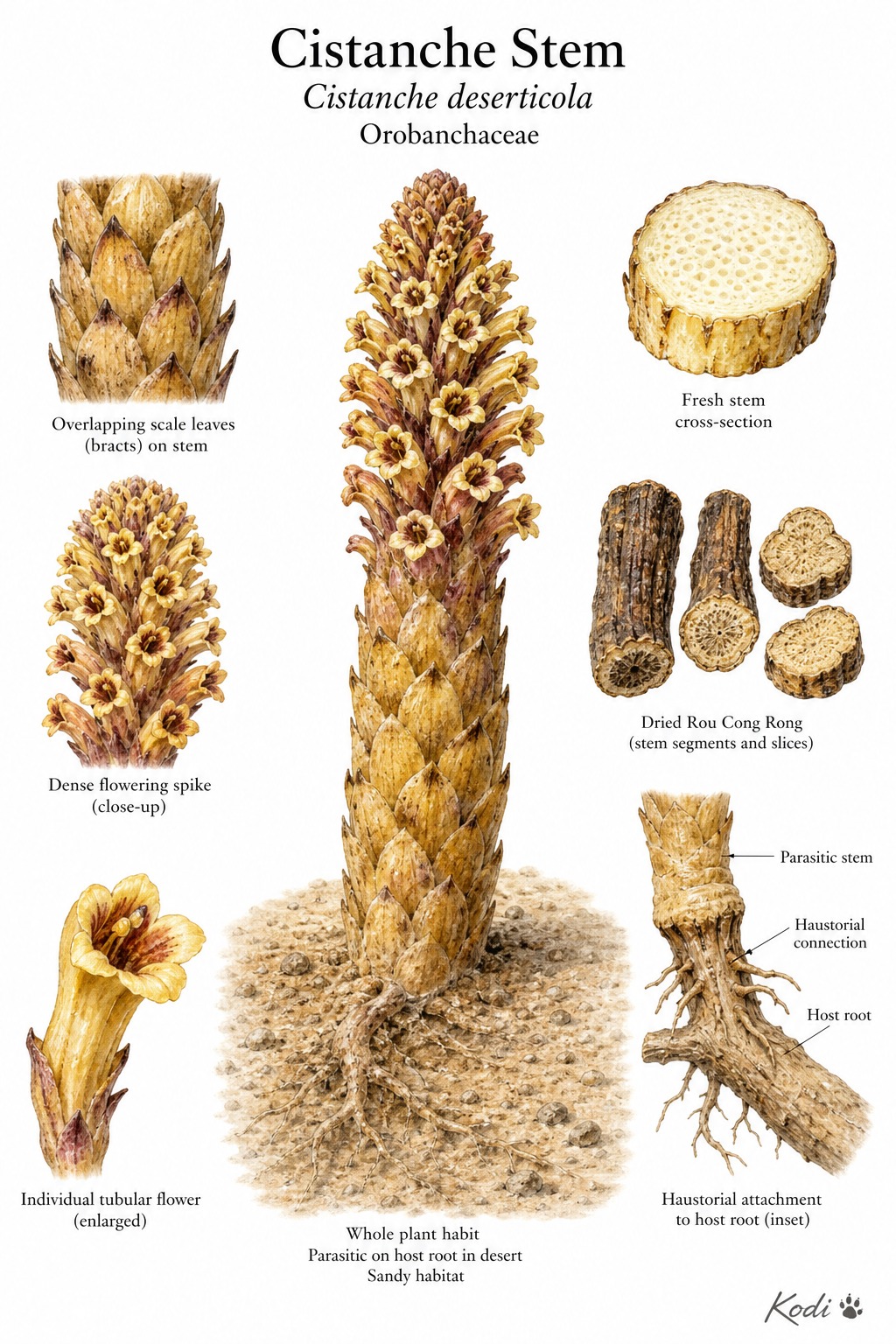
Known in TCM as Rou Cong Rong (肉苁蓉), this sweet and salty, warm herb enters the Kidney and Large Intestine. Traditionally, it tonifies Kidney Yang and replenishes essence - Rou Cong Rong is a classic deficiency tonic for impotence, infertility, weak low back and knees, and cold lower-burner fatigue, most often applied for constipation, erectile dysfunction, and infertility. Modern research has identified Phenylethanoid among its active constituents.
Part used: Whole herb
Also Known As
Latin: Herba Cistanches | Pinyin: Rou Cong Rong | Chinese: 肉苁蓉
TCM Properties
- Taste
- sweet, salty
- Temperature
- warm
- Channels
- Kidney, Large Intestine
Traditional Use
Primary Actions
- Tonifies Kidney Yang and replenishes essence - Rou Cong Rong is a classic deficiency tonic for impotence, infertility, weak low back and knees, and cold lower-burner fatigue.
- Moistens the intestines and relieves constipation - unlike many drying Yang tonics, it also benefits dry or weak bowel patterns, especially in older or depleted patients.
- Supports fertility and recovery after long-term depletion - the herb is valued when sexual weakness, fatigue, and bowel dryness reflect a deeper constitutional drain rather than an isolated symptom.
Secondary Actions
- Rou Cong Rong is often described as gentler and more moistening than hotter Yang tonics such as Fu Zi, which is why it is widely used in aging and chronic-deficiency patterns.
- Traditional use frequently pairs it with Tu Si Zi, Suo Yang, or Ba Ji Tian when the goal is to restore lower-burner vitality without overly drying the body.
Classic Formulas
- Cong Rong Suo Yang Zhou - gruel-style traditional use of Rou Cong Rong with Suo Yang for constipation and weakness in deficient patients.
- Kidney-Yang formulas with Ba Ji Tian, Du Zhong, and Tu Si Zi - common combination logic for infertility, impotence, and soreness of the low back and knees.
Classical References
- TCM Wiki describes Rou Cong Rong as a warm Yang tonic that also moistens the intestines, highlighting its dual role in reproductive weakness and constipation.
- Chinese materia medica consistently places the herb in the Kidney-Yang tonic family while emphasizing that it nourishes in a comparatively moist, less scorching way.
Modern Research
Active Compounds
- Phenylethanoid glycosides including echinacoside and acteoside - the best-known marker compounds across modern Cistanche research
- Iridoids and lignans - additional secondary metabolites contributing to broader pharmacologic activity
- Polysaccharides - high-molecular-weight fractions discussed in immunologic and anti-fatigue research
Studied Effects
- A broad review of Cistanche deserticola summarized hormone-regulating, aperient, immunomodulatory, neuroprotective, anti-inflammatory, anti-fatigue, and bone-related research, providing a modern frame for several classic Rou Cong Rong functions (PMID 23227786).
- A dedicated review of Cistanche tubulosa highlighted vasorelaxant, hepatoprotective, and glucose-tolerance-related effects while cataloging the plant's rich phenylethanoid glycoside chemistry (PMID 31257323).
- Experimental work also found that Cistanche tubulosa protected dopaminergic neurons through apoptosis- and GDNF-related pathways, supporting a modern neuroprotective research direction that remains preclinical (PMID 28018211).
PubMed References
- Cistanche deserticola Y. C. Ma, "Desert ginseng": a review (2012)
- A Review of Biologically Active Natural Products from a Desert Plant Cistanche tubulosa (2019)
- Cistanche tubulosa Protects Dopaminergic Neurons through Regulation of Apoptosis and Glial Cell-Derived Neurotrophic Factor: in vivo and in vitro (2016)
Safety & Interactions
Contraindications
- Diarrhea from damp-heat or excess rather than deficiency
- Yin-deficient heat patterns without Yang weakness
Cautions
- Modern literature often studies Cistanche deserticola or Cistanche tubulosa specifically, so extract findings should not be transferred blindly across all commercial products.
- Because Rou Cong Rong is moistening, some patients with loose stool or damp accumulation tolerate it poorly.
Conditions
- Constipation Traditional ★★★★☆ JSON
- Erectile Dysfunction Traditional ★★★★☆ JSON
- Infertility Traditional ★★★☆☆ JSON
- Kidney Yang Deficiency Traditional ★★★★☆ JSON
Frequently Asked Questions
What is Cistanche Stem used for?
Cistanche Stem is traditionally used to Tonifies Kidney Yang and replenishes essence - Rou Cong Rong is a classic deficiency tonic for impotence, infertility, weak low back and knees, and cold lower-burner fatigue., Moistens the intestines and relieves constipation - unlike many drying Yang tonics, it also benefits dry or weak bowel patterns, especially in older or depleted patients., Supports fertility and recovery after long-term depletion - the herb is valued when sexual weakness, fatigue, and bowel dryness reflect a deeper constitutional drain rather than an isolated symptom.. Research has investigated its effects on: A broad review of Cistanche deserticola summarized hormone-regulating, aperient, immunomodulatory, neuroprotective, anti-inflammatory, anti-fatigue, and bone-related research, providing a modern frame for several classic Rou Cong Rong functions (PMID 23227786).; A dedicated review of Cistanche tubulosa highlighted vasorelaxant, hepatoprotective, and glucose-tolerance-related effects while cataloging the plant's rich phenylethanoid glycoside chemistry (PMID 31257323)..
What are other names for Cistanche Stem?
Cistanche Stem is also known as Cistanches. In TCM: 肉苁蓉 (Rou Cong Rong); Herba Cistanches.
Is Cistanche Stem safe during pregnancy?
The safety of Cistanche Stem during pregnancy has not been established. Consult a qualified healthcare provider before use.
What are the contraindications for Cistanche Stem?
Cistanche Stem should not be used in: Diarrhea from damp-heat or excess rather than deficiency; Yin-deficient heat patterns without Yang weakness. Consult a qualified practitioner before use.