Doederlein's Spikemoss Herb
- Chinese
- 石上柏
- Pinyin
- Shi Shang Bai
- Latin
- Herba Selaginellae Doederleinii
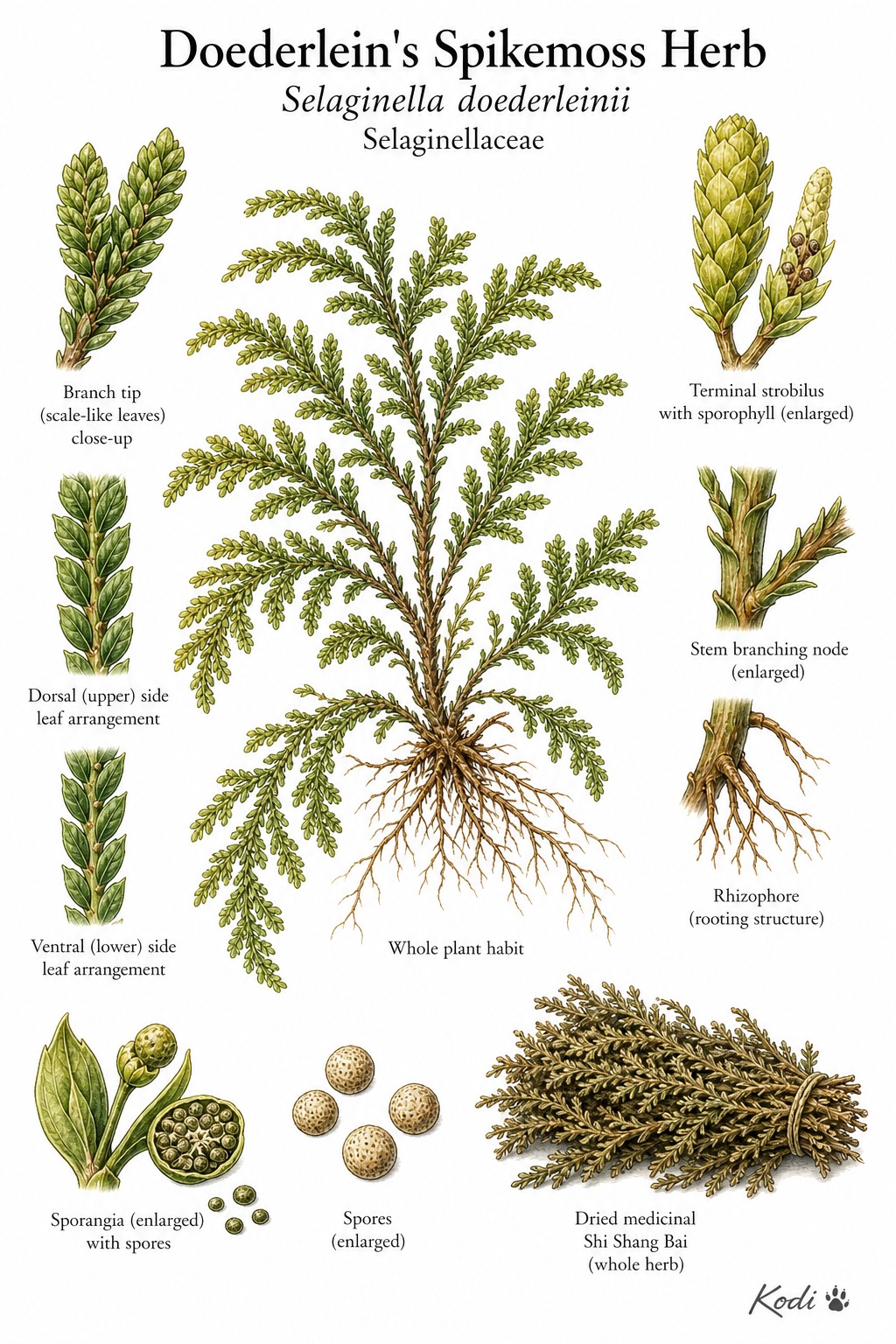
Known in TCM as Shi Shang Bai (石上柏), this bitter, cold herb enters the Liver, Gallbladder, and Lung. Traditionally, it clears heat and removes toxicity - Shi Shang Bai is used for sore throat, mastitis, eye swelling, and other hot, inflamed, toxin-pattern presentations, most often applied for sore throat, mastitis, and jaundice. Modern research has identified Biflavonoids among its active constituents.
Part used: Whole herb
Also Known As
Latin: Herba Selaginellae Doederleinii | Pinyin: Shi Shang Bai | Chinese: 石上柏
TCM Properties
- Taste
- bitter
- Temperature
- cold
- Channels
- Liver, Gallbladder, Lung
Traditional Use
Primary Actions
- Clears heat and removes toxicity - Shi Shang Bai is used for sore throat, mastitis, eye swelling, and other hot, inflamed, toxin-pattern presentations.
- Promotes urination and clears damp-heat - traditional indications include jaundice and heat-type urinary difficulty when dampness and heat obstruct the lower burner.
- Relieves lung heat and related upward inflammation - classic use extends to cough, wheezing, and asthma with evident heat signs.
Secondary Actions
- The herb is used both internally and externally, especially for burns or scalds where its cooling, toxin-resolving character is emphasized.
- Because Shi Shang Bai is distinctly bitter-cold, it is best matched to hot conditions rather than to weak, cold, or deficient constitutions.
Classic Formulas
- Shi Shang Bai with Pu Gong Ying or Zi Hua Di Ding - common heat-toxin pairing logic for mastitis, throat swelling, and inflamed superficial lesions.
- Damp-heat urinary combinations with Che Qian Cao and Jin Qian Cao - traditional strategy when jaundice or hot urination patterns are prominent.
Classical References
- TCM Wiki describes Shi Shang Bai as bitter and cold, entering the Liver, Gallbladder, and Lung channels, with actions of clearing heat, removing toxicity, and promoting diuresis.
- Traditional indications include sore throat, jaundice, eye pain and swelling, acute mastitis, cough or asthma due to lung heat, and heat stranguria.
Modern Research
Active Compounds
- Biflavonoids - the best-known Selaginella doederleinii constituents and the major focus of current anticancer and antioxidant literature
- Phenolic compounds - additional antioxidant-active constituents reported from the whole herb
- Selaginella-specific flavonoid derivatives - chemically distinctive compounds contributing to the plant's modern research profile
Studied Effects
- Chemical studies identified multiple phenolic constituents and helped establish the biflavonoid-rich profile of Selaginella doederleinii (PMID 17236034).
- More recent phytochemical work isolated additional flavonoids and reported antioxidant and antiproliferative activity, supporting the herb's modern reputation as a bioactive Selaginella species, though still mainly in preclinical settings (PMID 35740086).
- Broader review work on Selaginella biflavonoids continues to emphasize anti-tumor and anti-inflammatory potential, but these findings do not yet translate into validated clinical use for the crude herb (PMID 37175435).
PubMed References
Safety & Interactions
Contraindications
- Spleen-Stomach deficiency cold
- Loose stool from deficiency without heat signs
- Pregnancy without practitioner supervision
Cautions
- Most modern evidence for Shi Shang Bai remains preclinical and often centers on isolated flavonoids rather than traditional whole-herb dosing.
- Because the herb is bitter and cold, larger doses may be harder on fragile digestion.
Conditions
- Sore Throat Traditional ★★★★☆ JSON
- Mastitis Traditional ★★★☆☆ JSON
- Jaundice Traditional ★★★☆☆ JSON
- Urinary Tract Infection Traditional ★★☆☆☆ JSON
Frequently Asked Questions
What is Doederlein's Spikemoss Herb used for?
Doederlein's Spikemoss Herb is traditionally used to Clears heat and removes toxicity - Shi Shang Bai is used for sore throat, mastitis, eye swelling, and other hot, inflamed, toxin-pattern presentations., Promotes urination and clears damp-heat - traditional indications include jaundice and heat-type urinary difficulty when dampness and heat obstruct the lower burner., Relieves lung heat and related upward inflammation - classic use extends to cough, wheezing, and asthma with evident heat signs.. Research has investigated its effects on: Chemical studies identified multiple phenolic constituents and helped establish the biflavonoid-rich profile of Selaginella doederleinii (PMID 17236034).; More recent phytochemical work isolated additional flavonoids and reported antioxidant and antiproliferative activity, supporting the herb's modern reputation as a bioactive Selaginella species, though still mainly in preclinical settings (PMID 35740086)..
What are other names for Doederlein's Spikemoss Herb?
Doederlein's Spikemoss Herb is also known as Selaginella. In TCM: 石上柏 (Shi Shang Bai); Herba Selaginellae Doederleinii.
Is Doederlein's Spikemoss Herb safe during pregnancy?
Doederlein's Spikemoss Herb is not recommended during pregnancy.
What are the contraindications for Doederlein's Spikemoss Herb?
Doederlein's Spikemoss Herb should not be used in: Spleen-Stomach deficiency cold; Loose stool from deficiency without heat signs; Pregnancy without practitioner supervision. Consult a qualified practitioner before use.