Donkey Skin
- Chinese
- 驴皮
- Pinyin
- Lv Pi
- Latin
- Corium Asini
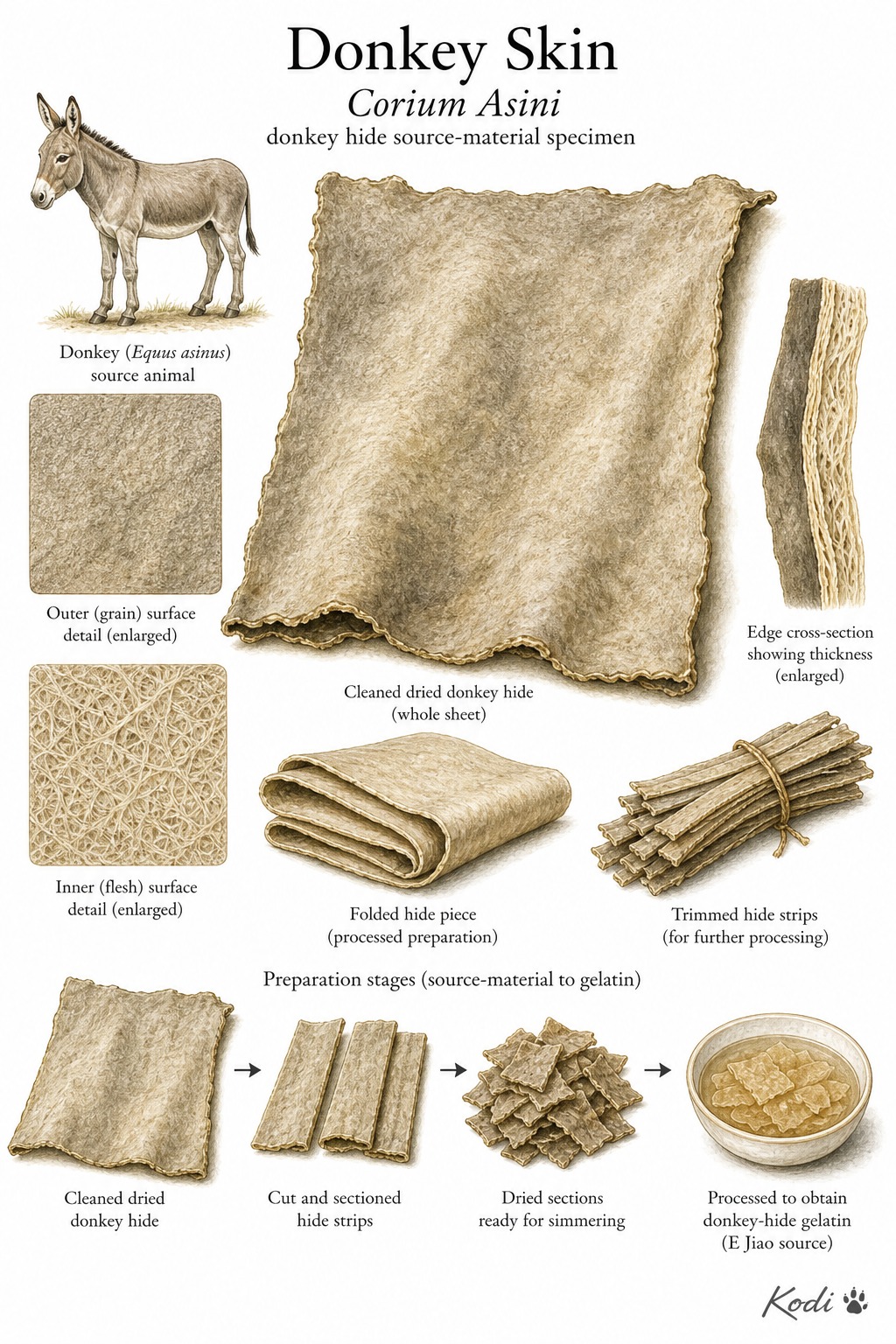
Known in TCM as Lv Pi (驴皮), this sweet, neutral herb enters the Liver and Kidney. Traditionally, it serves as the source material for preparing E Jiao - Lv Pi is historically important mainly because processed donkey-hide gelatin is made from it. Modern research has identified Collagen among its active constituents.
Part used: Hide/Skin
Also Known As
Latin: Corium Asini | Pinyin: Lv Pi | Chinese: 驴皮
TCM Properties
- Taste
- sweet
- Temperature
- neutral
- Channels
- Liver, Kidney
Traditional Use
Primary Actions
- Serves as the source material for preparing E Jiao - Lv Pi is historically important mainly because processed donkey-hide gelatin is made from it.
- Provides the raw collagen-rich animal material behind later blood-tonic preparations - any nourishing interpretation is usually mediated through cooked and refined gelatin rather than through stand-alone use of raw hide.
- Functions more as a medicinal raw material than as a commonly prescribed independent herb - direct clinical usage literature is much thinner than for E Jiao itself.
Secondary Actions
- Most classical therapeutic claims attach to processed E Jiao, so the stand-alone Lv Pi record should be read cautiously and as partly inferred from its role in the preparation chain.
- Trade authenticity and species identity are more central to Lv Pi than to most routine botanical herbs.
Classic Formulas
- E Jiao preparation traditions - Lv Pi is the essential raw material from which donkey-hide gelatin is produced before inclusion in blood-tonifying and bleeding-stabilizing formulas.
Classical References
- Historical and trade references treat donkey skin primarily as the source material for E Jiao rather than as a richly developed independent ben cao category.
- Because of that, modern interpretation of Lv Pi necessarily remains more conservative and more source-focused than the interpretation of E Jiao.
Modern Research
Active Compounds
- Collagen and related structural proteins - the core protein matrix underlying later gelatin production
- Elastin and connective-tissue proteins - part of the raw hide composition
- Amino acid-rich structural material - relevant mainly to downstream processing and authentication
Studied Effects
- Modern indexed research focuses overwhelmingly on processed E Jiao and on authentication of donkey-skin source material rather than on stand-alone clinical use of raw Lv Pi.
- Proteomic marker studies and collagen-component identification are therefore more relevant than efficacy trials when evaluating Lv Pi as a documented medicinal material (PMID 28670118).
PubMed References
Safety & Interactions
Contraindications
- Unverified or contaminated animal source material
- Self-preparation outside regulated or knowledgeable settings
Cautions
- Raw donkey skin is not interchangeable with refined E Jiao and should not be assumed to share the same safety or digestibility profile.
- This is primarily a source-material record, and direct therapeutic evidence is limited.
- Identity, processing quality, and contamination control are the main modern concerns.
Frequently Asked Questions
What is Donkey Skin used for?
Donkey Skin is traditionally used to Serves as the source material for preparing E Jiao - Lv Pi is historically important mainly because processed donkey-hide gelatin is made from it., Provides the raw collagen-rich animal material behind later blood-tonic preparations - any nourishing interpretation is usually mediated through cooked and refined gelatin rather than through stand-alone use of raw hide., Functions more as a medicinal raw material than as a commonly prescribed independent herb - direct clinical usage literature is much thinner than for E Jiao itself.. Research has investigated its effects on: Modern indexed research focuses overwhelmingly on processed E Jiao and on authentication of donkey-skin source material rather than on stand-alone clinical use of raw Lv Pi.; Proteomic marker studies and collagen-component identification are therefore more relevant than efficacy trials when evaluating Lv Pi as a documented medicinal material (PMID 28670118)..
What are other names for Donkey Skin?
Donkey Skin is also known as Asini. In TCM: 驴皮 (Lv Pi); Corium Asini.
Is Donkey Skin safe during pregnancy?
The safety of Donkey Skin during pregnancy has not been established. Consult a qualified healthcare provider before use.
What are the contraindications for Donkey Skin?
Donkey Skin should not be used in: Unverified or contaminated animal source material; Self-preparation outside regulated or knowledgeable settings. Consult a qualified practitioner before use.