Dried Lacquer
- Chinese
- 干漆
- Pinyin
- Gan Qi
- Latin
- Resina Toxicodendri
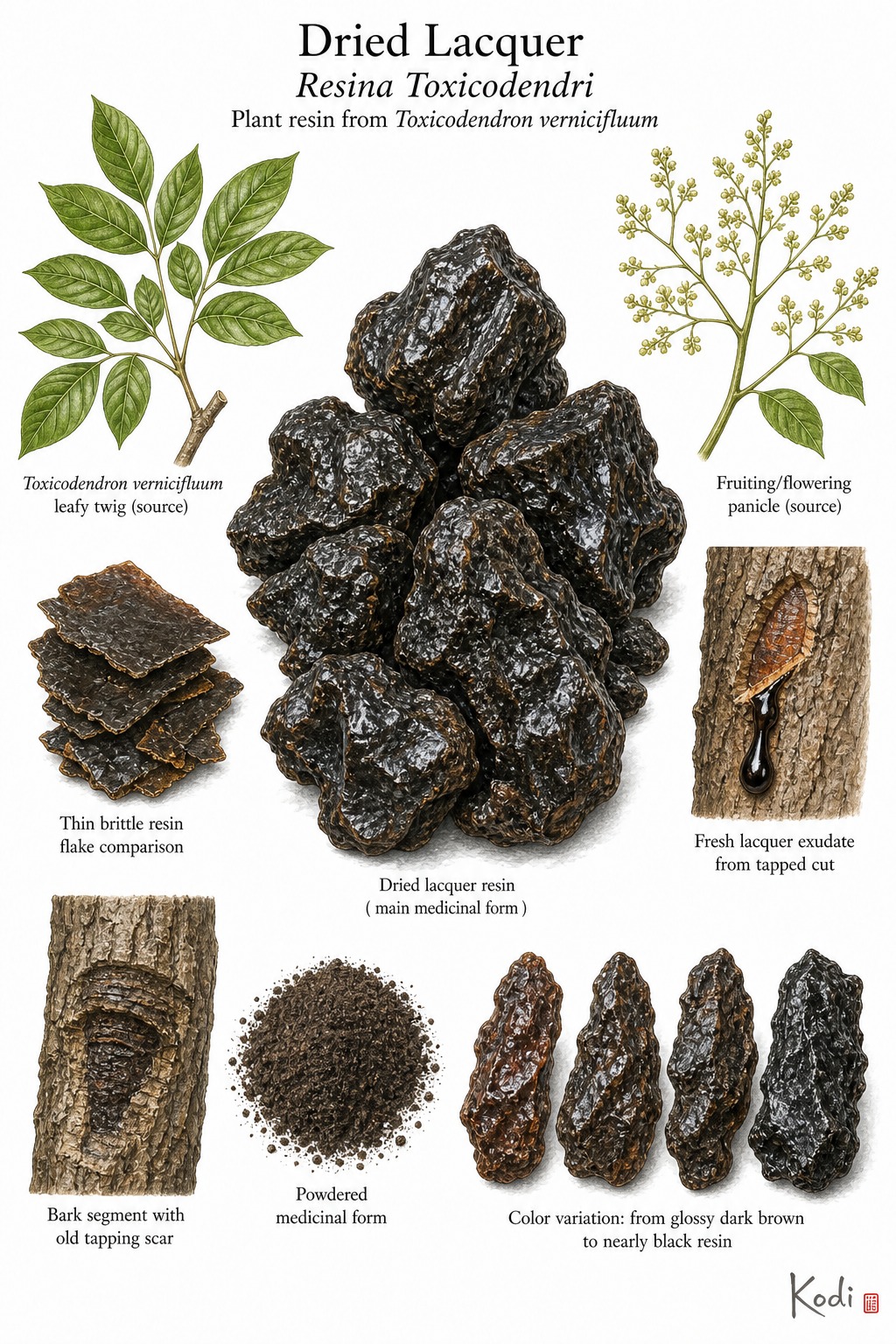
Known in TCM as Gan Qi (干漆), this acrid, warm herb enters the Liver and Spleen. Traditionally, it breaks blood stasis and disperses fixed accumulation - Gan Qi is a harsh traditional substance used for amenorrhea, abdominal masses, and stubborn stasis patterns, most often applied for amenorrhea, parasitic infection, and abdominal pain. Modern research has identified Urushiol among its active constituents.
Part used: Resin
Also Known As
Latin: Resina Toxicodendri | Pinyin: Gan Qi | Chinese: 干漆
TCM Properties
- Taste
- acrid
- Temperature
- warm
- Channels
- Liver, Spleen
Traditional Use
Primary Actions
- Breaks blood stasis and disperses fixed accumulation - Gan Qi is a harsh traditional substance used for amenorrhea, abdominal masses, and stubborn stasis patterns.
- Kills parasites - traditional indications extend to worm-related abdominal pain and persistent parasitic accumulation.
- Moves through hard and obstructed conditions rather than gently tonifying - this is a strongly activating, historically toxic material rather than a routine household herb.
Secondary Actions
- Gan Qi belongs to the small group of older medicinals whose historical use survives mostly as specialist documentation because modern safety standards make unsupervised use inappropriate.
- Even traditional sources that mention it also stress its harshness and the need for careful handling.
Classic Formulas
- Gan Qi with Tao Ren or Shui Zhi - blood-stasis breaking strategy for fixed abdominal masses and amenorrhea.
- Gan Qi with Bing Lang or Shi Jun Zi - traditional parasite-expelling combination logic when abdominal pain reflects worm accumulation.
Classical References
- TCM Wiki characterizes Gan Qi as acrid, warm, and toxic, with actions of removing blood stasis and killing parasites.
- Historical herb literature treats it as a forceful, hazardous medicinal reserved for stubborn stasis or parasite disorders rather than for general use.
Modern Research
Active Compounds
- Urushiol congeners - catechol derivatives responsible for severe allergic contact dermatitis and much of the material's toxicology
- Reactive lacquer phenolics - resin components that complicate safe handling and processing
- Related Toxicodendron polyphenols - chemically interesting but not sufficient to outweigh raw-material hazard
Studied Effects
- Most modern literature relevant to Gan Qi is toxicologic, especially around urushiol sensitivity and severe allergic contact dermatitis rather than around safe therapeutic use.
- Laboratory studies on Toxicodendron vernicifluum have identified anti-inflammatory constituents in detoxified or highly processed extracts, but those findings do not make crude Gan Qi appropriate for self-treatment (PMID 25582488).
- From a modern safety perspective, Gan Qi is better understood as a historically documented but high-risk medicinal material than as a practical consumer herb.
PubMed References
Safety & Interactions
Contraindications
- Pregnancy
- Known poison ivy, poison oak, or lacquer hypersensitivity
- Deficiency without fixed blood stasis or parasite accumulation
- Any unsupervised use
Cautions
- Gan Qi can cause severe allergic dermatitis and other toxic reactions even from limited exposure.
- Historical use does not override the substantial modern safety concerns associated with urushiol-containing lacquer materials.
- This record is primarily documentary and should not be read as a recommendation for practical self-care use.
Conditions
- Amenorrhea Traditional ★★★☆☆ JSON
- Parasitic Infection Traditional ★★★☆☆ JSON
- Abdominal Pain Traditional ★★☆☆☆ JSON
- Abdominal Distension Traditional ★★☆☆☆ JSON
Frequently Asked Questions
What is Dried Lacquer used for?
Dried Lacquer is traditionally used to Breaks blood stasis and disperses fixed accumulation - Gan Qi is a harsh traditional substance used for amenorrhea, abdominal masses, and stubborn stasis patterns., Kills parasites - traditional indications extend to worm-related abdominal pain and persistent parasitic accumulation., Moves through hard and obstructed conditions rather than gently tonifying - this is a strongly activating, historically toxic material rather than a routine household herb.. Research has investigated its effects on: Most modern literature relevant to Gan Qi is toxicologic, especially around urushiol sensitivity and severe allergic contact dermatitis rather than around safe therapeutic use.; Laboratory studies on Toxicodendron vernicifluum have identified anti-inflammatory constituents in detoxified or highly processed extracts, but those findings do not make crude Gan Qi appropriate for self-treatment (PMID 25582488)..
What are other names for Dried Lacquer?
Dried Lacquer is also known as Toxicodendri. In TCM: 干漆 (Gan Qi); Resina Toxicodendri.
Is Dried Lacquer safe during pregnancy?
Dried Lacquer is not recommended during pregnancy.
What are the contraindications for Dried Lacquer?
Dried Lacquer should not be used in: Pregnancy; Known poison ivy, poison oak, or lacquer hypersensitivity; Deficiency without fixed blood stasis or parasite accumulation; Any unsupervised use. Consult a qualified practitioner before use.