Dung Beetle
- Chinese
- 蜣螂
- Pinyin
- Qiang Lang
- Latin
- Catharsius molossus
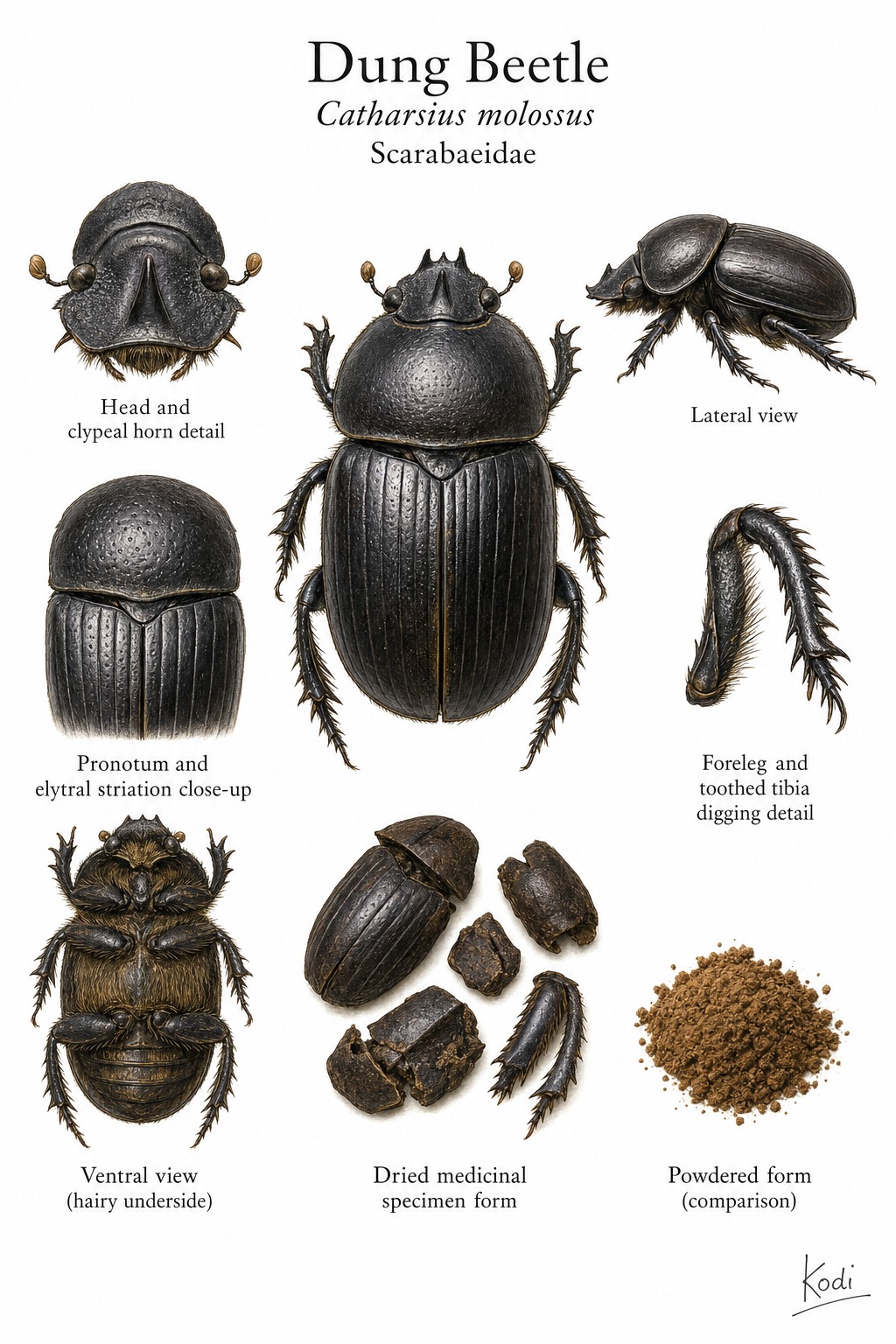
Known in TCM as Qiang Lang (蜣螂), this salty, cold herb enters the Stomach, Large Intestine, and Pericardium. Traditionally, it relieves severe constipation and attacks accumulation - Qiang Lang is a harsh attacking insect medicine historically used for hard focal masses, obstructed bowels, stubborn food accumulation, and repletion patterns that require breaking and purging rather than tonifying, most often applied for constipation, hemorrhoids, and amenorrhea. Modern research has identified Catharsius among its active constituents.
Also Known As
Latin: Catharsius molossus | Pinyin: Qiang Lang | Chinese: 蜣螂
TCM Properties
- Taste
- salty
- Temperature
- cold
- Channels
- Stomach, Large Intestine, Pericardium
Traditional Use
Primary Actions
- Relieves severe constipation and attacks accumulation - Qiang Lang is a harsh attacking insect medicine historically used for hard focal masses, obstructed bowels, stubborn food accumulation, and repletion patterns that require breaking and purging rather than tonifying.
- Breaks blood stasis and attacks toxins - classical use extends to hemorrhoidal swelling, chronic sores, nodular abdominal masses, amenorrhea with obstruction, and other hard stagnation patterns in which softer medicinals were considered insufficient.
- Opens obstruction and calms severe shen disturbance - older texts also mention its use in specialist formulas for epilepsy, mania, or severe internal blockage, though this has never been a common household application.
Secondary Actions
- Qiang Lang is a rare legacy insect drug with an aggressive, toxic, downward-draining character and is far less routine in modern practice than better known bowel-moving or blood-invigorating herbs.
- Because it is animal-derived and uncommon, authenticated sourcing, processing, and contamination control matter more than with ordinary dried botanicals.
Classic Formulas
- Qiang Lang appears in older attacking-accumulation pill traditions for constipation, abdominal masses, and pediatric accumulation disorders.
- Historical hemorrhoid and toxin-dispersing prescriptions paired Qiang Lang with purgatives and blood-invigorating medicinals when swelling, hardness, or obstruction predominated.
- Specialist formulas for severe shen disturbance sometimes combined Qiang Lang with other insect, mineral, or toxin-attacking agents, but such use is now largely of historical interest.
Classical References
- Early materia medica such as Shen Nong Ben Cao Jing place Qiang Lang among forceful, lower-grade medicinals used for accumulation, masses, and difficult obstruction rather than for gentle long-term use.
- Ben Cao Gang Mu and later commentaries preserved its reputation for breaking accumulations, dispersing stasis, and addressing hard or toxic lesions.
- Its traditional profile is that of a harsh attacking medicine chosen for excess patterns and avoided in weak, pregnant, or fluid-depleted patients.
Modern Research
Active Compounds
- Catharsius protease-1 (CPM-1) - a fibrinolytic serine protease isolated from Catharsius molossus
- N-acetyldopamine dimers - phenolic compounds with COX-1 and COX-2 inhibitory activity
- Glycosaminoglycan fractions - beetle-derived macromolecules studied for vascular and metabolic effects
- Melanin and chitin-associated biomaterial fractions - structural insect components explored for antioxidant and material-science relevance
Studied Effects
- A 2021 review of medicinal beetles highlighted Catharsius molossus as a traditional Chinese medicine source of fibrinolytic, anti-inflammatory, and antimicrobial leads, while emphasizing that the evidence remains early and almost entirely preclinical (PMID 33632986).
- N-acetyldopamine dimers isolated from Catharsius molossus inhibited COX-1 and COX-2 in vitro, offering a possible modern correlate for the beetle's traditional anti-inflammatory and toxin-dispersing reputation (PMID 26343619).
- Glycosaminoglycan fractions from Catharsius molossus showed anti-aging and cardiometabolic effects in aged rat models, but these findings are experimental and not clinically validated (PMID 28439422).
PubMed References
- Drug Discovery Insights from Medicinal Beetles in Traditional Chinese Medicine (2021)
- Identification of N-Acetyldopamine Dimers from the Dung Beetle Catharsius molossus and Their COX-1 and COX-2 Inhibitory Activities (2015)
- Anti-aging effect and gene expression profiling of dung beetle glycosaminoglycan in aged rats (2017)
Safety & Interactions
Contraindications
- Pregnancy
- Weak, elderly, or fluid-depleted patients without a clear excess accumulation pattern
- Diarrhea or loose stools without constipation or focal obstruction
- Known allergy to insect-derived medicinals
Cautions
- Qiang Lang is a toxic, strongly attacking insect medicine and is not appropriate for casual self-use or wellness-style supplementation.
- Human safety data are sparse, and authenticated sourcing is essential because contamination, spoilage, and adulteration risks are higher than for common plant herbs.
- MSK page not found - drug interaction data not available from Memorial Sloan Kettering integrative medicine database
Drug Interactions
- Anticoagulants or antiplatelet drugs - theoretical additive fibrinolytic or bleeding risk based on preclinical protease research
Conditions
- Constipation Traditional ★★★☆☆ JSON
- Hemorrhoids Traditional ★★☆☆☆ JSON
- Amenorrhea Traditional ★★☆☆☆ JSON
- Abscess Traditional ★★☆☆☆ JSON
Frequently Asked Questions
What is Dung Beetle used for?
Dung Beetle is traditionally used to Relieves severe constipation and attacks accumulation - Qiang Lang is a harsh attacking insect medicine historically used for hard focal masses, obstructed bowels, stubborn food accumulation, and repletion patterns that require breaking and purging rather than tonifying., Breaks blood stasis and attacks toxins - classical use extends to hemorrhoidal swelling, chronic sores, nodular abdominal masses, amenorrhea with obstruction, and other hard stagnation patterns in which softer medicinals were considered insufficient., Opens obstruction and calms severe shen disturbance - older texts also mention its use in specialist formulas for epilepsy, mania, or severe internal blockage, though this has never been a common household application.. Research has investigated its effects on: A 2021 review of medicinal beetles highlighted Catharsius molossus as a traditional Chinese medicine source of fibrinolytic, anti-inflammatory, and antimicrobial leads, while emphasizing that the evidence remains early and almost entirely preclinical (PMID 33632986).; N-acetyldopamine dimers isolated from Catharsius molossus inhibited COX-1 and COX-2 in vitro, offering a possible modern correlate for the beetle's traditional anti-inflammatory and toxin-dispersing reputation (PMID 26343619)..
What are other names for Dung Beetle?
Dung Beetle is also known as Catharsius. In TCM: 蜣螂 (Qiang Lang); Catharsius molossus.
Is Dung Beetle safe during pregnancy?
Dung Beetle is not recommended during pregnancy.
What are the contraindications for Dung Beetle?
Dung Beetle should not be used in: Pregnancy; Weak, elderly, or fluid-depleted patients without a clear excess accumulation pattern; Diarrhea or loose stools without constipation or focal obstruction; Known allergy to insect-derived medicinals. Consult a qualified practitioner before use.
Does Dung Beetle interact with any medications?
Dung Beetle may interact with: Anticoagulants or antiplatelet drugs - theoretical additive fibrinolytic or bleeding risk based on preclinical protease research. Always inform your healthcare provider of any herbal supplements you are taking.