English Walnut Seed
- Chinese
- 胡桃仁
- Pinyin
- He Tao Ren
- Latin
- Semen Juglandis
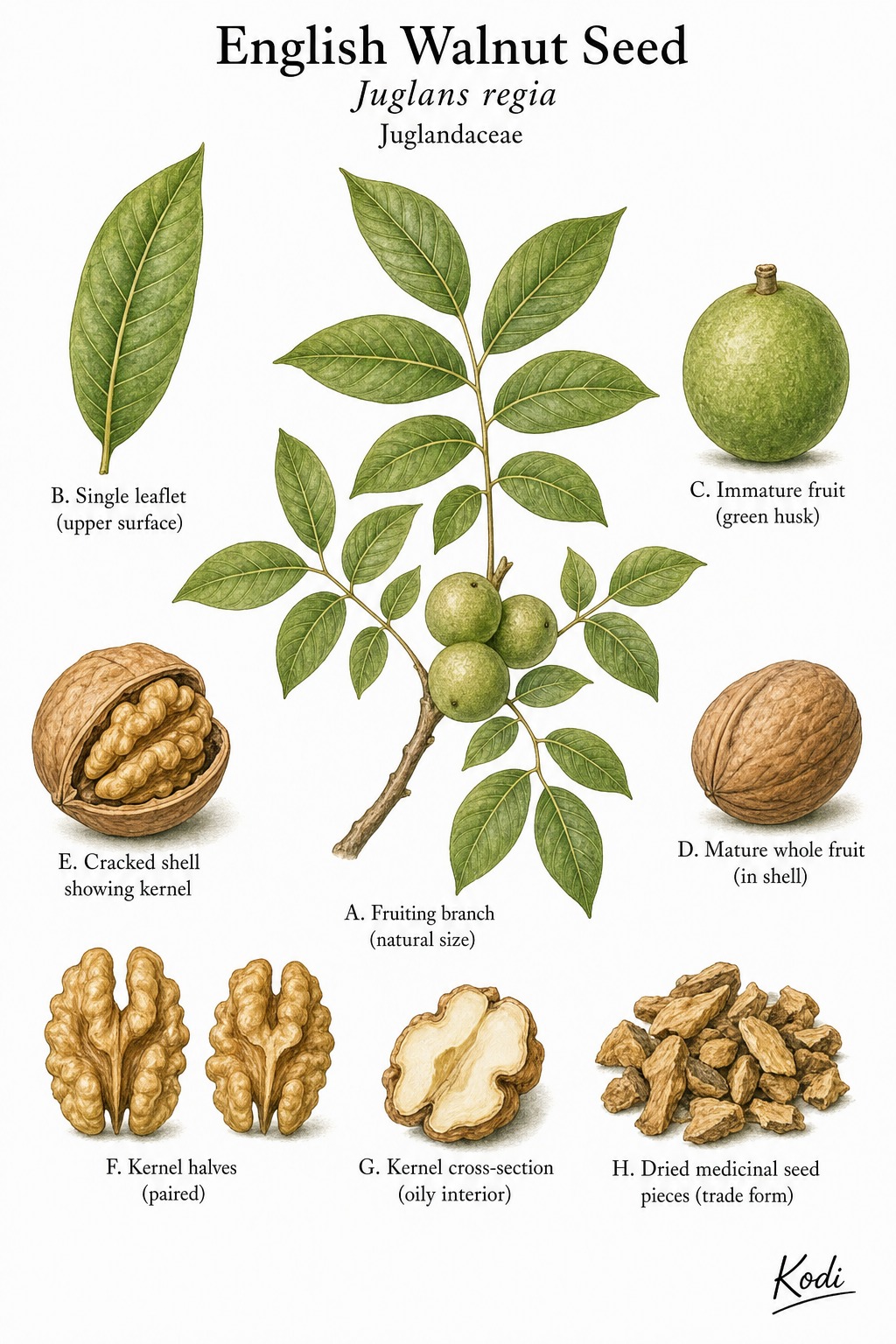
Known in TCM as He Tao Ren (胡桃仁), this sweet, warm herb enters the Kidney, Lung, and Large Intestine. Traditionally, it tonifies Kidney and strengthens the low back - He Tao Ren is classically used for soreness, weakness, and deficiency patterns involving the lower back, knees, fertility, and essence, most often applied for constipation, low back pain, and asthma. Modern research has identified Alpha-linolenic among its active constituents.
Part used: Seed
Also Known As
Latin: Semen Juglandis | Pinyin: He Tao Ren | Chinese: 胡桃仁
TCM Properties
- Taste
- sweet
- Temperature
- warm
- Channels
- Kidney, Lung, Large Intestine
Traditional Use
Primary Actions
- Tonifies Kidney and strengthens the low back - He Tao Ren is classically used for soreness, weakness, and deficiency patterns involving the lower back, knees, fertility, and essence.
- Warms the Lung and helps grasp qi - traditional use extends to chronic wheezing, asthma, and cough when the root problem is deficiency and failure of the Kidney to support the breath.
- Moistens the intestines - its oily seed nature makes it useful for dry constipation, especially in older, weak, or post-illness patients.
Secondary Actions
- He Tao Ren sits on the border between food and medicine, which helps explain why it appears in both kitchen therapy and formal tonic formulas.
- Its strength is gentle nourishment and moistening, not rapid symptom suppression or acute infection treatment.
Classic Formulas
- Ren Shen Ge Jie San and related Lung-Kidney deficiency formulas use walnut to support grasping qi and chronic wheeze patterns.
- Kidney-deficiency low-back formulas often pair He Tao Ren with Bu Gu Zhi, Du Zhong, or Tu Si Zi for essence and lumbar weakness.
- Constipation formulas for elderly or debilitated patients use walnut with hemp seed, honey, or moistening tonics when dryness is central.
Classical References
- Traditional materia medica describe He Tao Ren as a sweet warm seed that tonifies the Kidney, warms the Lung, and moistens the intestines.
- Its food-like nutritive character made it especially attractive in convalescence, aging, and deficiency patterns.
- Compared with harsher yang tonics, walnut is regarded as gentler and more sustaining, though also slower and less targeted.
Modern Research
Active Compounds
- Alpha-linolenic acid and other unsaturated fatty acids - key nutritional lipids in walnut seed research
- Ellagitannins and related polyphenols - major antioxidant compounds studied for vascular and metabolic effects
- Phytosterols - constituents tied to lipid and cardiovascular discussions
- Tocopherols and other antioxidant micronutrients - part of walnut's broader cardiometabolic profile
Studied Effects
- A 2022 meta-analysis found that walnut intake improved several lipid markers in randomized controlled trials, supporting modern cardiovascular interest in the edible seed (PMID 36364723).
- A 2024 systematic review examined walnut ellagitannins and summarized mechanistic data on antioxidant and biologic effects, though most findings remain pathway-oriented rather than condition-specific (PMID 39199220).
- A 2024 meta-analysis reported favorable effects of walnut consumption on endothelial function markers in adults, reinforcing the seed's modern preventive cardiometabolic profile (PMID 38200617).
PubMed References
- The Effect of Walnut Intake on Lipids: A Systematic Review and Meta-Analysis of Randomized Controlled Trials (2022)
- Mechanistic Insights into the Biological Effects and Antioxidant Activity of Walnut (Juglans regia L.) Ellagitannins: A Systematic Review (2024)
- Effect of walnut consumption on markers of endothelial function in adults: A systematic review and meta-analysis of randomized controlled trials (2024)
Safety & Interactions
Contraindications
- Tree nut allergy
- Use with caution in severe phlegm-damp digestive congestion if the rich oily seed is poorly tolerated
Cautions
- Ordinary food use is usually safe for most people, but medicinal use is not appropriate for anyone with a walnut allergy.
- Walnut oils, powders, and concentrated extracts are not always interchangeable with whole food intake.
- MSK page not found - drug interaction data not available from Memorial Sloan Kettering integrative medicine database
Conditions
- Constipation Traditional ★★★★☆ JSON
- Low Back Pain Traditional ★★★☆☆ JSON
- Asthma Traditional ★★★☆☆ JSON
- Impotence Traditional ★★★☆☆ JSON
Frequently Asked Questions
What is English Walnut Seed used for?
English Walnut Seed is traditionally used to Tonifies Kidney and strengthens the low back - He Tao Ren is classically used for soreness, weakness, and deficiency patterns involving the lower back, knees, fertility, and essence., Warms the Lung and helps grasp qi - traditional use extends to chronic wheezing, asthma, and cough when the root problem is deficiency and failure of the Kidney to support the breath., Moistens the intestines - its oily seed nature makes it useful for dry constipation, especially in older, weak, or post-illness patients.. Research has investigated its effects on: A 2022 meta-analysis found that walnut intake improved several lipid markers in randomized controlled trials, supporting modern cardiovascular interest in the edible seed (PMID 36364723).; A 2024 systematic review examined walnut ellagitannins and summarized mechanistic data on antioxidant and biologic effects, though most findings remain pathway-oriented rather than condition-specific (PMID 39199220)..
What are other names for English Walnut Seed?
English Walnut Seed is also known as Juglandis. In TCM: 胡桃仁 (He Tao Ren); Semen Juglandis.
Is English Walnut Seed safe during pregnancy?
The safety of English Walnut Seed during pregnancy has not been established. Consult a qualified healthcare provider before use.
What are the contraindications for English Walnut Seed?
English Walnut Seed should not be used in: Tree nut allergy; Use with caution in severe phlegm-damp digestive congestion if the rich oily seed is poorly tolerated. Consult a qualified practitioner before use.